Overview
The Igbo people are one of the largest ethnic groups in West Africa, primarily residing in southeastern Nigeria.
Their population exceeds 30 million, and they are known for their vibrant culture, communal spirit, traditions, festivals, and achievements in agriculture, commerce, crafts, and academia.
The Igbo briefly declared independence as the “Republic of Biafra” in the late 1960s.
The Igbo people are one of the major ethnic groups of West Africa and primarily live in southeastern Nigeria. They are mainly found in regions such as:
- Anambra State
- Imo State
- Abia State
- Enugu State
- Ebonyi State
and surrounding areas.
The Igbo are widely recognized as one of Nigeria’s three largest ethnic groups, alongside the Yoruba and Hausa peoples.
Their language is:
Igbo
which belongs to the Niger-Congo language family.
The Igbo language includes multiple regional dialects, while Standard Igbo is used in education, media, and public communication.
Historically, the Igbo developed numerous village-based communities throughout southeastern Nigeria.
Unlike some other regions of Africa that were dominated by large centralized kingdoms, many traditional Igbo societies were organized through relatively decentralized systems of local self-governance.
However, certain historical political entities did exist, including:
The Kingdom of Nri
which played an important role in the cultural and spiritual history of the region.
Family and kinship networks have traditionally been central to Igbo society.
Agriculture has long been an important foundation of Igbo life, with crops such as:
- Yam
- Cassava
- Cocoyam
being widely cultivated.
Among these, yam holds particular cultural significance.
One of the best-known traditional celebrations is:
The New Yam Festival
which marks the harvest season and remains an important cultural event in many Igbo communities.
In terms of religion, traditional Igbo beliefs historically included ancestor veneration and spiritual practices connected to various deities and forces of nature.
Today, Christianity is the dominant religion among the Igbo, although traditional beliefs and rituals continue to be maintained in some communities.
Igbo culture is also known for its rich artistic and ceremonial traditions.
Various festivals feature:
- Masquerade performances
- Music
- Drumming
- Dance
which continue to play important roles in cultural expression and community life.
During the modern era, many Igbo people became active in education, commerce, and entrepreneurship, contributing significantly to economic development both within Nigeria and beyond.
In the late 20th century, political tensions following Nigerian independence led to:
The Biafran War (1967–1970)
This conflict had a profound impact on Igbo society and remains one of the most significant events in modern Igbo history.
Today, Igbo communities can be found not only throughout Nigeria but also across Africa, Europe, North America, and other parts of the world.
Efforts related to:
- Language preservation
- Cultural heritage
- Education
- Economic development
continue to be important within many Igbo communities.
Today, the Igbo are recognized as one of the major ethnic groups of Nigeria, and their language, community traditions, festivals, music, and history continue to represent an important part of the cultural diversity of West Africa.
Location
Region
- Continent: Africa
- Region: Southeastern Nigeria (Enugu, Abia, Imo, Anambra, Ebonyi states)
- Diaspora: Smaller Igbo communities exist in Cameroon, Equatorial Guinea, and worldwide (especially the US and UK).
Igbo Flag and Symbols
Uli Patterns
Key Symbols
Traditional body and wall art, often created by Igbo women, symbolizing nature, life, and harmony.
Igbo Masks (Mgbedike)
Unique masks used in festivals and ceremonies, embodying spirits and ancestors.
Language
- Name: Igbo
- Language Family: Niger–Congo > Atlantic–Congo > Benue–Congo
- Speakers: Over 30 million (mainly Nigeria)
- Grammar: SVO (Subject–Verb–Object), tonal language (meaning changes with tone), uses various affixes and tenses.
Writing System
- Script:Latin alphabet (modern standard for writing Igbo)
- Traditional script:Nsibidi, a pictographic system, also influenced Igbo culture, though not used for modern writing.
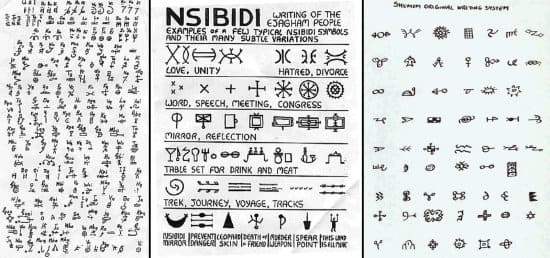
・Script::Latin alphabet (modern standard for writing Igbo)
・Traditional script:Nsibidi, a pictographic system, also influenced Igbo culture, though not used for modern writing.
▶Igbo Alphabet
@sekainomoji_bot
Common Igbo Greetings and Phrases
| English | Igbo | Pronunciation |
| Hello | Ndewo | n-DEH-woh |
|---|---|---|
| Good morning | Ụtụtụ ọma | oo-TOO-too OH-ma |
| Thank you | Daalụ | DAH-loo |
| Nice to meet you | Jisie ike | JEE-see EH-keh |
| Good night | Ka chi fo | kah CHEE foh |
| Delicious | Ọ dị ụtọ | aw DEE oo-TOH |
| Fun/Enjoyable | Ọ dị m mma | aw DEE mm MAH |
Note
“Ndewo” is a universal greeting. “Jisie ike” also means “good luck” or “take care.”
Language Origin & Historical Background
- Igbo is an ancient language of West Africa, believed to have been spoken for thousands of years.
- It was standardized during British colonial rule, but many dialects remain.
- The Igbo worldview features “Chi”—a personal spirit or destiny—and a rich oral tradition.
Access Guide
The currency of the Igbo people is the Naira (NGN).
0.0005 EUR / 0.0006 USD / 0.096 JPY / 0.004 CNY / 0.0009 AUD / 0.0008 SGD / 0.0051 HKD / 0.0004 GBP / 0.05 INR
https://www.xe.com/currencyconverter/
Example routes to the Igbo People (Nigeria)
| Departure City | Direct/Transit | Arrival Airport | Flight Time (approx.) | Reference Fare (one-way/round-trip, Economy) |
| Los Angeles | LA → via New York/Atlanta → Lagos | Lagos Intl. Airport (LOS) | About 19–25 hr | US$1,200–1,800 |
|---|---|---|---|---|
| New York | NY → via Abuja/London → Lagos | Lagos Intl. Airport (LOS) | About 15–20 hr | US$950–1,500 |
| London | London → Lagos (direct) | Lagos Intl. Airport (LOS) | About 6.5–7.5 hr | £400–750 |
| Tokyo | Tokyo → via Dubai/Doha/Istanbul → Lagos | Lagos Intl. Airport (LOS) | About 22–28 hr | ¥170,000–280,000 |
| Sydney | Sydney → via Middle East/Europe → Lagos | Lagos Intl. Airport (LOS) | About 25–33 hr | A$1,800–2,500 |
| Hong Kong | Hong Kong → via Doha/Istanbul → Lagos | Lagos Intl. Airport (LOS) | About 19–26 hr | HK$8,800–13,000 |
| Shanghai | Shanghai → via Doha/Istanbul → Lagos | Lagos Intl. Airport (LOS) | About 20–27 hr | CNY6,500–9,800 |
| Singapore | Singapore → via Dubai/Doha → Lagos | Lagos Intl. Airport (LOS) | About 19–25 hr | S$1,500–2,400 |
Traditional Games
For Children
Okwe
A traditional board game using stones or shells, related to the “Mancala” family common across Africa.
Ube
A seed/fruit game similar to marbles or jacks.
For Adults
Iko Ogu
Village wrestling matches, testing strength and courage.
Masquerade Dance
Dancers wearing masks perform to traditional music at festivals and rituals.
Introduction video
Summary
- The Igbo are a major ethnic group in Nigeria, numbering over 30 million.
- Uli patterns and masks are cultural symbols.
- Igbo is a tonal Niger–Congo language with many unique expressions.
- Rich in traditional games like Okwe, wrestling, and masquerade dancing.