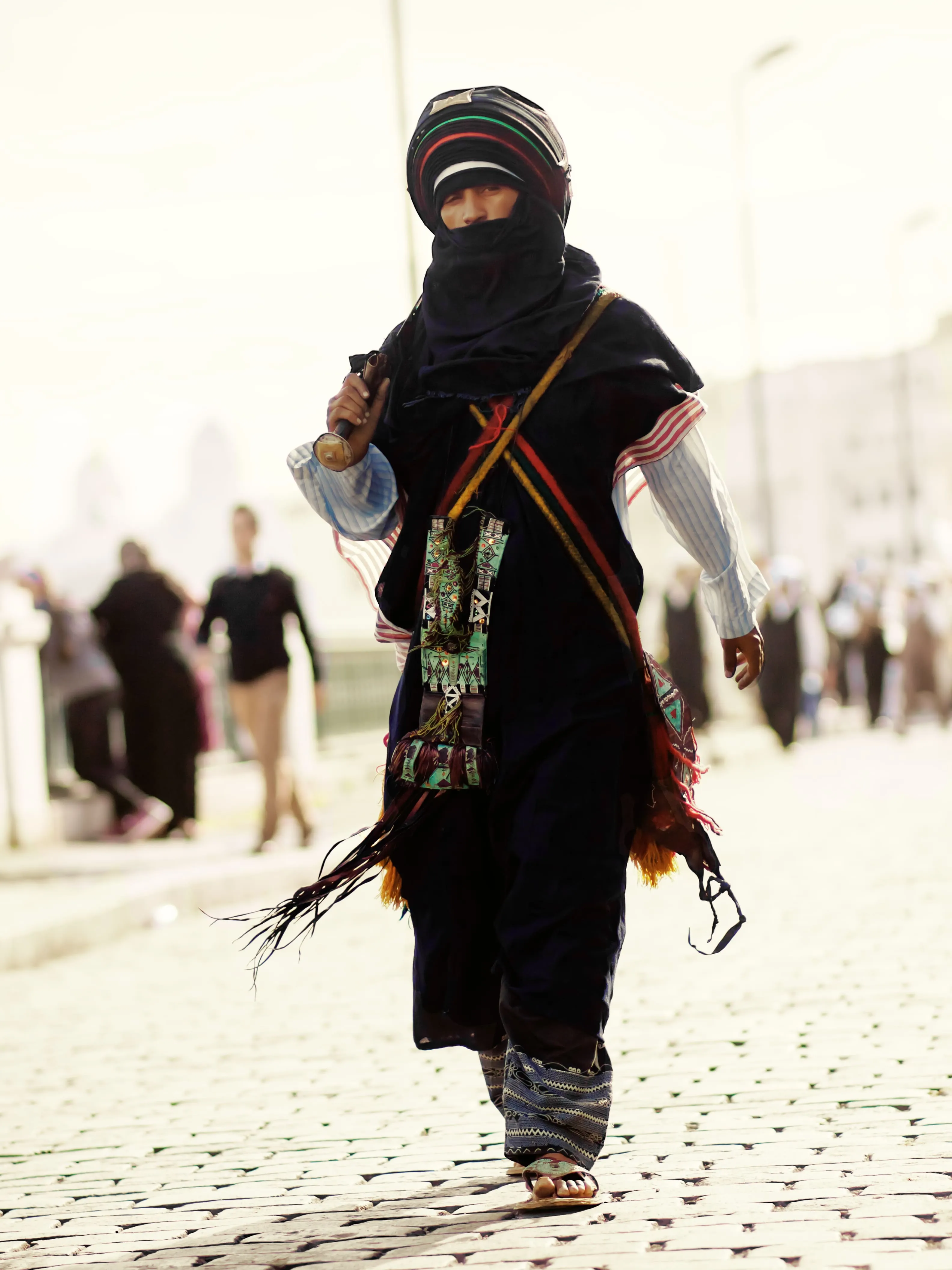
Who are the Tuareg people?
Tuareg communities live across the Sahara and its southern neighbour, the Sahel. Their homelands include Niger, Mali, Algeria, Libya and Burkina Faso, extending across national borders.[1]
Herding, farming, craft, trade and urban life all form part of this wider picture. UCLA’s Fowler Museum explored these varied lives alongside Tuareg art in its exhibition Art of Being Tuareg.[3]
Movement and the history of towns
Agadez, in Niger, developed as a crossroads of caravan trade. UNESCO connects its growth in the fifteenth and sixteenth centuries with the establishment of the Sultanate of Aïr. Tuareg groups settled in the town while retaining the divisions of earlier encampments, helping shape its streets.[14]
The town’s earthen architecture, mosques, palace and craft traditions show how movement, exchange and settlement have long been connected. They also introduce another kind of home alongside the desert tent.[14]
Why the name “Blue People”?
The name is associated with indigo-dyed cloth wrapped around the head and face. Dye can transfer to the wearer’s skin, adding to the striking impression of blue. Clothing colours, materials and styles nevertheless vary, including between everyday and festive dress.[3]
The tagelmust: cloth with social meaning
The long cloth worn by men around the head and face is known by names including tagelmust. Anthropologist Jeremy Keenan’s study of the Kel Ahaggar examines the veil as an expression of belonging and social relationships. Its significance includes ways of dressing and showing respect, alongside its practical uses.[15]
Keenan’s 1974 paper draws on fieldwork in Ahaggar between 1964 and 1971. Its setting and date help place these observations in context.[15]
Homes, families and food
A portable home can be a decorated space
Tuareg tents include hide-covered and mat-covered forms. Wooden supports, screens that roll up and leather bags combine practical uses with carving and patterned decoration. Cleveland State University’s open art-history textbook introduces examples through museum objects.[5]
What might “matrilineal” mean in daily life?
The textbook describes a custom in which a woman’s family provides her tent at marriage, and the home and household goods belong to her. This is one way to explore links between mothers and daughters and women’s ownership. Descent, property and political authority are distinct matters; a particular custom does not mean that women everywhere control all land, livestock or power.[5]
Grain, milk, meat and tea
A food account linked to the community organisation Amman Imman describes seasonal changes in the Azawak region of Niger. Milk availability varies, and grain has been obtained through trade with farming communities. Food connects herding households with a wider network of exchange.[6]
For women in Tangarwashane, the account lists semolina bread broken into pieces and eaten with sauce, millet dishes served with milk, rice with meat, and cheese made from goat or cow milk. Strong green tea with sugar also features. These examples belong to a particular regional account, with meals changing by season and circumstance.[6]
Silverwork and leatherwork
Craft skills appear in household tools as well as jewellery. The Smithsonian’s National Museum of African Art describes the makers known as inadan, whose work includes metalwork, woodcarving and leatherwork. One collection object is an ornate hammer used to break up sugar for tea.[4]
The Fowler Museum followed two family workshops in Niger, showing how makers of jewellery and leather goods developed relationships with customers abroad. Craft connects family work, design and changing markets.[3]
The exhibition also included pendants known as the cross of Agadez. Their origins have been debated; a cross-like outline alone does not establish a single religious meaning.[3]
Tamasheq, Tamajeq and Tamahaq: regional varieties
Tuareg belongs to the Berber branch of the Afro-Asiatic language family. Arabic belongs to the same broad family, but this does not make Tuareg a dialect of Arabic.[2]
| Name | Regions or communities |
|---|---|
| Tamahaq | Ahaggar in Algeria, and Ajjer in Algeria and Libya. |
| Tamažeq (Tamajeq) | Aïr in Niger, among other areas. |
| Tamašeq (Tamasheq) | The Adrar des Ifoghas in Mali, among other areas. |
| Tawellemmet | Iwellemmeden communities across Niger and Mali. |
Salem Chaker identifies further local varieties, showing how each name connects with regional differences.[1]
Vowel length can change a verb’s meaning
The same overview contrasts tensa, “she fell asleep”, with tensâ, “she is or was asleep”. Vowel length helps distinguish an event from a state. The marks follow the source’s transcription.[1]
Tifinagh: marking and sharing short messages
Tifinagh continues a tradition connected with ancient Libyco-Berber writing in North Africa. Among Tuareg communities, it has been used for short messages, ownership marks, signatures and word games. Writing can carry meaning and identity without being used mainly for long literary works.[7]
Its origins require a more careful explanation than a direct descent from Phoenician. Chaker discusses local graphic traditions alongside possible influences from other alphabets, reviewing a question that remains debated.[7]
Traditional forms and modern systems
Neo-Tifinagh has several modern forms. Systems developed in Morocco and Tuareg writing practices are not identical. Unicode’s account distinguishes several character sets, including modern Tuareg letters. Knowing the region and system helps when comparing examples.[8]
Berber languages also have traditions of writing in Latin and Arabic letters. A language’s classification and the script chosen to write it are separate questions.[2]
Poetry, strings and drums
The imzad: a one-string bowed instrument
The imzad has one string, sounded with a bow. UNESCO describes women playing it with the instrument on their knees. A skin-covered gourd forms its body, and its melody accompanies poetry and songs. Musicians, poets, singers and participating voices help create the performance together.[9]
Practices and knowledge linked to the imzad among Tuareg communities in Algeria, Mali and Niger were inscribed on UNESCO’s Representative List of the Intangible Cultural Heritage of Humanity in 2013. Making the instrument and learning through observation and listening are part of that tradition.[9]
Tende: the sound of a mortar drum
Tende names a drum made by stretching a skin over a wooden grain mortar, as well as its music and social occasions. The University of Würzburg’s account describes singing, handclapping, drumming and dance.[10]
It also records gatherings where men on camels circle a group of singing women. Songs praise animals and riders’ skills and express social relationships. Musical arrangements and performers differ by region.[10]
Singing with guitars: Tinariwen
Guitars are another part of Tuareg musical expression. Tinariwen’s official history tells how founder Ibrahim Ag Alhabib learned from Tuareg melodies and other music. He and fellow musicians played at weddings and community gatherings.[11]
Their songs expressed homesickness and the experience of exile. The band’s account connects musicians’ lives with drought, conflict and journeys in search of work. Listening to the guitars can also open a way into individual experiences and memories.[11]
Games in the sand and festive competition
Games recorded around Agadez
Anthropologist Dominique Casajus documented games from the Agadez region in a 1988 paper. Games drawn in the sand use nearby materials such as twigs, while their vocabulary recalls herding and place names.[12]
| Game | An introduction |
|---|---|
| Ishigän | Twig counters move along a spiral drawn in the sand. Throws of sticks with contrasting sides determine movement. The centre is called “Agadez”. |
| Dâra | Players align three counters on a grid to capture an opponent’s piece. Related games are known among neighbouring peoples too. |
These are regional examples. Names and procedures vary; this introduction does not present one official rulebook for all Tuareg communities.[12]
Sebeïba in Djanet: song and dance
Two communities in the Algerian oasis of Djanet practise the Sebeïba ritual and ceremonies. Male dancers and female singers compete to represent their communities before taking part in the ritual.[13]
UNESCO also describes craftspeople making and repairing clothing, jewellery and instruments. Artistic competition gives potential rivalry a shared form of expression. Inscribed on the Representative List in 2014, the tradition connects performance, craft and transmission between generations.[13]
History, belief and cultural change
Caravan routes carried cultural and religious exchange as well as goods. Agadez’s mosques and palace show connections between commerce, town life and religion.[14]
Regional histories also include French colonial conquest: Chaker’s overview notes the military defeat of the Ahaggar Tuareg in 1902.[1] Later experiences of drought, conflict and migration in search of work appear in Tinariwen’s history, alongside continuing connections with language and music.[11]
Research on music also records spirit beliefs and rituals. These can be read in relation to Islam, regional history and community practices, with attention to differences in personal belief.[10]
People wearing particular clothes, working in a family workshop, singing or living in a town offer concrete ways to encounter Tuareg culture as something made and passed on in everyday life.
Frequently asked questions
Which country do the Tuareg come from?
Their homelands span several countries across the Sahara and Sahel.[1]
Do all Tuareg people live as nomads?
No. Herding and movement form part of a wider picture that includes farming, craft and life in towns and cities.[3]
Is the imzad played like a guitar?
The imzad is a one-string instrument played with a bow. Guitar music offers a different instrument and form of expression to explore.[9][11]
Is Tifinagh the same everywhere?
Traditional practices and modern systems differ. Distinguishing Moroccan Neo-Tifinagh from Tuareg writing helps when learning about each.[8]