Overview
The Kalash are a small Indigenous people living in the Kalash Valleys (Bumburet, Rumbur, Birir) of Chitral District, Khyber Pakhtunkhwa province, northwestern Pakistan, in the Hindu Kush mountains.
Their population numbers only about 4,000–5,000.
The Kalash are known for their vibrant polytheistic traditions, colorful clothing, music, dance, and unique festivals. They are often described as a “living ancient culture” of Asia.
The Kalash people, also known as the Kalasha, are a small ethnic and religious minority living in the Chitral District of Khyber Pakhtunkhwa Province in northwestern Pakistan. They mainly inhabit three remote valleys in the Hindu Kush Mountains:
- Bumburet
- Rumbur
- Birir
These valleys are often collectively known as the Kalash Valleys.
The Kalash are widely recognized as one of Pakistan’s smallest Indigenous minority communities. Their population is generally estimated to be only a few thousand people, making them one of the most distinctive and vulnerable cultural groups in the region.
The Kalash speak:
Kalasha / Kalasha-mun
which belongs to the Indo-Aryan branch of the Indo-European language family.
In the surrounding region, languages such as Urdu and Khowar are also widely used, and many Kalash people live in a multilingual environment.
The Kalash are especially known for preserving their own traditional religion and ritual life in a region where most surrounding communities are Muslim. Their religious traditions include beliefs and practices connected to nature, ancestors, deities, ritual purity, seasonal festivals, and community ceremonies.
Festivals play a central role in Kalash cultural life. Major festivals include:
- Joshi, celebrated in spring
- Uchau, celebrated around the harvest season
- Chaumos, held around the winter solstice
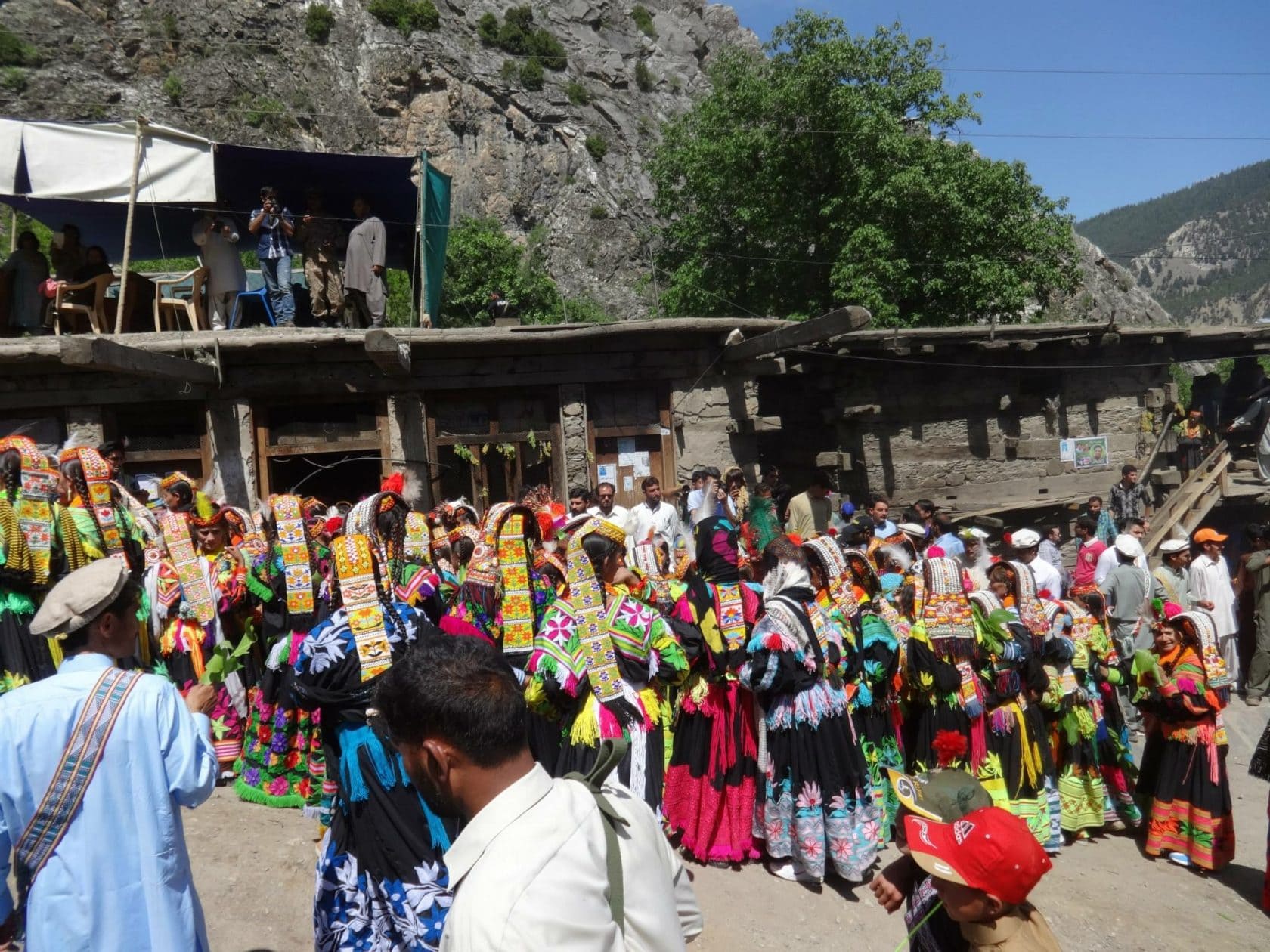
These festivals involve music, dancing, ritual gatherings, and community celebrations that mark seasonal change, fertility, harvest, and religious meaning.
Traditional Kalash life has been based on agriculture and animal husbandry. In the mountain valleys, people have cultivated grains and fruit trees while also raising livestock such as goats. The geographically isolated environment of the Hindu Kush has played an important role in helping Kalash culture remain distinct over time.
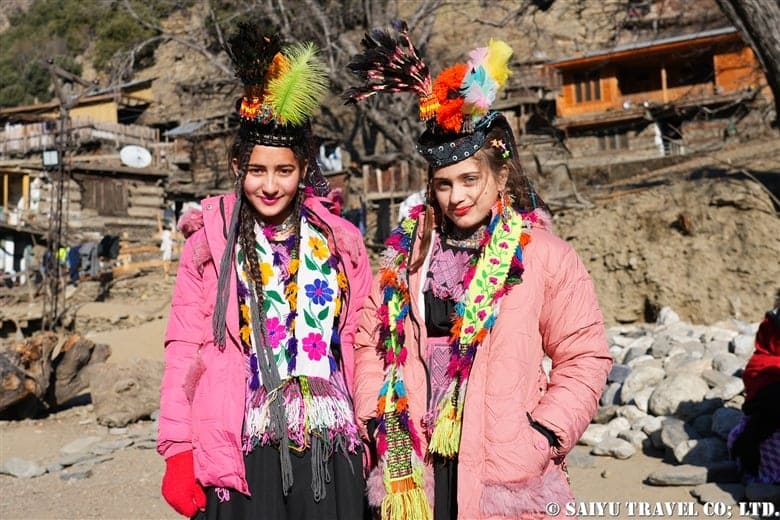
The Kalash are also well known for their clothing traditions. Kalash women traditionally wear distinctive black robes decorated with colorful embroidery, beads, and shell ornaments. Their headdresses and beadwork are among the most visible symbols of Kalash identity, especially during festivals and ceremonies.
Historically, the Kalash have lived in close contact with neighboring peoples, local rulers, and Islamized communities in the Chitral region. Nearby Nuristan, across the border in present-day Afghanistan, once had communities with related religious traditions, but the region underwent major political and religious changes in the late 19th century. The Kalash Valleys, however, continued to preserve their own cultural and religious traditions.
In modern times, Kalash society has been affected by tourism, formal education, road development, religious and social change, natural disasters, and climate change. Tourism brings income to some local communities, but it also creates challenges related to cultural preservation, privacy, and the impact of outside visitors on traditional ceremonies.
Recent efforts have focused on protecting Kalash culture, language, religious practices, and community rights. The cultural landscape of the Kalash Valleys has also been placed on Pakistan’s UNESCO World Heritage Tentative List, reflecting its cultural importance and international recognition.
Today, the Kalash are recognized as one of the most distinctive minority peoples of northern Pakistan. Their language, festivals, traditional religion, clothing, and mountain lifestyle represent an important part of the cultural diversity of the Hindu Kush region.
Sources (International Databases)
Location
Region
Continent: Asia
Region: Hindu Kush mountains, Kalash Valleys (Bumburet, Rumbur, Birir), Chitral District, Khyber Pakhtunkhwa, Pakistan
Igbo Flag and Symbols
shushut
- Colorful traditional dress (especially women’s headpiece “shushut”)
- Traditional wooden houses and embroidery patterns
Language
- Name: Kalasha-mondr (Kalasha language)
- Language Family:Indo-European > Indo-Iranian > Dardic > Chitrali group
- Speakers: About 4,000–5,000
- Grammar: Features agglutinative structures, gender and number in nouns, SOV (Subject–Object–Verb) word order
- Usage: Spoken daily within the community, but Urdu and Khowar are often used in schools and official situations
Script
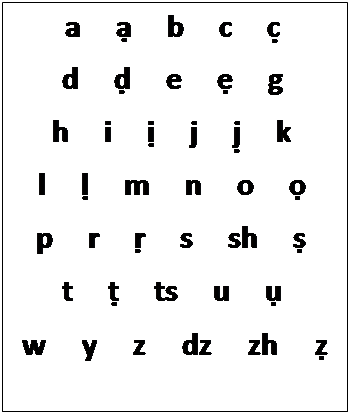
Writing System
- Traditionally oral; written Kalasha now uses the Latin alphabet (romanized script).
- No unique script, but a standardized Latin-based orthography is being adopted.
▶Example Image – Kalasha Alphabet
THE KALASH TIMES
Common Kalasha Greetings and Phrases
| English | Kalasha | Pronunciation |
| Hello | Ishpata | ee-SHPA-ta |
|---|---|---|
| Good morning | Ishpata | ee-SHPA-ta |
| Thank you | Bo shukria | bo SHOO-kree-a |
| Nice to meet you | Basha waira | BA-sha WHY-ra |
| Good night | Sumi ba | SOO-mee ba |
| Delicious | Shapash | SHA-paash |
| Fun/Enjoyable | Khosh as | KHOSH as |
Written Kalasha is still being standardized, so spelling and pronunciation may vary by source.
Language Origin & Historical Background
- Kalasha is an Indo-European language with ancient roots, showing similarities with Greek and Sanskrit in vocabulary and grammar.
- Their long isolation in the mountains helped preserve their distinct language and culture.
- Despite pressure from surrounding Islamic society, the Kalash have retained their unique beliefs and traditions.
Access Guide
The currency of the Kalash people is the Rupee (PKR).
0.0031 EUR / 0.0035 USD / 0.51 JPY / 0.025 CNY / 0.0053 AUD / 0.0044 SGD / 0.027 HKD / 0.0026 GBP / 0.3 INR
https://www.xe.com/currencyconverter/
The Kalash People Region
Example Routes to the Kalash People (Pakistan, Chitral District)
| Departure City | Direct/Transit | Arrival Airport | Flight Time (approx.) | Reference Fare (one-way/round-trip, Economy) |
| Los Angeles | LA → via Doha/Turkey/Europe → Islamabad | Islamabad Airport (ISB) | About 18–24 hr | US$950–1,600 |
|---|---|---|---|---|
| New York | NY → via Istanbul/Doha → Islamabad | Islamabad Airport (ISB) | About 16–21 hr | US$900–1,500 |
| London | London → via Doha/Turkey → Islamabad | Islamabad Airport (ISB) | About 10–14 hr | £400–700 |
| Tokyo | Tokyo → via Bangkok/Doha/Dubai → Islamabad | Islamabad Airport (ISB) | About 14–19 hr | ¥120,000–200,000 |
| Sydney | Sydney → via Bangkok/Doha → Islamabad | Islamabad Airport (ISB) | About 17–23 hr | A$1,200–1,900 |
| Hong Kong | Hong Kong → via Doha/Thailand → Islamabad | Islamabad Airport (ISB) | About 10–16 hr | HK$6,500–9,500 |
| Shanghai | Shanghai → via Bangkok/Doha → Islamabad | Islamabad Airport (ISB) | About 12–18 hr | CNY4,800–7,500 |
| Singapore | Singapore → via Bangkok/Doha → Islamabad | Islamabad Airport (ISB) | About 11–15 hr | S$850–1,400 |
Traditional Games
For Children
Tash
A simple game using stones or sticks—throwing, picking, and counting, similar to jacks or marbles.
Climbing trees and hide-and-seek
Physical play in the natural environment is common.
For Adults
Traditional dances
Traditional dances (group dances during Chaomos and Uchal festivals)
Polo and wrestling
Competitions between villages, especially during festivals.
Introduction video
Summary
- The Kalash are a small, colorful minority in Pakistan, famous for their ancient polytheistic culture, bright clothing, and traditional music and dance.
- Their language, Kalasha-mondr, is Indo-European, now written using a Latin-based script.
- Group dancing and physical games remain core parts of Kalash cultural life.