Overview
The Miao are an ancient people, believed to have migrated south from the Yellow River basin around 4,000 years ago, developing a unique culture through continual adaptation.
The Miao people are one of the ethnic minority groups living mainly in southern China. They are primarily found in mountainous regions such as:
- Guizhou Province
- Hunan Province
- Yunnan Province
- Guangxi Zhuang Autonomous Region
Related ethnic groups can also be found outside China in countries including:
- Vietnam
- Laos
- Thailand
- Myanmar
Within China’s official ethnic classification system, the Miao are grouped together under the name “Miao,” although the term includes many communities with different languages, clothing styles, and cultural traditions.
The Miao people are believed to have lived in the mountainous regions of southern China for centuries. Throughout history, they experienced periods of migration, assimilation, conflict, and interaction with various Chinese dynasties. As Han Chinese expansion moved southward, some Miao groups are thought to have relocated deeper into mountainous areas.
During the 18th and 19th centuries, warfare and political pressures also caused some Miao communities to migrate beyond China. As a result, Miao-related communities can now be found across Southeast Asia as well as overseas in countries such as the United States and France.
Linguistically, the Miao people mainly speak languages belonging to the:
Hmong-Mien language family
However, there is significant regional variation, and some Miao groups speak languages that differ considerably from one another. Many people also speak Mandarin Chinese in addition to their local languages.
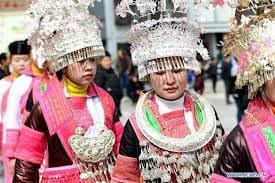
The Miao are widely known for their colorful traditional clothing and highly developed embroidery traditions. Women’s garments often feature geometric designs, animal motifs, and detailed decorative patterns. Clothing styles and color schemes vary greatly depending on the region.
The Miao are also famous for their silver ornaments, including elaborate headdresses, necklaces, and ceremonial jewelry. In some communities, large silver decorations are worn during festivals and weddings.
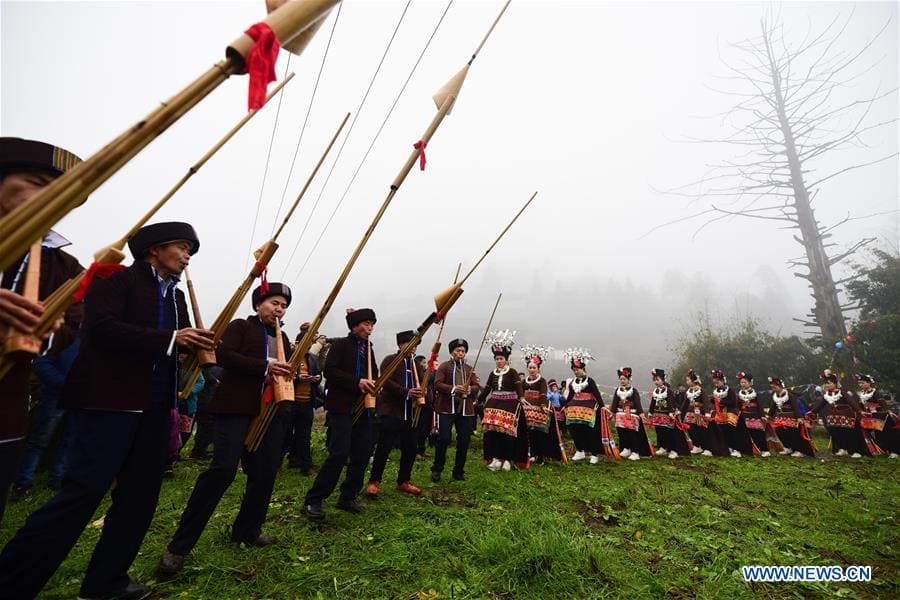
Music and dance are important aspects of Miao culture. Traditional instruments such as the:
- Lusheng (a reed-pipe instrument)
- Bronze drums
are commonly used during celebrations and ceremonies, along with traditional dances.
Traditionally, Miao religious beliefs included:
- Ancestor worship
- Nature worship
- Spirit beliefs
Today, influences from Buddhism, Taoism, and Christianity can also be found in some communities.
In modern times, tourism and urbanization have changed aspects of traditional Miao life. At the same time, efforts to preserve:
- Indigenous languages
- Traditional clothing
- Embroidery techniques
- Folk music
continue in many regions.
Today, the Miao are recognized as one of the major ethnic minority groups of China, and their diverse culture, history, and artistic traditions continue to attract international attention.
Location
Primarily in southern China (Guizhou, Hunan, Yunnan), and spread to Vietnam, Laos, and Thailand.
Region
Continent: Oceania
Region:Primarily in southern China (Guizhou, Hunan, Yunnan), and spread to Vietnam, Laos, and Thailand.
Culture
- Textiles and Embroidery:Famous for intricate handwoven clothing, especially among women.
- Silver Ornaments:Lavish silver accessories worn during festivals.
- Music and Dance:Reed-pipe instrument (lusheng) performances and group dances.
- Agriculture:Terraced rice fields, corn farming, and traditional agricultural life.
Miao Symbols and Flag
No official national flag
but symbolic motifs includ
- Phoenix:Symbol of luck and rebirth.
- Butterfly:Represents life and origin (Miao mythology speaks of a butterfly mother creating humans).
- Silver Accessories:Indicators of status and celebration.
Language
Miao Language Features
Language Family
- Hmong-Mien (Miao-Yao) language family.
Phonetics
- Extremely tonal: 6 to 8 distinct tones.
- Rich system of vowels and consonants.
Writing
- Originally oral tradition with no writing system.
- Now written using the Pollard script and Latin alphabet systems.
Characteristics
- Tone is crucial: different tones completely change meanings.
- Significant regional dialect differences, especially within China.
Common Miao Greetings and Phrases
| English | Miao Language (Hunan Dialect Example) | Pronunciation |
| Hello | Ntxoov zoo | Nor-joe |
|---|---|---|
| Good morning | Muaj peev | Moo-bay |
| Thank you | Ua tsaug | Wah-bee-ah |
| Nice to meet you | Tos zoo | Taw-yao |
| Good night | Nyo siab | Yao-shen |
| Delicious | Tsau qab | Tsah-bao |
| Fun/Enjoyable | Zoo siab | Hao-zoo |
Notes
・Ntxoov zoo can mean both "hello" and "how are you?"
・Regional variations are common in Miao language expressions.
Origin and Writing of Miao Language
Miao language belongs to the Hmong-Mien (Miao-Yao) family.
Ancestors likely migrated southward from the Yellow River basin over 4,000 years ago.
Miao language may even predate Old Chinese in certain linguistic layers.
Writing Systems
Traditionally Oral: Cultural memory passed through songs and storytelling.
Pollard Script:
Developed in the early 20th century by missionary Samuel Pollard; uses innovative combinations of vertical and horizontal marks.
Latin Alphabet Systems
Widely adopted since the 1950s for ease of education and literacy.
Chinese Characters:
Rarely used, except for names or place names in adapted forms.
Key Points
- Origin Extremely ancient, pre-dating much of Han China
- Family Hmong-Mien language family
- Tradition Oral transmission without early writing
- Current Scripts Pollard script and Latin-based alphabets
- Tone Usage 6–8 tones essential to word meaning
Access Guide
The currency of the Miao people is the Chinese Yuan (CNY, 元).
The currency shown here is the official currency (CNY) of China, where the Miao people mainly live. Different currencies may be used in other countries.
https://www.xe.com/currencyconverter/
| Departure City | Direct/Transit | Arrival Airport | Flight Time (approx.) | Reference Fare (one-way/round-trip, Economy) |
| Los Angeles | LA → Beijing or Shanghai → Guiyang | Guiyang Longdongbao (KWE) | 15–20 hours | US$900–1,300 |
|---|---|---|---|---|
| New York | NY → Beijing or Shanghai → Guiyang | Guiyang Longdongbao (KWE) | 17–23 hours | US$1,100–1,600 |
| London | London → Beijing or Shanghai → Guiyang | Guiyang Longdongbao (KWE) | 17–22 hours | £700–1,000 |
| Tokyo | Tokyo → Shanghai or Beijing → Guiyang | Guiyang Longdongbao (KWE) | 7–10 hours | ¥70,000–120,000 |
| Sydney | Sydney → Guangzhou or Beijing → Guiyang | Guiyang Longdongbao (KWE) | 13–18 hours | A$950–1,300 |
| Hong Kong | Hong Kong → Guiyang | Guiyang Longdongbao (KWE) | 2.5–3 hours | HK$1,200–2,000 |
| Shanghai | Shanghai → Guiyang | Guiyang Longdongbao (KWE) | 2.5–3.5 hours | CNY 900–1,400 |
| Singapore | Singapore → Guangzhou or Shanghai → Guiyang | Guiyang Longdongbao (KWE) | 7–10 hours | S$450–650 |
Traditional Games of the Miao People
1.Lusheng Dance (Reed-Pipe Dance)
・Description:Playing lusheng (reed-pipe instrument) while dancing in circles.
・Purpose:Celebration, matchmaking, and community bonding.
2.Miao Pitch-Pot (Throwing Arrows into a Jar)
・Description:Throwing small arrows into a jar from a distance.
・Purpose:Tests concentration and accuracy.
3.Miao Chicken Chase
・Description:Children chase chickens during festivals.
・Purpose:Agility and festive joy.
4.Tug-of-War Competitions
・Description:Large-scale team contests.
・Purpose:Strength-building and communal fun.
Introduction video
The Miao people's language, vibrant arts, and traditional games showcase their resilience, creativity, and deep-rooted connection to nature and community.