Overview
- The Tibetan people are an ethnolinguistic group native to the Tibetan Plateau, known for their unique blend of high-altitude pastoralism and deep spiritual tradition.
- They have a distinct language, script, and cultural identity rooted in Tibetan Buddhism.
The Tibetan people are an ethnic group who have traditionally lived mainly on the Tibetan Plateau. Today, Tibetan communities are found primarily in the Tibet Autonomous Region of China, as well as in Tibetan areas of Qinghai, Sichuan, Gansu, and Yunnan provinces. Tibetan communities also exist in Himalayan regions such as India, Nepal, and Bhutan.
The Tibetan Plateau, the traditional homeland of the Tibetan people, is an extremely high-altitude region often called:
“The Roof of the World”
In this harsh natural environment, the Tibetan people developed a distinctive culture adapted to life in the highlands.
The Tibetan language belongs to the Tibeto-Burman branch of the Sino-Tibetan language family. There are regional varieties of Tibetan, including Central Tibetan, Amdo, and Khams, with differences in pronunciation and dialect. Tibetan is written using the Tibetan script and has been used in religious texts, literature, education, and daily life.
One of the most important elements of Tibetan culture is Tibetan Buddhism. Tibetan Buddhism developed in Tibet while inheriting traditions from Indian Buddhism. Monasteries, stupas, scriptures, mandalas, prayer flags, and prayer wheels are widely recognized as symbols of Tibetan culture.
Tibetan Buddhism includes several major schools, such as Gelug, Nyingma, Kagyu, and Sakya. The Dalai Lama is known as a high-ranking religious leader associated with the Gelug school of Tibetan Buddhism.
Traditional Tibetan society has long relied on agriculture and pastoralism. In highland regions, animals such as yaks, sheep, and goats have played important roles in food, clothing, fuel, transportation, and daily life. In agriculture, barley has been one of the most important crops suited to the cold highland climate. Roasted barley flour, known as:
Tsampa
is one of the traditional staple foods of Tibet.
Tibetan housing and clothing are also adapted to the high-altitude climate. In some nomadic regions, black tents made from yak hair are used, while settled communities often have houses built from stone and earth. Traditional clothing known as:
Chuba
is a long robe designed for practical use in cold environments.
Music, dance, and festivals are also important parts of Tibetan culture. Masked dances connected with religious ceremonies, monastic rituals, folk songs, and music using string and wind instruments are all part of Tibetan cultural expression. The Tibetan New Year, known as:
Losar
is one of the most important annual festivals.
Historically, the Tibetan Empire was established around the 7th century, and political unification advanced during the reign of King Songtsen Gampo. During this period, Buddhism was introduced, and Tibetan writing and literary culture developed. Later Tibetan history involved complex relationships among royal lineages, local governments, religious authorities, and monastic institutions.
In the modern era, Tibetan regions experienced major political and social changes. From the 1950s onward, Tibet came under Chinese administration, and major changes took place in governance, education, economy, urbanization, and transportation infrastructure. Tibetan exile communities also formed in countries such as India and Nepal.
Today, Tibetan people live not only in agricultural and pastoral regions of the Tibetan Plateau but also in cities and overseas communities. At the same time, issues such as Tibetan language preservation, protection of religious culture, changes in traditional lifestyles, and environmental conservation on the plateau remain important concerns.
Today, the Tibetan people are recognized as one of the representative peoples of the Himalayan and Tibetan Plateau regions. Their language, Buddhist culture, highland way of life, arts, music, and festivals represent an important part of the cultural diversity of Inner Asia.
Location
Primarily in the Tibet Autonomous Region (TAR) of China.
- Also widely spread across Qinghai, Sichuan, Gansu, and Yunnan provinces.
- Significant diaspora communities live in India (Dharamshala, Ladakh), Nepal, and Bhutan.
History
- Tibet formed an empire in the 7th century, establishing diplomacy with China, India, and Nepal.
- From the 17th century, the Dalai Lama became both the religious and political leader.
- After China’s assertion of control in the 1950s, the 14th Dalai Lama fled into exile in 1959.
- Modern Tibet faces restrictions, yet cultural preservation efforts continue globally.
Culture
- Tibetan Buddhism:Emphasizes prayer, meditation, and monastic learning.
- Nomadic pastoralism:Traditional lifestyle includes herding yaks and sheep.
- Architecture & Art:Potala Palace, mandalas, thangka (sacred paintings).
- Cuisine:Tsampa (barley flour), butter tea, yak cheese, dried meats.
Spiritual objects
- Prayer wheels (mani):Spin to send prayers into the world.
- Prayer flags (lungta):Five-colored flags spreading blessings with the wind.
Tibetan Symbols and Flag
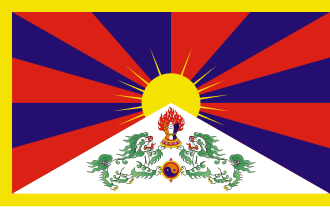
Tibetan National Flag (Snow Lion Flag)
- Features the sun, two snow lions, snowy mountains, and colored rays.
- Symbol of the Tibetan exile movement; banned in China.
Prayer flags (Lungta/Tarcho)
・Blue, white, red, green, yellow — representing elements and spreading prayers.
Snow Lion
Mythical protector and symbol of courage.
Language
Belongs to the Tibeto-Burman branch of the Sino-Tibetan family.
・Major dialects Central Tibetan (Lhasa), Kham, Amdo.
Characteristics
- No tones.
- Rich vowel and consonant systems.
- Complex honorific system.
Common Tibetan Greetings and Phrases
| English | Tibetan (Lhasa Dialect) | Pronunciation |
| Hello | Tashi Delek | Tah-shee De-lek |
|---|---|---|
| Good morning | Nyinmo Delek | Nin-mo De-lek |
| Thank you | Thu-je che | Too-jay chay |
| Nice to meet you | Kherang-la tashi delek | Ke-rang-la Tah-shee De-lek |
| Good night | Lo Delek | Lo De-lek |
| Delicious | Ma-sho | Mah-show |
| Fun/Enjoyable | Ga-wa | Gah-wah |
Language Origins
- Tibetan emerged within the Tibeto-Burman group, developing a script under King Songtsen Gampo (~7th century).
- Used extensively for translating Buddhist scriptures.
- Remains a liturgical and educational language.
Writing System
- Tibetan script was developed in the 7th century, derived from ancient Indian Brahmi script.
- Used for religious texts, government, signage, and daily writing.
- Written horizontally; aesthetically ornate.
Detailed Habitat
- China:Tibet Autonomous Region, Qinghai, Sichuan (west), Gansu (south), Yunnan (north).
- India:Dharamshala, Ladakh, Sikkim.
- Also found in Nepal, Bhutan, and among global Tibetan diaspora.
Access Guide
The currency of the Tibetan people is the Chinese Yuan (CNY, 元).
The currency shown here is the official currency (CNY) of China, where the Tibetan people mainly live. Different currencies may be used in other countries.
https://www.xe.com/currencyconverter/
Tibet (Lhasa)
Access to Tibet (Lhasa) from Major Cities
| Departure City | Direct/Transit | Arrival Airport | Flight Time (approx.) | Reference Fare (one-way/round-trip, Economy) |
| Los Angeles | LA → Beijing/Chengdu → Lhasa | Lhasa Gonggar (LXA) | 19–25 hours | US$1,200–1,800 |
|---|---|---|---|---|
| New York | NY → Beijing/Chengdu → Lhasa | Lhasa Gonggar (LXA) | 21–27 hours | US$1,250–2,000 |
| London | London → Beijing/Chengdu → Lhasa | Lhasa Gonggar (LXA) | 17–23 hours | £900–1,500 |
| Tokyo | Tokyo → Beijing/Shanghai → Lhasa | Lhasa Gonggar (LXA) | 13–17 hourss | ¥110,000–180,000 |
| Sydney | Sydney → Guangzhou/Chengdu → Lhasa | Lhasa Gonggar (LXA) | 16–22 hours | A$1,300–2,000 |
| Hong Kong | Hong Kong → Chengdu/Chongqing → Lhasa | Lhasa Gonggar (LXA) | 8–12 hours | HK$3,800–6,000 |
| Shanghai | Shanghai → Chengdu → Lhasa | Lhasa Gonggar (LXA) | 7–10 hours | CNY 2,800–4,500 |
| Singapore | Singapore → Chengdu → Lhasa | Lhasa Gonggar (LXA) | 12–17 hours | S$900–1,600 |
Traditional Games of the Tibetans People
1.Korkor (Ring Toss)
Throwing small wooden rings onto a peg.
2.Lakpa (Ball Chase Game)
Competitive game with teams chasing a ball.
3.Folk Dance & Song (Gorshey, Yang-gar)
Circle dances with chanting, often during harvest or weddings.
4.Prayer Wheel Races
Friendly competitions on who can spin the most during walking rituals.
Introduction video
Tibetan culture is a profound blend of spiritual devotion, linguistic heritage, and highland resilience, offering timeless insight into the harmony between people, belief, and the natural world.