Overview
- Spoken Regions: Primarily in southern China (Guangxi, Hunan, Yunnan), Laos, northern Vietnam, and northern Thailand
- Number of Speakers: Approximately 800,000 to 1 million worldwide
The Yao people are an ethnic group distributed mainly across southern China and parts of northern Southeast Asia, including Vietnam, Laos, Thailand, and Myanmar. In China, they are officially recognized as one of the country’s ethnic minority groups. In Vietnam, related communities are commonly known as the Dao.
Their main areas of settlement include mountainous regions of southern China, especially Guangxi Zhuang Autonomous Region, Hunan Province, Yunnan Province, Guizhou Province, and Guangdong Province. Yao-related communities also live in northern Vietnam, northern Laos, and northern Thailand.
The name “Yao” refers to a broad classification that includes several different groups. Among them are the Mien, also known as Iu Mien. These groups may differ in language, customs, clothing, and local traditions. Not all people classified as Yao speak the same language, and there are significant regional differences.
Linguistically, many Yao-related groups speak languages belonging to the Hmong-Mien language family. One of the best-known languages is Iu Mien. However, some groups classified as Yao speak varieties related to Chinese or languages from the Tai-Kadai family, depending on the region.
Historically, the Yao people have been closely connected with the mountainous regions of southern China. Over time, they experienced migration, settlement in highland areas, interaction with neighboring peoples, and changing relationships with state authorities. Some Yao-related groups migrated over several centuries from southern China into Vietnam, Laos, Thailand, and neighboring areas.
Traditional Yao life has often been based on agriculture in mountainous environments. Depending on the region, communities have practiced shifting cultivation, terrace farming, tea cultivation, fruit growing, and other forms of highland agriculture. Their way of life developed in close connection with the mountain landscapes where they lived.
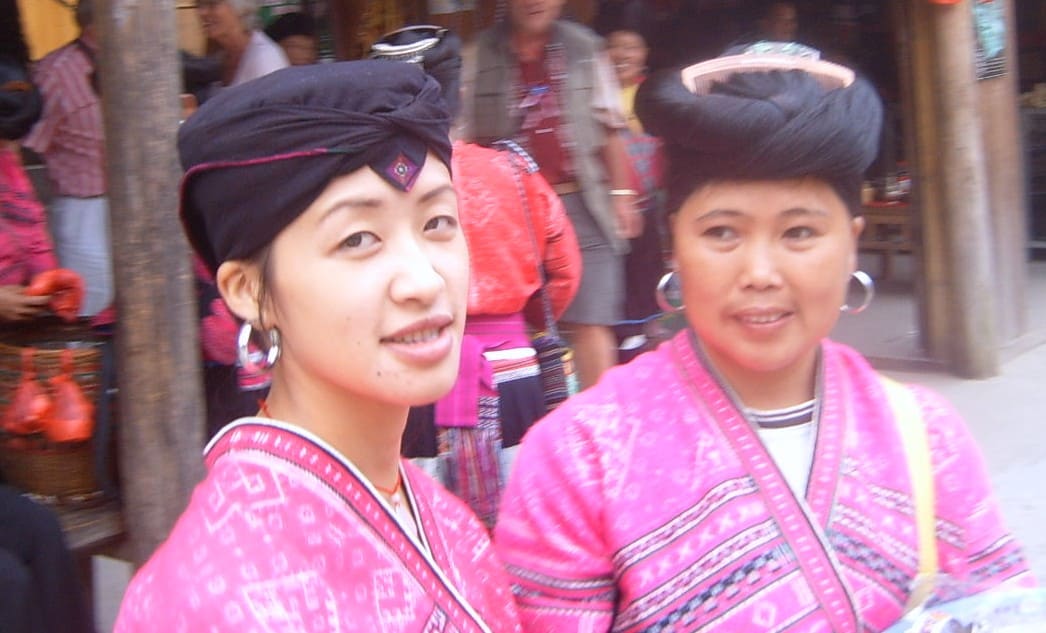
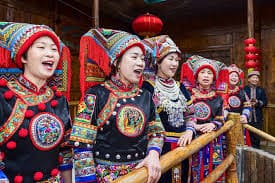
The Yao are also known for embroidery, textile traditions, and distinctive traditional clothing. Women’s clothing in particular may include regional embroidery, headdresses, silver ornaments, and brightly colored fabrics. Clothing styles and decorations vary by community and region and often serve as important markers of ethnic identity.
In terms of religion and belief, Yao communities have traditions that include ancestor worship, Daoist elements, and local folk beliefs. Among some Mien groups, there is a strong tradition of religious and ritual texts written in Chinese characters, reflecting historical connections with Daoist culture.
Today, many Yao people live not only in rural mountain villages but also in towns and cities. They are involved in fields such as education, tourism, handicrafts, agriculture, and local industries. At the same time, issues such as language preservation, cultural continuity, regional development, and youth migration to urban areas remain important challenges.
Since the late 20th century, Iu Mien communities from Laos, Thailand, and other regions have also migrated to countries such as the United States and France. As a result, Yao-related diaspora communities now exist outside Asia as well.
Today, the Yao are recognized as one of the representative highland peoples of southern China and northern Southeast Asia. Their languages, clothing, embroidery, ritual traditions, and mountain-based way of life represent an important part of the cultural diversity that connects East Asia and Southeast Asia.
Location
Region
Continent: Asia
Region: Primarily in southern China (Guangxi, Hunan, Yunnan), Laos, northern Vietnam, and northern Thailand
Cultural Symbols and Iconography
- Clothing: Women wear predominantly black outfits decorated with red, white, and green embroidery, along with heavy silver jewelry.
- Symbolic Patterns: Embroidery often features spirals, birds, dragons, and suns representing cosmology and ancestor worship.
- Ritual Elements: Taoist-derived symbols, talismans, and paper effigies are widely used in ceremonial practices.
Language
Yao (Iu Mien / Yao Language)
- Language Family: Hmong-Mien family
- Language Name: Internationally known as "Iu Mien," or simply "Yao language"
Linguistic Features
- Tonal language (6 to 8 tones distinguish meaning)
- Predominantly monosyllabic words, SVO word order
- No grammatical gender or number; grammatical relations indicated by word order and particles
- Sentence-final particles and word repetition convey respect and nuance
Script Writing System
Traditional Writing
No indigenous script; religious texts and rituals use Chinese characters through phonetic transcription and semantic borrowing (a practice sometimes called "pseudo-scripture")
Latin-Based Script:
- Recently standardized as the Iu Mien Unified Romanized Alphabet
- Tones marked numerically at the end of syllables (e.g., "mienh2" for "person")
- Nasalization and consonant variation may be indicated with diacritics
Common Expressions and Greetings (in Iu Mien)
| English | Iu Mien | Pronunciation |
| Hello | Nyei zoux | Nyei zou |
|---|---|---|
| How are you? | Nyei zoux maiv? | Nyei zou maiv? |
| Yes | Mienh | Mien |
| Goodbye | Goux daaih | Gou daai |
| My name is... | Gou mangz... | Gou mang (your name) |
Note
Tone and vocabulary may vary across regions and dialects.
Historical Origins of the Language
- The Hmong-Mien languages originated in the mountainous regions of southern China and are closely tied to ethnic distributions south of the Yangtze River
- The Yao people have been documented since the Han dynasty and have formed multiple subgroups through interaction and conflict with the Han Chinese
- Religiously syncretic with Taoism, leading to the development of ritual language and chanted traditions
- Migration to Southeast Asia accelerated in the 19th–20th centuries due to displacement and resettlement, resulting in today’s multi-national distribution
Access Guide
The currency of the Yao people is the Chinese Yuan (CNY, 元).
The currency shown here is the official currency (CNY) of China, where the Yao people mainly live. Different currencies may be used in other countries.
https://www.xe.com/currencyconverter/
the Yao People Region
Example routes to the Yao People (Kunming, Yunnan, China)
| Departure City | Direct/Transit | Arrival Airport | Flight Time (approx.) | Reference Fare (one-way/round-trip, Economy) |
| Los Angeles | LA → via Shanghai/Beijing/Hong Kong → Kunming | Kunming Changshui Int'l (KMG) | About 18–27 hr | US$700–1,200 |
|---|---|---|---|---|
| New York | NY → via Shanghai/Beijing → Kunming | Kunming Changshui Int'l (KMG) | About 18–26 hr | US$900–1,500 |
| London | London → via Beijing/Shanghai → Kunming | Kunming Changshui Int'l (KMG) | About 17–25 hr | £500–850 |
| Tokyo | Tokyo → via Hong Kong/Shanghai → Kunming | Kunming Changshui Int'l (KMG) | About 9–14 hr | ¥60,000–120,000 |
| Sydney | Sydney → via Guangzhou/Hong Kong → Kunming | Kunming Changshui Int'l (KMG) | About 15–22 hr | A$700–1,200 |
| Hong Kong | Hong Kong → Kunming (direct or via Guangzhou) | Kunming Changshui Int'l (KMG) | About 2.5–5 hr | HK$1,800–3,800 |
| Shanghai | Shanghai → Kunming (direct) | Kunming Changshui Int'l (KMG) | About 3.5–5 hr | CNY1,600–2,500 |
| Singapore | Singapore → via Guangzhou/Hong Kong → Kunming | Kunming Changshui Int'l (KMG) | About 7–12 hr | S$550–900 |
Traditional Games
Children’s Games
- Spinning top games with string or stick-balancing challenges using bamboo
- Tag and hide-and-seek (sometimes themed with mythic creatures like monkey spirits or ancestral ghosts)
- Rhythmic call-and-response games accompanied by singing
Adult & Ritual-Based Games:
- New Year’s "Ancestor Calling Games," combining song and dance to invite spirits
- Imitative archery (string-pulling games) and shuttlecock-style feather kicking
- Male dance battles performed as improvised contests of movement and music
Introduction video
Note
Many games are deeply linked to ritual, blending humor with reverence.