Overview
The Frisians are an ethnic and linguistic community with deep historical roots in the lowlands and islands along the North Sea coast.
Their main homelands today include the Province of Friesland in the northern Netherlands, known as Fryslân in West Frisian; East Frisia in northwestern Germany; North Frisia in Schleswig-Holstein; and Saterland in Lower Saxony.
The Frisians cannot be described as a single, uniform people living within one country. Different Frisian regions have experienced different histories, and the Frisian languages spoken today are divided into West Frisian, North Frisian, and Saterland Frisian.
In Fryslân in the Netherlands, West Frisian has official status alongside Dutch. In Germany, the Frisians are recognized as a historically established minority, while North Frisian and Saterland Frisian are protected as regional or minority languages.
East Frisia also retains a strong regional and cultural identity connected with Frisian history. However, the principal languages used there today are German and East Frisian Low Saxon. Saterland Frisian is the main surviving descendant of the East Frisian language once spoken more widely in the region.
Frisian culture has been shaped not only by language, but also by the sea and tidal flats, raised dwelling mounds, dikes, waterways, agriculture, dairy farming, fishing, shipping, regional sports, music, literature, and festivals.
These elements differ from one region to another. The Frisians are not a people who simply preserve an unchanged coastal way of life from the past. Today, they live modern lives in rural communities, islands, port towns, and cities, often combining a Dutch or German national identity with a regional or ethnic Frisian identity.
Homelands and Regional Communities
Fryslân in the Netherlands
The Province of Friesland in the northern Netherlands is called Fryslân in West Frisian.
Its capital is Leeuwarden, known as Ljouwert in West Frisian. The province includes farmland, lakes, canals, polders, the Wadden Sea coast, and parts of the West Frisian Islands.
West Frisian is most widely spoken in this region. However, not every resident identifies as Frisian, and not every resident speaks West Frisian.
Some people use West Frisian at home, others mainly use Dutch, and many move between the two languages depending on the setting. The province is therefore multilingual rather than linguistically uniform.
Fryslân should not be confused with West Friesland, a region in the Province of North Holland. Their historically related names can cause confusion, but they are separate areas within the modern administrative system of the Netherlands.
East Frisia
East Frisia is a historical region in the northwestern part of Lower Saxony, Germany.
It is centered around places including Aurich, Leer, Emden, and Wittmund, and includes a section of the North Sea coast and the East Frisian Islands.
A regional identity, history, and customs connected with the Frisian past remain important in East Frisia. However, the traditional regional language most widely used today is not a Frisian language. It is East Frisian Low Saxon, which belongs to the Low German language group.
For this reason, the terms “East Frisian people” and “modern speakers of an East Frisian language” do not describe the same group.
North Frisia
North Frisia is located in Schleswig-Holstein in northern Germany.
Frisian communities are found on the mainland of the district of Nordfriesland, on the North Frisian Islands, on the small islands known as the Halligen, and on Heligoland.
North Frisian is not one uniform form of speech. It consists of several local varieties associated with particular islands and mainland communities, and some of these varieties differ considerably from one another.
German is now the main language of public life, while Low German and Danish are also used in parts of the region. Some people inherit North Frisian at home, some learn it through school or cultural activities, and others understand it without using it regularly in conversation.
Saterland
Saterland is a municipality in the district of Cloppenburg in Lower Saxony, Germany.
Saterland Frisian is spoken there and is known locally as Seeltersk.
Saterland Frisian is the only surviving language descended from the East Frisian branch that was once spoken more widely during the Middle Ages. Estimates differ according to the source and survey method, but it is an endangered language with only a few thousand speakers.
Saterland was historically surrounded by peatlands and had limited transport connections with neighboring areas. This relative geographical isolation is often identified as one reason why the language survived for so long.
Today, community organizations, schools, dictionaries, teaching materials, signs, research projects, and digital resources all contribute to language transmission and revitalization. [German Minority Secretariat: The Frisians](https://www.minderheitensekretariat.de/en/the-frisians/)
Connections Across the Frisian Regions
The Frisian regions of the Netherlands and Germany do not belong to one political organization.
However, organizations in the western, eastern, and northern regions maintain contact through cultural exchanges, conferences, education, and language protection. These cross-regional activities are often described as Interfrisian or pan-Frisian cooperation.
At the same time, not all Frisians experience ethnic identity in the same way. Some strongly identify as Frisian, some mainly use Frisian as a regional identity, and others primarily identify as Dutch or German. A person may also hold several of these identities at the same time.
Population and Self-Identification
There is no single worldwide statistic that gives an exact population for all Frisians.
Ethnic self-identification is not measured uniformly in national censuses, and the categories “Frisian people,” “Frisian-language speakers,” and “residents of Frisian regions” do not refer to identical populations.
In Germany, membership in a national minority is based on a person's free self-identification. The state does not maintain an official register of minority members. Published population figures are therefore often estimates made by organizations or researchers. [German Minority Secretariat: Autochthonous Minorities](https://www.minderheitensekretariat.de/en/autochthonous-minorities/)
In Fryslân in the Netherlands, the number of West Frisian speakers likewise does not equal the number of people who identify as Frisian.
Names and Terminology
Frisian, Frisia, and Fryslân
In English, Frisian can be used as an adjective or noun referring to the Frisian people, the Frisian languages, or the cultures of the Frisian regions.
The plural noun Frisians is also used for the people. However, “Frisian People” is the natural form for an English page title. “Frisians People” is not standard English usage.
Frisia is a name for the historical and cultural region extending along parts of the North Sea coast of the Netherlands and Germany. It is not the name of a single modern country or administrative territory.
Fryslân is the West Frisian name of the Dutch Province of Friesland. The Dutch name is Friesland, while related forms of the name are used in German.
Regional self-designations also vary. Friezen is used in West Frisian, while forms such as Frasche and Fräiske occur in varieties of North Frisian. Seelter is used in Saterland Frisian.
Linglobe uses “Frisian People” as the English title for the wider regional community and explains the differences among West Frisia, East Frisia, North Frisia, and Saterland within the article.
Indigenous Peoples and Historical Minorities
The Frisians are a people with long historical roots along the North Sea coast.
However, it is not common to classify all Frisians as Indigenous Peoples in the specific sense used by modern international institutions.
In Germany, the Frisians are protected as an autochthonous ethnic group or national minority—that is, a historically established minority with longstanding ties to the territory.
In the Netherlands, West Frisian is protected as a regional or minority language, and the Frisians are recognized within the Council of Europe framework for the protection of national minorities. [UNESCO: Frisian Language and Culture Policy](https://www.unesco.org/creativity/en/policy-monitoring-platform/frisian-language-and-culture)
Linglobe therefore describes the Frisians as an ethnic and linguistic community with historical roots along the North Sea coast.
History and Roots
Early Settlements on the North Sea Coast
People have lived along the coasts of what are now the northern Netherlands and northwestern Germany since ancient times.
Much of this land is low-lying and vulnerable to tides, storm surges, and flooding from rivers.
Beginning around 600 BCE, communities built artificial dwelling mounds from soil, animal manure, and other materials to protect homes and farmland from floods.
These mounds are called terpen in the Frisian region of the Netherlands, wierden in neighboring areas, and Warften along parts of the German North Sea coast. As settlements were occupied over many generations, some mounds were enlarged and developed into villages with churches, houses, and roads. [Fries Museum: The Mounds](https://www.friesmuseum.nl/en/see-and-do/exhibitions/the-mounds)
The Frisii of the Roman Period
Roman-period sources record names such as Frisii and Frisiavones for peoples living near the North Sea coast.
These communities practiced animal husbandry, farming, fishing, and trade. At different times, they cooperated with or resisted the Roman Empire.
However, the Roman-period Frisii cannot simply be treated as an unchanged ethnic group identical to the modern Frisians.
Population movements, changes in the coastal environment, political rule, and language shifts occurred repeatedly. Modern Frisian identities developed through this long and complex history.
Early Medieval Frisia and North Sea Trade
During the early Middle Ages, the name Frisia was used for territories extending from the Rhine estuary along parts of the North Sea coast.
Trade developed through maritime and river routes. Wool, textiles, furs, livestock, salt, and metal goods moved through networks connecting the North Sea with inland waterways.
Trading centers such as Dorestad attracted people and goods from Frankish, Anglo-Saxon, Scandinavian, and other regions.
Rulers including Aldgisl and Redbad are associated with this period. However, early medieval Frisia should not be represented as a unified nation-state with modern borders and a single national population. Political authority, alliances, and territory changed over time.
Frankish Expansion and Christianization
During the seventh and eighth centuries, the Frankish kingdoms expanded their control toward the North Sea coast.
Christianization was also promoted by missionaries including Willibrord and Boniface. Local communities did not all convert immediately or in the same way. Older beliefs, political resistance, and new religious institutions interacted over a long period.
By around the end of the eighth century, many Frisian regions had been incorporated into Carolingian political rule and the institutional structures of the Christian Church.
Old Frisian Law and “Frisian Freedom”
During the Middle Ages, Old Frisian was used to record laws concerning land, inheritance, courts, and other aspects of social life.
The surviving Old Frisian legal manuscripts provide important evidence about communities, agriculture, social relations, and methods of resolving disputes.
From the late tenth century onward, parts of what are now the northern Netherlands and northwestern Germany developed political systems in which hereditary lordship was relatively weak. Free farmers, judges, and local communities played important roles in government and law. This tradition is known as “Frisian Freedom.”
It was not the same as modern democracy or a completely equal society. Conflict among regions and powerful families, as well as weaknesses in systems of justice, also formed part of this history. [Fryske Akademy: History and Heritage](https://www.fryske-akademy.nl/en/research/history-and-heritage/)
Political Division and Regional Differences
From the late Middle Ages into the early modern period, the Frisian regions became divided among several territories and states.
Western regions came under Habsburg rule, later became part of the Dutch Republic, and eventually formed part of the modern Netherlands.
East Frisia developed as a county and later passed through Prussian and Hanoverian rule before becoming part of modern Germany.
North Frisia was connected with the histories of the Danish monarchy and the Duchy of Schleswig. From the nineteenth century onward, it became incorporated into the political territory of Germany.
Life under different governments, school systems, religious institutions, and national languages contributed to major differences among the cultures and languages of West Frisia, East Frisia, North Frisia, and Saterland.
Modern Language and Cultural Movements
From the nineteenth century onward, movements to study and publish regional languages, folklore, and history developed across Europe.
In the Frisian regions, scholars and writers produced dictionaries, grammars, literature, newspapers, local histories, and collections of cultural traditions.
During the twentieth century, research, educational, and cultural organizations—including the Fryske Akademy, Afûk, Frisian councils, and Seelter Buund—became involved in documenting languages, supporting education, publishing materials, and encouraging regional exchange.
Today, books and school education are joined by radio, television, websites, apps, subtitles, recordings, and other digital materials in efforts to transmit the Frisian languages. [Afûk: About the Organization](https://afuk.frl/en/about-the-afuk/)
Culture
Water and the Landscape
The relationship between land and water is central to understanding life in the Frisian regions.
Raised dwelling mounds, dikes, sluices, canals, drainage channels, and polders represent knowledge and collective labor accumulated over many generations in a low-lying environment.
As dikes became more widespread, communities were able to expand farming and settlements on land protected from the sea. At the same time, drainage contributed to land subsidence, while storm surges and saltwater intrusion created continuing challenges.
Sea-level rise, heavy rainfall, drought, land subsidence, and the balance between environmental protection and agriculture remain important issues in the coastal regions of the Netherlands and Germany. [Fries Museum: The Dike](https://www.friesmuseum.nl/te-zien-en-te-doen/tentoonstellingen/de-dijk)
Agriculture, Livestock, and Dairy Farming
Fertile clay soils and grasslands have supported agriculture and the raising of cattle, sheep, and horses.
Dairy products such as milk, butter, and cheese served as household foods and as goods traded beyond the region.
From the modern period onward, agricultural cooperatives, mechanization, selective breeding, and food processing transformed production. Farming today includes large dairy operations, family farms, and forms of agriculture that place greater emphasis on environmental sustainability.
The black horse breed known internationally as the Friesian horse is also connected with this region. However, no single animal is an official ethnic symbol representing all Frisian people. [Fries Agricultural Museum](https://www.museum.nl/en/fries-landbouwmuseum)
The Sea, Fishing, and Trade
Fishing, shellfish gathering, seafaring, port work, and maritime trade were important in coastal and island communities.
In inland lake districts, freshwater fishing and transportation by smaller vessels also developed. Relationships with the sea and waterways therefore differed among islands, port towns, and farming communities.
In seventeenth- and eighteenth-century Hindeloopen, captains and merchants brought home furniture from other parts of the Netherlands, textiles from India, Chinese porcelain, and other goods through maritime trade. These objects were combined with local painted furniture and interior decoration to create a distinctive style.
Hindeloopen decoration should not, however, be presented as a traditional pattern shared by every Frisian community. [Fries Museum: Hindeloopen](https://www.friesmuseum.nl/en/see-and-do/exhibitions/hindeloopen)
Families, Villages, and Community Life
Farming, water management, fishing, and dike maintenance required cooperation extending beyond individual households.
Churches, schools, sports clubs, music groups, local festivals, and volunteer organizations continue to connect people in many towns and villages.
There is no single family or community system shared by all Frisians. Urbanization, commuting, migration, education, and religious change have produced widely varied patterns of modern life.
Food and Tea Culture
Food traditions in the Frisian regions include dairy products, fish, potatoes, breads made from rye or wheat, and various baked sweets.
In Fryslân, regional foods include Fryske sûkerbôle, a sweet bread made with sugar and cinnamon, and Fryske dúmkes, small spiced biscuits.
East Frisia has an important tea culture in which strong tea is served with a piece of rock sugar called a Kluntje and a small amount of cream. The tea is traditionally left unstirred, allowing the drinker to experience the cream, tea, and sugar in succession.
East Frisian tea culture has been practiced for around 300 years and was added to Germany's Nationwide Inventory of Intangible Cultural Heritage in 2016. This custom is not shared in the same form across all Frisian regions. [German Commission for UNESCO: East Frisian Tea Culture](https://www.unesco.de/staette/ostfriesische-teekultur/)
Literature, Music, and Performing Arts
West Frisian has a broad body of work ranging from medieval legal manuscripts to modern novels, poetry, children's literature, songs, and films.
Stories, poems, plays, songs, dictionaries, and local histories are also produced in North Frisian and Saterland Frisian.
Local choirs, wind ensembles, folk dance, and theater play important roles in cultural events. At the same time, contemporary Frisians create and enjoy many forms of art and music, including classical music, rock, pop, electronic music, and film.
West Frisian broadcasting, newspapers, and online media create opportunities to use the language in public life. The Council of Europe has recommended further measures to make Frisian easier to use in education, government, the courts, public signs, and the media. [Council of Europe: Recommendations on Regional and Minority Languages in the Netherlands](https://www.coe.int/en/web/portal/-/the-netherlands-should-strengthen-the-use-of-frisian-limburgish-and-low-saxon-and-support-romanes-and-yiddish)
Religion and Worldview
Before Christianization, the North Sea coastal regions had Germanic religious traditions associated with the natural world, ancestors, and multiple deities.
Christianity became central to society during the Middle Ages. After the Reformation, Protestant traditions became influential in many parts of the Netherlands and northern Germany, while Saterland includes communities with strong Catholic traditions.
Frisians today include Protestants, Catholics, followers of other religions, and people with no religious affiliation.
There is therefore no single “Frisian religion.” Regional cultural relationships with the sea and land should also be distinguished from specific religious beliefs.
Flags and Symbols
No Universal Official Ethnic Flag
There is no single, universally recognized official ethnic flag representing all Frisians.
West Frisia, East Frisia, North Frisia, and Saterland have their own regional flags, administrative flags, organizational flags, and regional colors.
Many images labeled “Frisian flag” online show the official flag of the Dutch Province of Fryslân. It should not be presented as the official flag of every Frisian community, including those in Germany.
Flag
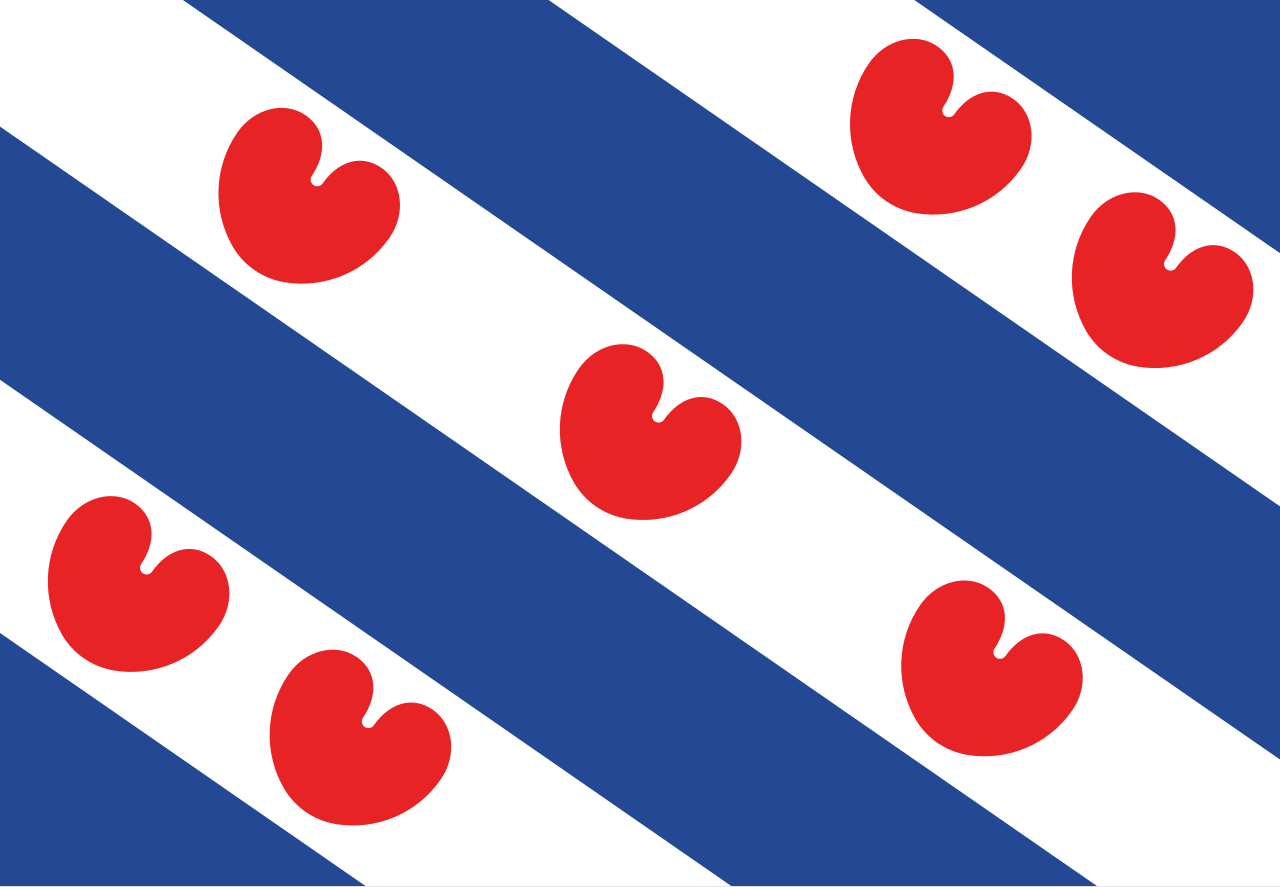
Flag of the Province of Fryslân
The official flag of the Province of Fryslân has diagonal blue and white stripes and seven red pompeblêden.
A pompeblêd is a stylized leaf of a yellow water lily. Its shape is sometimes mistaken for a heart, but it does not represent a heart.
The seven leaves are commonly explained as symbols of the “Seven Sea Lands,” an idea connected with medieval traditions and regional identity. The current design was formally established as the provincial flag in 1957. [Province of Fryslân: The Frisian Flag](https://www.fryslan.frl/fy/fryske-flagge)
When the flag is shown on Linglobe, it should be labeled “Flag of the Province of Fryslân” rather than presented as a common flag for the entire Frisian people.
Water, Dwelling Mounds, and Dikes
The sea, tidal flats, lakes, canals, dwelling mounds, and dikes are important visual elements representing the coastal environment and the lives of its communities.
Water-management knowledge is not unique to the Frisians, however. Related practices developed in many low-lying areas around the North Sea, including other parts of the Netherlands and Germany.
Ships and the Skûtsje
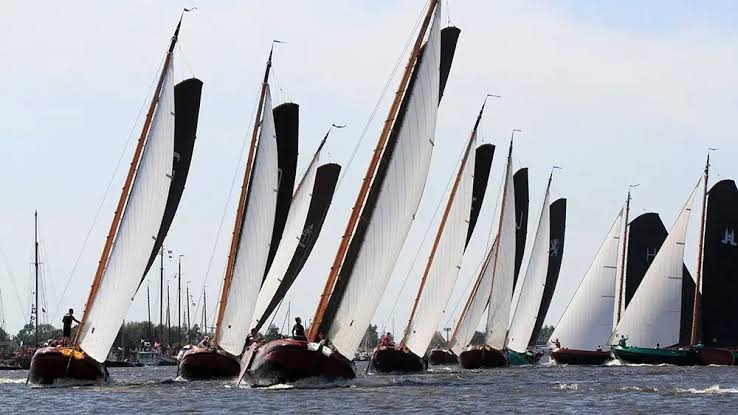
A skûtsje is a flat-bottomed sailing vessel formerly used to transport freight on inland waterways in the Netherlands.
Historic vessels now compete in races called skûtsjesilen, which have become a major summer cultural event in Fryslân.
The skûtsje represents inland water transport and shipbuilding skills associated with the West Frisian region, but it is not an official emblem of all Frisians.
Languages
The Frisian Languages
The Frisian languages belong to the West Germanic branch of the Germanic family within the Indo-European language family.
The Frisian languages spoken today are generally divided into West Frisian, North Frisian, and Saterland Frisian.
They share historical roots but developed separately for many centuries. Their differences go beyond minor regional accents or dialect features. A West Frisian speaker cannot necessarily understand North Frisian or Saterland Frisian without studying them.
West Frisian
West Frisian is spoken mainly in Fryslân in the Netherlands. In the language itself, it is called Frysk.
Under the Dutch Use of Frisian Language Act of 2014, West Frisian and Dutch have official status in the Province of Fryslân. Under certain conditions, residents may use Frisian in provincial and municipal government and in legal proceedings. [Mercator European Research Centre: Frisian in the Netherlands](https://wiki.mercator-research.eu/languages%3Afrisian_in_the_netherlands)
According to a 2025 survey published by the Fryske Akademy, about nine out of ten residents of Fryslân reported that they understood West Frisian well, and nearly two-thirds said they could speak it. More than half could read it, while approximately one-fifth reported being able to write it well.
These results show that West Frisian remains widely used as a spoken language, while literacy and opportunities for written use vary considerably. [Fryske Akademy: 2025 Language Survey](https://www.fryske-akademy.nl/en/news/news-filter/taalsurvey-2025-fryske-taal-bliuwt-stevich-ferankere-yn-de-maatskippij/)
North Frisian
North Frisian is spoken on the mainland of North Frisia, on several islands, and on Heligoland in Germany.
It consists of several varieties associated with particular islands and villages, each with its own pronunciation, vocabulary, and spelling traditions. Examples include Fering-Öömrang on Föhr and Amrum, Sölring on Sylt, and Halunder on Heligoland.
The number of speakers is estimated to be in the thousands. Many varieties face an aging speaker population and a decline in transmission within families.
North Frisian is taught in some schools, early-childhood programs, and cultural organizations. New school materials in Fering were introduced in 2025. [State Government of Schleswig-Holstein: North Frisian School Materials](https://www.schleswig-holstein.de/DE/landesregierung/ministerien-behoerden/I/Presse/PI/2025/bm/250507_schulbuecher_friesisch)
Saterland Frisian
Saterland Frisian, also called Seeltersk, is the only surviving language of the East Frisian branch.
It has been influenced by German and Low German, but remains a Frisian language with its own sound system, vocabulary, and grammar.
Transmission efforts include school activities, community organizations, dictionaries, literature, signs, and online learning materials. In recent years, cooperation among research institutions and community organizations has also produced an English-language reference grammar. [Fryske Akademy: English Grammar of Saterland Frisian](https://www.frisianhumanities.frl/en/news/news-article/english-grammar-on-saterfrisian)
Relationship with English
The Frisian languages and English are historically close relatives within the West Germanic language group and are often discussed together under the term Anglo-Frisian.
Because they share certain historical sound changes and elements of basic vocabulary, Frisian is sometimes described as the language most closely related to English.
This does not mean that modern English and the modern Frisian languages are mutually intelligible. Their historical relationship does not allow speakers to hold conversations without learning the other language. [Penn Libraries: Frisian, a Language in Transition](https://www.library.upenn.edu/news/frisian)
Language Transmission and Revitalization
The situation of the Frisian languages differs greatly from one region to another.
West Frisian has a large number of speakers and an established public framework, but challenges remain in different levels of education, workplaces, urban settings, and written use.
North Frisian and Saterland Frisian have much smaller speaker communities. Increasing opportunities for families to transmit these languages to children is especially important.
Current revitalization activities include early-childhood education, school lessons, adult courses, dictionaries, literature, theater, music, radio, television, social media, videos, sound archives, and language technology.
Basic Expressions
The following expressions are used in standard West Frisian:
Goeie is an informal greeting similar to “hello” or “hi.”
Tankewol means “thank you.”
Oant sjen means “goodbye” or “see you.”
These are West Frisian expressions. North Frisian and Saterland Frisian use different forms depending on the region and language variety.
Traditional Games and Sports
The Frisian regions have sports connected with their local environments, including farmland, waterways, roads, winter ice, and sailing vessels.
Not every sport is practiced throughout all Frisian regions.
Keatsen
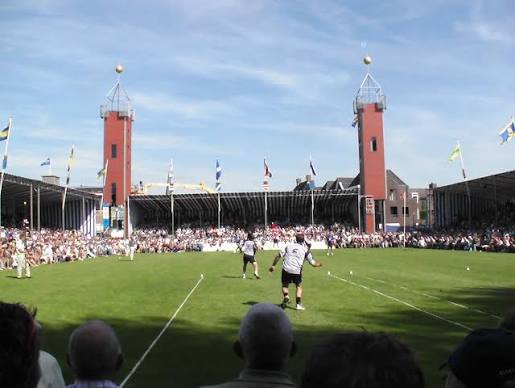
Keatsen is a ball game strongly associated with Fryslân. It is called kaatsen in Dutch.
In its best-known form, two teams of three players compete on a grass court and strike a small, hard ball with the hand.
Scoring involves a position called a keats, which marks where a ball could not be successfully returned. As a result, court position and tactics matter as much as simply sending the ball toward the opposing side.
Today, keatsen is practiced through clubs, competitions, schools, and community events. It is often presented as a representative Frisian sport, but many Frisians do not take part in it. [Afûk: Frisian Sports](https://afuk.frl/nl/vrije-tijd/der-op-ut/sport/)
Fierljeppen
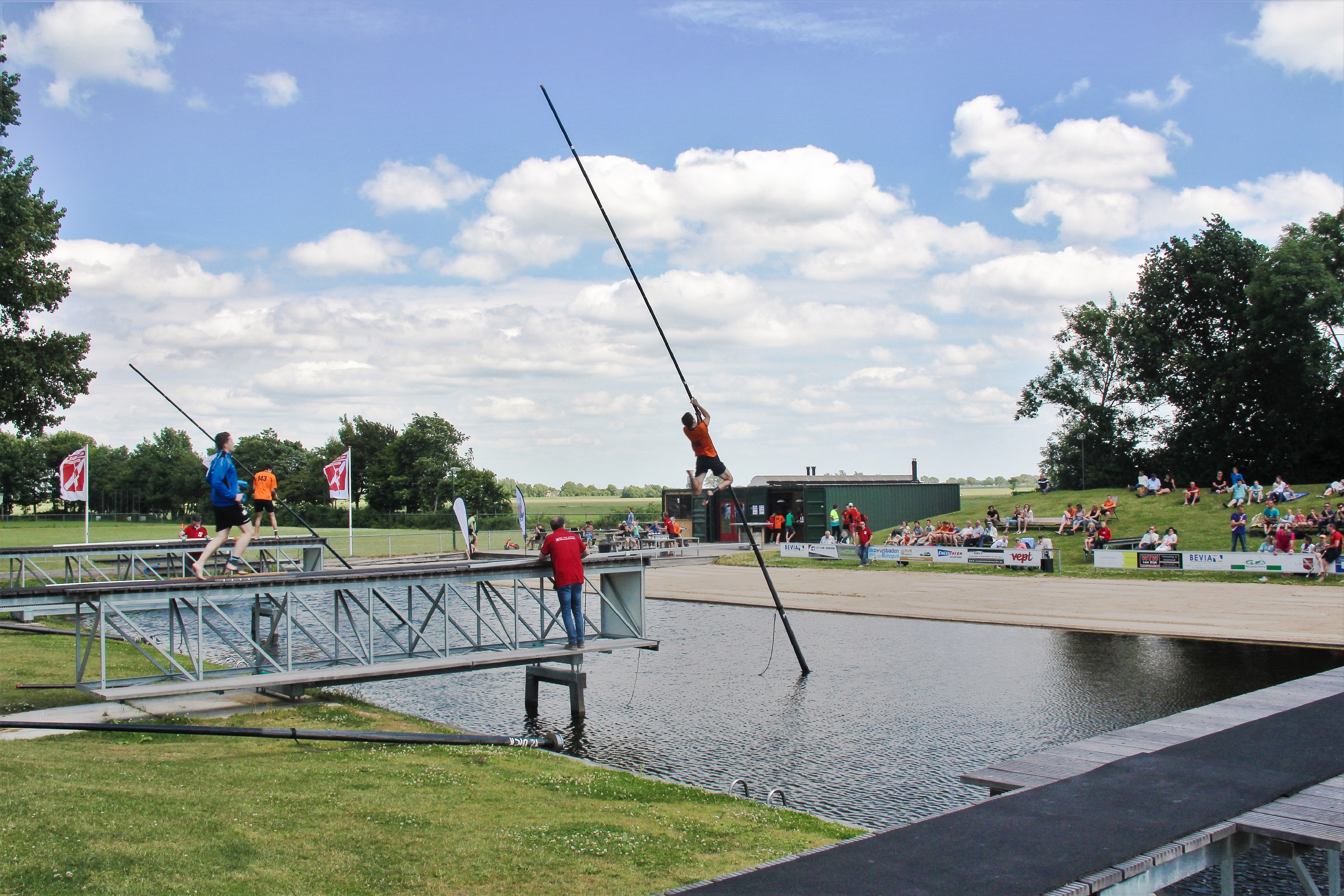
Fierljeppen is a sport in which competitors use a long pole to cross a waterway.
An athlete runs toward the pole, jumps onto it, climbs upward as it tips forward, and attempts to land as far as possible on the opposite bank.
The activity is commonly linked to the practical use of poles by farmers and other residents traveling through a landscape filled with ditches and waterways. It is now a regulated sport with safety equipment and formal competitions. [Frysk Ljeppers Boun](https://fierljeppen.frl/)
Skûtsjesilen
Skûtsjesilen consists of races using skûtsjes, sailing vessels once used to carry peat, manure, agricultural products, and other freight.
Crews compete by reading the wind, water depth, width of lakes and waterways, and the positions of other boats.
Modern races help preserve historic cargo vessels while also functioning as contemporary sporting events involving families, towns, businesses, and sailing crews. [Province of Fryslân: Frisian Sports](https://www.fryslan.frl/friesesporten)
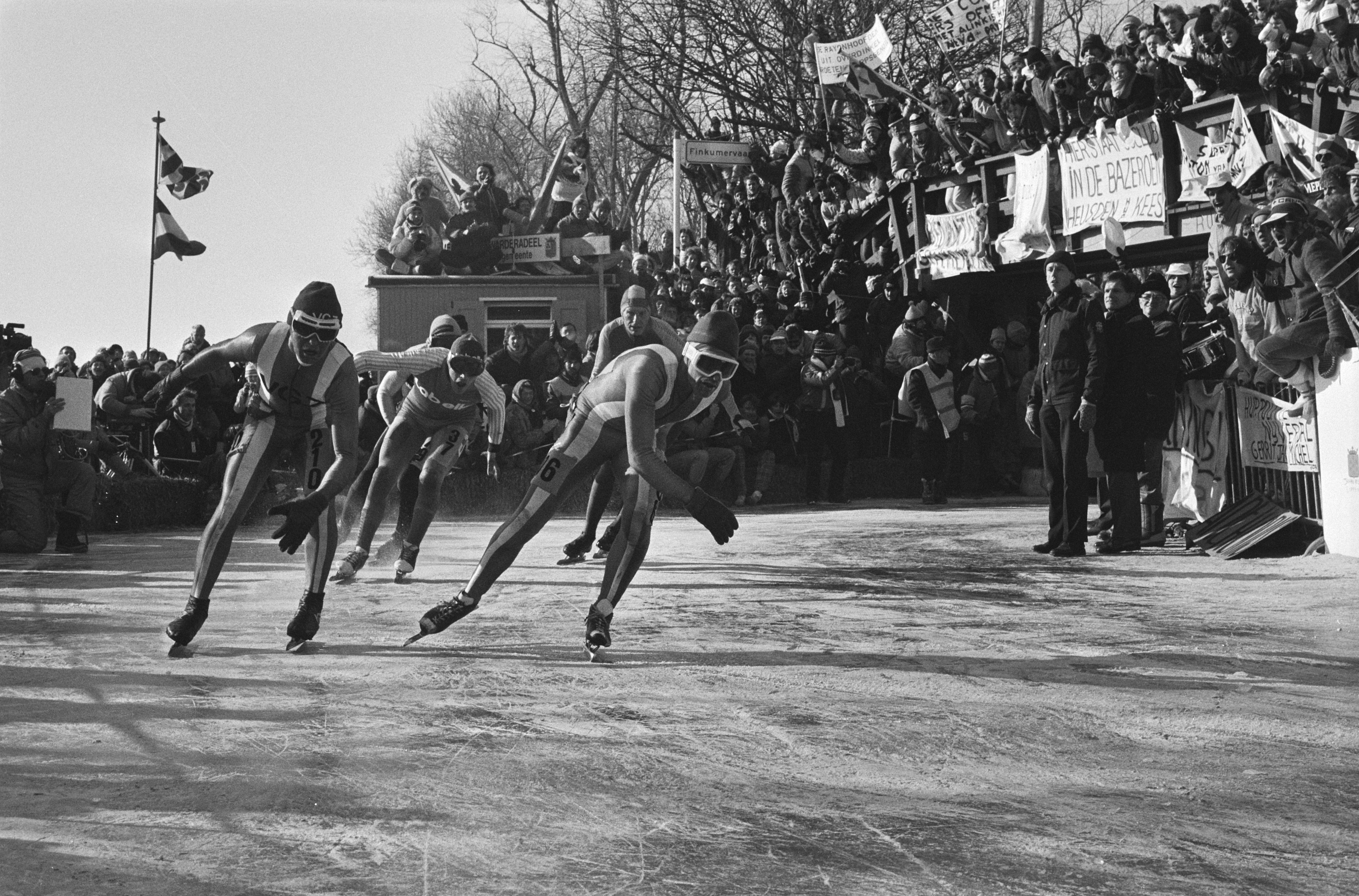
Speed Skating and the Elfstedentocht
When lakes, canals, and waterways froze during winter, skating developed as a form of transportation, recreation, and competition.
The Elfstedentocht is a natural-ice skating tour of approximately 200 kilometers connecting eleven historic cities in Fryslân. The first official event was held in 1909.
The tour cannot be held every year because the route requires natural ice thick enough to be safe. A warming climate has made opportunities to hold the event even more limited. [Official Elfstedentocht Website: The 1909 Tour](https://elfstedentocht.frl/en/tour/tour-of-1909/)
Boßeln and Klootschießen
In East Frisia, Oldenburg, Schleswig-Holstein, and neighboring areas, people practice Boßeln, in which a ball is thrown along a road with the aim of covering a course in as few throws as possible, and Klootschießen, which emphasizes long-distance throwing.
Teams take turns throwing as they move along a road or outdoor course. Clubs and sporting associations now organize rules and competitions.
These activities are closely connected with regional culture in East and North Frisia, although related sports are also found elsewhere in northern Germany and the Netherlands. [Friesischer Klootschießer-Verband](https://www.fkv-online.de/)
Introduction Photo
Common Misconceptions
“All Frisians Live in the Netherlands”
Fryslân in the Netherlands has the largest population of Frisian-language speakers, but Frisian communities also exist in East Frisia, North Frisia, and Saterland in Germany.
People have also moved to other regions and countries for education, employment, marriage, and other reasons.
“All Frisians Speak the Same Frisian Language”
West Frisian, North Frisian, and Saterland Frisian share historical roots but developed separately.
North Frisian itself also contains substantial regional diversity.
Some people who identify as Frisian mainly speak Dutch, German, Low German, or another language.
“All East Frisians Speak East Frisian”
The traditional regional language widely used in East Frisia today is East Frisian Low Saxon. It belongs to the Low German group and is distinct from the Frisian languages.
Seeltersk in Saterland is the principal surviving language descended from the medieval East Frisian branch.
“Frisian Is a Dialect of Dutch or German”
The Frisian languages belong to the same West Germanic group as Dutch and German, but they have their own histories, sound systems, vocabulary, and grammar.
They have been strongly influenced by Dutch, Low German, and Standard German through centuries of contact. This influence does not make them merely dialects of those languages.
“English Speakers Can Understand Frisian Because It Is Closely Related to English”
Descriptions of Frisian and English as closely related refer to language history and genealogical classification.
Modern vocabulary, pronunciation, and grammar differ greatly, so English speakers cannot understand a Frisian language without learning it.
“The Flag with Seven Red Hearts Represents All Frisians”
The red shapes on the flag of Fryslân are not hearts. They are pompeblêden representing water-lily leaves.
The flag is the official flag of the Dutch Province of Fryslân, not a common official flag representing every Frisian community in the Netherlands and Germany.
Frisians Today
Frisians today live not only in rural communities and islands, but also in cities such as Leeuwarden, Groningen, Emden, and Flensburg, as well as outside the traditional Frisian regions.
Their occupations are not limited to agriculture, dairy farming, fishing, or shipping. Frisians work in education, government, health care, industry, energy, tourism, information technology, research, the arts, media, and many other fields.
Relationships with the Frisian languages are equally diverse.
Some people use a Frisian language daily at home and in their communities. Others understand it but have few opportunities to speak it, learn to read and write it at school, or begin studying the language of their parents or grandparents as adults.
In Fryslân in the Netherlands, West Frisian is used in government, education, broadcasting, and cultural activities. Challenges remain, however, including the social dominance of Dutch, differences among schools in the amount and quality of Frisian-language education, and limited written use among parts of the younger population.
North Frisian and Saterland Frisian face greater challenges from their small and aging speaker populations and declining transmission within families. At the same time, new teaching materials, early-childhood programs, community theater, music, dictionaries, digital archives, and social media are creating new ways to learn and use the languages.
Changes involving renewable energy, tourism, housing, agriculture, environmental protection, and sea-level rise also affect life in the coastal regions.
Preserving culture does not mean reproducing an unchanged way of life from the past.
Frisian cultures continue to change through education, research, art, sports, media, family conversations, and connections across regional borders, while recognizing the distinct histories and languages of the different