Overview
- The Nenets, also known as the Yamal People, are an Indigenous group living in the Russian Arctic, particularly on the Yamal Peninsula.
- Their name means “the people,” and they are known for reindeer herding, oral traditions, and spiritual ties to nature.
- Despite historical pressures, the Nenets have preserved their unique identity through a nomadic lifestyle.
The Nenets are one of the Indigenous peoples living in the Arctic regions of northern Russia. They mainly inhabit:
- The Yamal Peninsula
- Nenets Autonomous Okrug
- Northern Western Siberia
and other tundra regions within the Arctic Circle.
The name “Yamal” is believed to come from the Nenets language and is commonly interpreted as meaning:
“the end of the world”
or
“the edge of the land.”
The Nenets belong to the Samoyedic branch of the Uralic language family and traditionally speak:
The Nenets language
Today, many Nenets people also speak Russian, although the Nenets language continues to be used in daily life in some regions.
The Nenets are widely known for their traditional way of life adapted to the harsh Arctic environment. In particular:
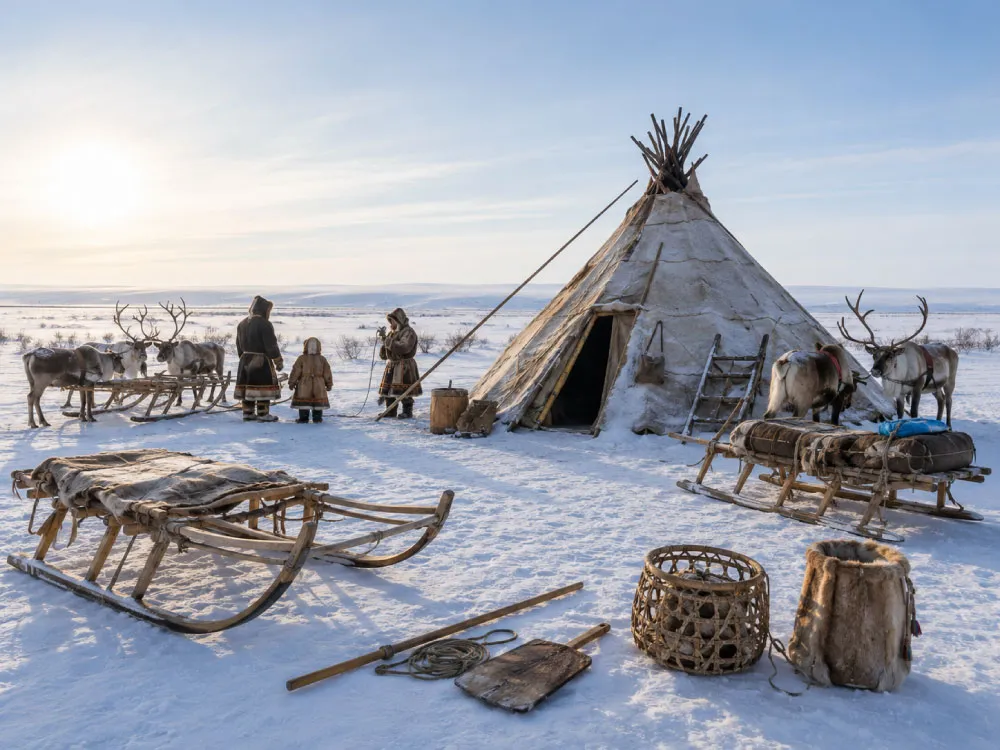
Reindeer herding
is one of the central elements of Nenets culture.
Reindeer play essential roles in many aspects of daily life, including:
- Transportation
- Food
- Clothing
- Trade
- Tools and materials
Traditional Nenets society has historically followed a nomadic lifestyle, moving seasonally together with reindeer herds across the tundra. In some regions, these long-distance migration traditions continue today.
The Nenets are also known for their traditional dwellings called:
Chum
which are cone-shaped portable tents made from wooden poles and reindeer skins. These structures are designed specifically for survival in extremely cold environments.
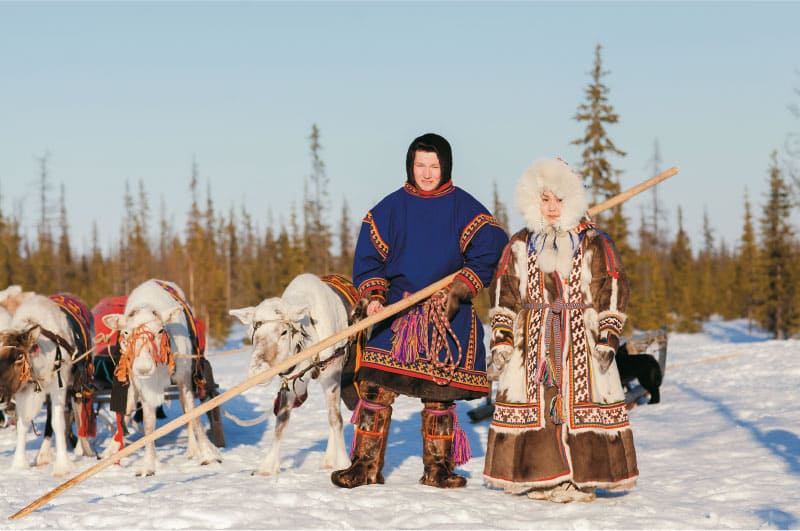
Traditional Nenets clothing is also made using reindeer fur and is adapted for protection against Arctic temperatures.
In terms of religion and spirituality, traditional Nenets culture historically included shamanistic beliefs that emphasized relationships with nature and spiritual beings. Today, some regions have also been influenced by Russian Orthodox Christianity.
Historically, the Nenets maintained their nomadic culture across northern Siberia for many centuries. However, during the periods of the Russian Empire and the Soviet Union, administrative control, collectivization policies, and industrial development significantly affected traditional Nenets life.
From the 20th century onward, developments related to:
- Oil and natural gas extraction
- Industrialization
- Sedentarization policies
had major impacts on Nenets communities and their environment.
Today, some Nenets people continue traditional reindeer herding lifestyles, while others live in towns and settled communities.
Efforts related to:
- Language preservation
- Environmental protection
- Indigenous rights
- Cultural preservation
have also become increasingly important in recent years.
Today, the Nenets are recognized as one of the representative Indigenous peoples of the Arctic region, and their nomadic traditions, relationship with reindeer, tundra lifestyle, and traditional knowledge continue to represent an important part of the cultural diversity of Siberia.
Location
- Primarily in the Yamal-Nenets Autonomous Okrug of northern Russia
- They inhabit tundra and subarctic zones above the Arctic Circle.
Other regions include:
・Taimyr Peninsula
・Komi Republic
・Arkhangelsk Oblast
History
- The Nenets have lived in the Arctic for thousands of years.
- Became tributaries of Russian principalities in the 13th century.
- During the Soviet era, experienced forced sedentarization and Russification.
- Since the 1990s, there has been a revival of language, religion, and cultural education.
Culture
- Dwellings: Use the "chum"—a cone-shaped tent made from reindeer hides.
- Clothing:Wear fur-lined garments such as the malitsa and piima boots.
- Diet:Includes raw reindeer meat, blood, and Arctic fish (muksun, salmon).
- Spirituality:Based on animism and shamanism, revering spirits of fire, animals, and land.
- Family Structure:Patrilineal but women play essential roles in herding and child-rearing.
Nenets People Symbols and Flag

- Reindeer: both sacred and vital for survival.
- Chum tents, shamanic drums, and fur garments.
- The blue-white-red patterns found on clothing and banners in the Yamal region.
Language
- Nenets language belongs to the belongs to the Samoyedic branch of the Uralic language family.
- Characterized by vowel harmony and complex morphology.
- About 30,000 speakers; efforts for revitalization are ongoing.
Common Nenets Language Greetings and Phrases
| English | Nenets | Pronunciation |
| Hello | Хасава | Hah-sah-vah |
|---|---|---|
| Good morning | Хасава вэй | Hah-sah-vah vay |
| Good night | Хасава сята | Hah-sah-vah syah-tah |
| Thank you | Нумалада | Noo-mah-lah-dah |
| Nice to meet you | Хава пырна | Hah-vah pur-nah |
| Delicious | Сыра-мы | Sih-rah-mih |
| Fun/Enjoyable | Ям’я хаба | Yahm-yah hah-bah |
Language Origins
- Nenets is one of the oldest branches of the Uralic family.
- Distantly related to Finnish, Hungarian, and Estonian.
- Oral storytelling is key to cultural transmission; language is seen as a sacred force.
Writing System
- Traditionally oral; no writing system until the 20th century.
- Today uses the Cyrillic alphabet, adapted for Nenets sounds.
- Language is taught in schools and used in children's books and radio.
Detailed Habitat
- Yamal Peninsula:Core of nomadic reindeer culture.
- Taimyr region:Contains nature preserves and traditional villages.
- Komi Republic & Khanty-Mansi:Smaller communities and migration routes.
- Temperatures can drop below −40°C in winter.
Access Guide
The currency of the Yamal (Nenets) people is the Russian Ruble (RUB).
0.011 EUR / 0.013 USD / 1.8 JPY / 0.09 CNY / 0.019 AUD / 0.016 SGD / 0.098 HKD / 0.0092 GBP / 1.08 INR
https://www.xe.com/currencyconverter/
Yamal (Nenets) Region
Access to Yamal (Nenets) Region (Salekhard) from Major Cities
| Departure City | Direct/Transit | Arrival Airport | Flight Time (approx.) | Reference Fare (one-way/round-trip, Economy) |
| Los Angeles | LA → Istanbul/Moscow → Salekhard | Salekhard (SLY) | 27–35 hours | US$1,400–2,200 |
|---|---|---|---|---|
| New York | NY → Istanbul/Moscow → Salekhard | Salekhard (SLY) | 25–33 hours | US$1,350–2,200 |
| London | London → Istanbul/Moscow → Salekhard | Salekhard (SLY) | 19–28 hours | £950–1,500 |
| Tokyo | Tokyo → Istanbul/Moscow → Salekhard | Salekhard (SLY) | 24–32 hours | ¥180,000–320,000 |
| Sydney | Sydney → Istanbul/Moscow → Salekhard | Salekhard (SLY) | 31–38 hours | A$2,000–3,300 |
| Hong Kong | Hong Kong → Istanbul/Moscow → Salekhard | Salekhard (SLY) | 23–31 hours | HK$10,000–17,000 |
| Shanghai | Shanghai → Istanbul/Moscow → Salekhard | Salekhard (SLY) | 22–29 hours | CNY9,500–16,000 |
| Singapore | Singapore → Istanbul/Moscow → Salekhard | Salekhard (SLY) | 25–33 hours | S$1,900–3,100 |
Traditional Games
1.Reindeer sled racing (Ngartak):
Held during winter celebrations.
2.Toy hunting games
Practice for future hunters with miniature bows.
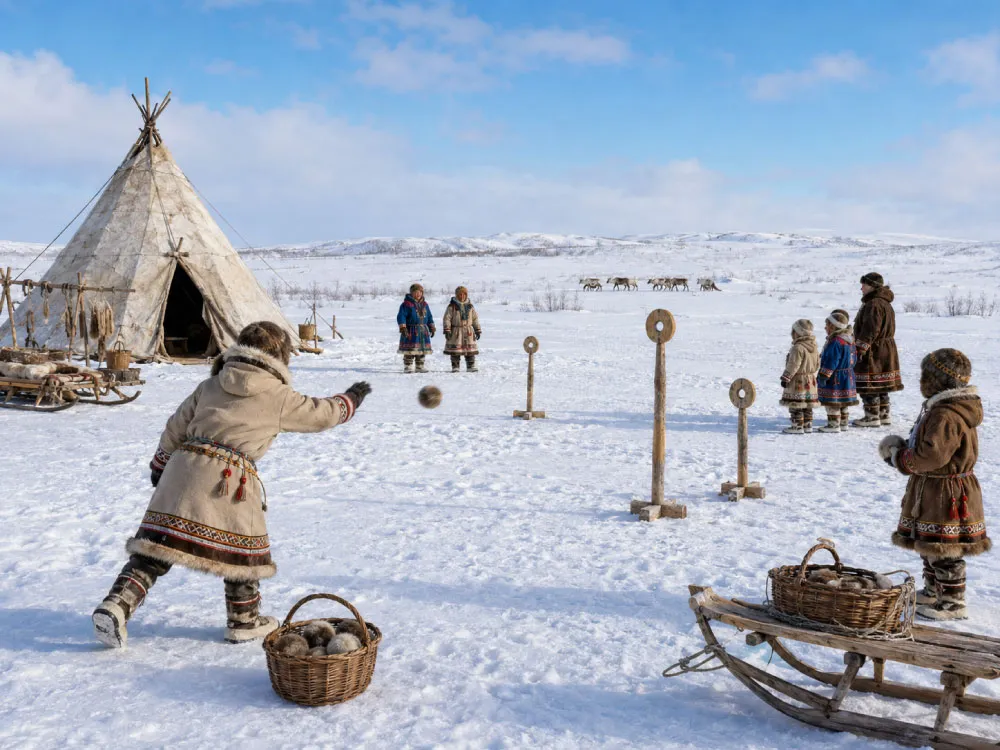
3.Fur ball toss
A game using soft fur balls to throw distances.
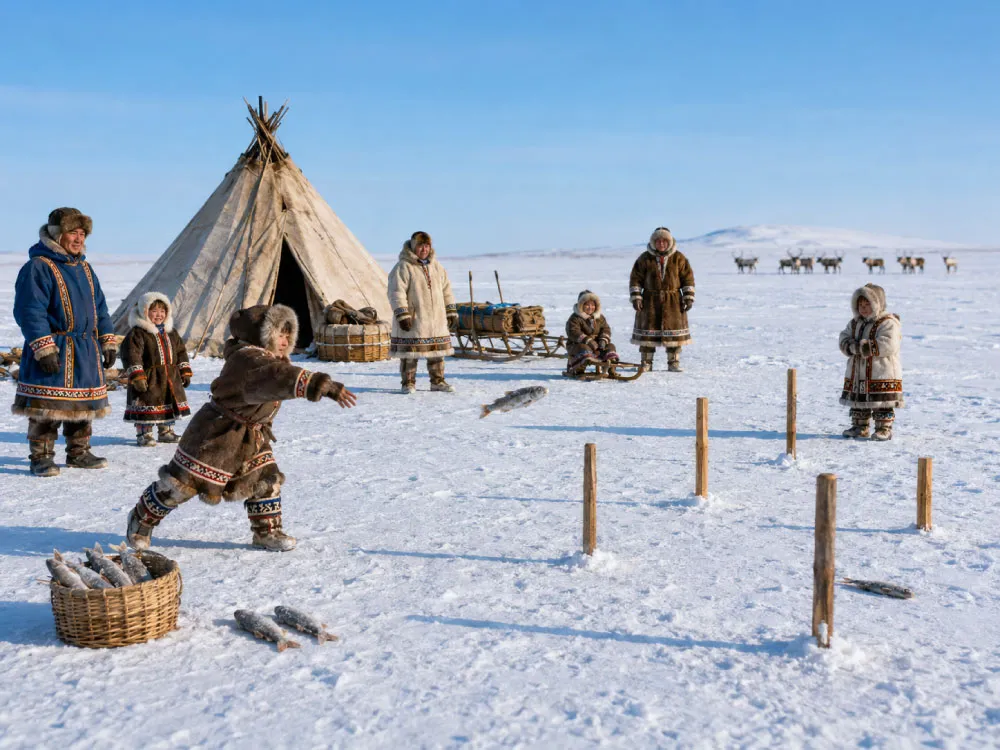
4.Frozen fish slide
Slide fish across ice for distance or accuracy.
5.Oral epic recitations
Competitions to recite mythology and legends.
Introduction video
The Nenets people carry the warmth of stories across frozen lands. Through language, reindeer, and song, they protect an Arctic world where every word is a spark against the snow.