Overview
The Sorbs are a West Slavic people whose homeland is Lusatia in eastern Germany.
Lusatia lies mainly in eastern Saxony and southern Brandenburg. The ancestors of today’s Sorbs have lived in this region for approximately 1,500 years. In Germany, the Sorbs are legally recognized as one of the country’s four autochthonous national minorities.
The Sorbian people are often described as two main regional groups: the Upper Sorbs of Upper Lusatia and the Lower Sorbs of Lower Lusatia.
Upper Sorbian developed in Upper Lusatia, while Lower Sorbian developed in Lower Lusatia. Both belong to the West Slavic branch of the Slavic language family, but they have separate standardized forms, spelling systems, pronunciations, and literary traditions.
The total Sorbian population is commonly estimated at around 60,000. Approximately 40,000 are said to live in Upper Lusatia in Saxony, while about 20,000 live in Lower Lusatia in Brandenburg.
However, Germany does not conduct an ethnic census requiring people to prove that they are Sorbian. Sorbian identity is based on voluntary self-identification, so these figures are estimates rather than confirmed census totals. Official information on the Sorbs from the Free State of Saxony
Today’s Sorbs are not people who live only in rural villages or always wear traditional clothing.
Some mainly use German in daily life, while others speak a Sorbian language at home or in their community. Some begin learning Sorbian as adults. Sorbs also work in education, the arts, government, research, the media, business, and many other areas of contemporary society.
Homeland and Regional Communities
Lusatia
Lusatia is called Lausitz in German, Łužica in Upper Sorbian, and Łužyca in Lower Sorbian.
The historical region of Lusatia extends across parts of present-day Germany and Poland. However, the main traditional Sorbian settlement areas protected by law today are located in the German states of Saxony and Brandenburg.
Lusatia includes forests, farmland, rivers, wetlands, lakes, villages, and industrial towns.
The Spreewald in Brandenburg is particularly well known for its network of waterways and wetlands. In Lower Sorbian, it is called Błota.
Lusatia has also long been an important region for lignite mining and electricity production. Some villages were relocated or destroyed by open-cast mining, disrupting connections among land, cemeteries, churches, language communities, and neighboring families.
Upper Lusatia
Upper Lusatia is located mainly in eastern Saxony.
One of its principal cultural centers is the city called Bautzen in German and Budyšin in Upper Sorbian.
Bautzen is home to the Sorbian Museum, the German-Sorbian People’s Theatre, the Sorbian Institute, the Foundation for the Sorbian People, publishing organizations, and the headquarters of Domowina.
One area where Upper Sorbian has remained comparatively strong is the Catholic region around Bautzen and Kamenz. In some villages, Upper Sorbian is used within families, churches, kindergartens, schools, and community events.
However, not all Upper Lusatian Sorbs are Catholic. There are also Protestant communities, people without a religious affiliation, and families that primarily use German.
Lower Lusatia
Lower Lusatia is located mainly in southern Brandenburg.
Its principal cultural center is the city called Cottbus in German and Chóśebuz in Lower Sorbian.
Cottbus is home to Lower Sorbian educational and cultural institutions, museums, libraries, and radio and television production facilities.
In Lower Lusatia, the official designation “Sorbs/Wends” is frequently used alongside “Sorbs.”
Lower Sorbian has lost many of its intergenerational home speakers and is considered one of Europe’s most endangered minority languages.
At the same time, kindergartens, schools, adult courses, broadcasting, publishing, and digital learning resources are being used to help more people learn and use the language. Official information on the Sorbs/Wends from Brandenburg
Transitional Areas and Regional Differences
Upper Sorbian and Lower Sorbian culture are not separated by a single, clearly defined boundary.
Areas around Hoyerswerda and Schleife have linguistic and cultural characteristics located between the better-known Upper and Lower Sorbian traditions.
Traditional clothing, dialects, songs, dances, religious customs, and Easter traditions also differ from one region to another.
Sorbian cultural regions are often described as including Lower Lusatia, the Catholic region of Upper Lusatia, the area around Hoyerswerda, and the Schleife region.
For this reason, one particular costume or custom should not be presented as a tradition shared by all Sorbs.
Urban Communities and People Living Outside Lusatia
Education, employment, marriage, and family migration have led some Sorbs to live outside the traditional settlement area, including in cities such as Berlin, Dresden, and Leipzig.
Living in a city does not mean that a person has lost their Sorbian identity.
Sorbs living outside Lusatia may maintain cultural connections through family, cultural associations, student organizations, music, literature, online activities, and participation in events held in Lusatia.
Names and Terminology
In English, Sorbs is the plural noun used for the people.
Sorbian is the corresponding adjective used for the people’s languages and culture. For this reason, “Sorbian People” is a natural English page title. The term “Lusatian Sorbs” is also widely used.
In German, the people are called Sorben.
In Upper Sorbian, the plural name for the people is Serbja, while the Lower Sorbian form is Serby.
The names Serbja and Serby resemble the English word Serbs, which refers to the people of Serbia. However, the Sorbs and the Serbs are not the same people. They are related only in the broader sense that both speak languages belonging to the Slavic family.
The names Wends and the German Wenden have also historically been used for West Slavic peoples.
Some people in Lower Lusatia continue to identify themselves as Wends or Wenden. The laws and government institutions of Brandenburg therefore use the combined designation “Sorbs/Wends.”
It would be inaccurate to describe Wend as an incorrect or offensive term in every context. However, attitudes toward the name vary by region and individual, so it is important to respect the terminology used by the person or organization concerned. Minority Secretariat information on the Lusatian Sorbs
Linglobe uses “Sorbian People” as the page title while also explaining the continued use of the name “Wends,” particularly in Lower Lusatia.
History and Roots
Slavic Settlement in Lusatia
West Slavic peoples connected to the ancestors of today’s Sorbs settled in regions that included present-day eastern Germany during the sixth and seventh centuries.
At that time, the region contained numerous smaller tribes and communities.
The Milceni of Upper Lusatia and the Lusici of Lower Lusatia are among the groups recorded in historical sources. However, they cannot be directly equated with today’s Upper and Lower Sorbs.
Languages, settlements, political rule, religion, and relations with neighboring populations changed over many centuries, gradually contributing to the development of modern Sorbian culture. Historical publication from the Sorbian Institute
Political Changes During the Middle Ages
During the medieval period, Lusatia was affected by the expansion of East Frankish and Holy Roman imperial power, Christianization, and the arrival of German-speaking settlers.
At different times, Lusatia came under the authority of the Bohemian Crown, Saxony, Brandenburg, Prussia, and other rulers and states.
German became increasingly important in towns and government, while Sorbian languages and customs continued especially in rural communities.
In some regions, however, language shift from Sorbian to German progressed over time, gradually reducing the area in which Sorbian languages were widely spoken.
The Reformation and Written Culture
The Protestant Reformation of the sixteenth century influenced the development of written Sorbian.
Religious texts, including catechisms, prayer books, hymns, and Bible translations, were produced so that local people could receive religious instruction in languages they understood.
Upper and Lower Lusatia differed in their political histories, religious traditions, and dialects.
As a result, a single standardized Sorbian language did not emerge. Upper Sorbian and Lower Sorbian instead developed as separate written languages.
Church institutions sometimes encouraged Germanization, but in other communities, worship, hymns, religious instruction, and education helped preserve Sorbian language use.
The Nineteenth-Century Cultural Revival
During the nineteenth century, interest in national languages and cultures grew across Europe.
Sorbian teachers, clergy, writers, musicians, and scholars began recording folktales, songs, languages, history, and regional clothing. They also published newspapers, books, dictionaries, and literary works.
In 1847, Maćica Serbska was established as a scholarly and cultural organization supporting the study of Sorbian language, literature, history, and culture. Official information on Maćica Serbska
The poet Handrij Zejler, the composer Korla Awgust Kocor, and many other figures contributed to the development of modern Sorbian culture.
The song now recognized as the Sorbian anthem, “Rjana Łužica” in Upper Sorbian and “Rědna Łužyca” in Lower Sorbian, also emerged from the literary and musical culture of this period.
The Establishment of Domowina
In 1912, Domowina was founded as an umbrella organization connecting several Sorbian associations.
The name Domowina comes from a Sorbian word associated with home and homeland.
The organization promoted education, publishing, cultural activities, and cooperation among regional associations. It developed into an important representative organization for Sorbian cultural and linguistic rights. Domowina’s history
Under National Socialism
The National Socialist government did not recognize the Sorbs as a distinct people and attempted to assimilate them as part of the German population.
Sorbian-language cultural activities, publishing, education, and organizations were restricted. In 1937, Domowina and other Sorbian organizations were banned.
Activists, teachers, clergy members, and others were subjected to surveillance, removal from their positions, detention, or other forms of persecution. Public use of Sorbian languages was severely reduced.
However, Sorbian languages and culture did not disappear completely. Families, churches, and village communities continued to maintain elements of their languages and customs.
After the Second World War and During the East German Period
After the Second World War, most of Lusatia became part of the German Democratic Republic, commonly known as East Germany.
Sorbian languages and culture received official recognition, and Sorbian-language schools, publishing houses, research institutions, theatres, museums, and broadcasting services were developed.
These institutions played an important role in cultural and linguistic continuity.
However, cultural organizations also operated under state supervision, and independent political activity was not always permitted.
Industrialization, urbanization, German-dominant workplaces, and population movements also affected the transmission of Sorbian languages within families.
Open-cast lignite mining was particularly disruptive. Villages inhabited by Sorbian communities were relocated or demolished. The losses affected not only buildings but also relationships among neighbors, local dialects, cemeteries, churches, and community customs connected to particular places.
After German Reunification
Following German reunification in 1990, Sorbian rights were reaffirmed in the constitutions and laws of Saxony and Brandenburg.
These protections include the right to identify as Sorbian, use a Sorbian language in public life, maintain cultural and educational institutions, and display bilingual place names in the traditional settlement area.
The laws also state that public authorities must not investigate or demand proof of a person’s declaration of Sorbian identity. Saxon Sorbs Act Brandenburg Sorbs/Wends Act
In 1991, the Foundation for the Sorbian People was established with support from the German federal government and the states of Saxony and Brandenburg.
Upper Sorbian and Lower Sorbian are also protected under the Council of Europe’s European Charter for Regional or Minority Languages.
Culture
Families, Communities, and Cultural Organizations
Sorbian culture is passed on through families as well as villages, churches, schools, choirs, dance groups, sports associations, theatres, museums, publishing organizations, and research institutions.
Some people grow up speaking a Sorbian language at home. Others may have grandparents who spoke it but do not speak it fluently themselves.
Some families learn the language through schools or adult courses and try to introduce it to a new generation.
Domowina continues to serve as an umbrella organization connecting regional and cultural associations.
However, membership in Domowina is not a requirement for being Sorbian. People differ in how they relate to cultural organizations and how they express their Sorbian identity.
Religion and Regional Differences
Christianity has influenced Sorbian festivals, music, calendars, and language education for centuries.
Some parts of Upper Lusatia have strong Catholic traditions, while Protestant traditions are widespread in Lower Lusatia and other parts of Upper Lusatia.
Churches may provide spaces where Sorbian is used in worship, hymns, sermons, and community events.
However, not all Sorbs are Christian. Some have no religious affiliation, while others participate in local customs mainly as cultural traditions.
Traditional Clothing
There is no single Sorbian traditional costume.
Clothing differs among Lower Lusatia, Catholic Upper Lusatia, the Hoyerswerda area, the Schleife region, and other local communities. Fabrics, colors, caps, headdresses, embroidery, skirt shapes, and dressing methods vary.
Even within the same region, different clothing may be worn for daily activities, church, weddings, funerals, festivals, or youth dances.
Clothing may also indicate a person’s region, age group, marital status, or role in a particular event.
Today, relatively few people wear traditional clothing as everyday dress. It is more often worn during festivals, church events, stage performances, weddings, and cultural programs. Sorbs also live their daily lives in ordinary contemporary clothing. Information on Sorbian clothing from the Sorbian Cultural Centre
The Bird Wedding
The Bird Wedding is called Ptači kwas in Upper Sorbian and Ptaškowa swajźba in Lower Sorbian.
It is a children’s custom generally celebrated around January 25.
Children place plates near a window and receive sweets or baked goods shaped like birds and nests, traditionally described as gifts of thanks from the birds.
In kindergartens and schools, children may act out a wedding with a bird bride, a bird groom, and guests representing different birds. Songs and dances may also be included.
The form of the celebration and the kinds of sweets given to children vary among regions and families.
Zapust and Zampern
In Lower Lusatia, Zapust festivals are held around the end of winter and beginning of spring.
In some communities, young people wear regional clothing and participate in processions, dances, and visits to local households.
During Zampern, groups of costumed participants and musicians travel through a village, collecting food, eggs, donations, or other contributions.
These activities are more than tourist parades. They can provide opportunities to visit households, strengthen community relationships, and mark the seasonal calendar.
The organization of the events and the roles of participants vary from one community to another.
Easter and Horseback Processions
Easter is one of the most visible seasons in the Sorbian cultural calendar.
In the Catholic region of Upper Lusatia, formally dressed men participate in Easter horseback processions known in German as Osterreiten.
The riders travel from one parish to another while praying and singing hymns that proclaim the resurrection of Jesus.
This is not a horse race or a performance originally created for tourism. It is a religious procession and community event. It is also a regional custom rather than a practice shared by all Sorbs.
Other Sorbian Easter traditions include egg-rolling games, the collection of Easter water, songs, bonfires, and customs that vary among individual regions. Domowina’s information on Sorbian intangible cultural heritage
Decorated Eggs and Handcrafts
Colorfully decorated Easter eggs are among the most widely recognized visual expressions of Sorbian culture.
Methods include applying wax before dyeing the shell, building raised patterns with colored wax, scratching designs into a dyed shell, and using an etching process to remove color.
Patterns may combine suns, plants, triangles, dots, and lines, but their meanings and arrangements differ among artists, regions, and techniques.
It would be inaccurate to describe one pattern as a sacred symbol shared by all Sorbs.
Decorated eggs are made within families and through schools, museums, workshops, exhibitions, and competitions. Domowina’s information on Sorbian Easter eggs
Embroidery, weaving, pottery, woodworking, and the making and maintenance of regional clothing are also practiced as Sorbian handcraft traditions.
Music, Literature, and Performing Arts
Choral singing and music have played important roles in maintaining Sorbian languages and culture.
Sorbian musical traditions include church hymns, folk songs, dance music, and choral compositions. Contemporary musicians also use Sorbian languages in rock, pop, jazz, rap, and other modern genres.
Since the nineteenth century, Sorbian publishing has included poetry, novels, newspapers, children’s literature, plays, dictionaries, and linguistic research.
The German-Sorbian People’s Theatre currently stages productions in German, Upper Sorbian, and Lower Sorbian. It also presents bilingual performances for schools.
Sorbian art is not limited to traditional clothing and folk music. Contemporary artists use painting, film, photography, design, and digital media to express experiences connected to modern Lusatia, minority identity, and language.
Food Culture
Sorbian food culture developed through the agricultural life of Lusatia, seasonal cycles, religious festivals, and interaction with German and neighboring Slavic communities.
Dishes may include potatoes, grain, dairy products, vegetables, meat, fish, and linseed oil.
Cakes, bread, sweets, and egg dishes are prepared for festivals and family events. Bird- and nest-shaped baked goods associated with the Bird Wedding are examples of foods connected to the seasonal calendar.
However, it can be difficult to draw a clear boundary between Lusatian regional food and food belonging exclusively to the Sorbian people.
The same dish may be enjoyed by both Sorbian and German-speaking neighbors. Food culture therefore reflects not only ethnic differences but also centuries of interaction within the same region.
Flag and Symbols
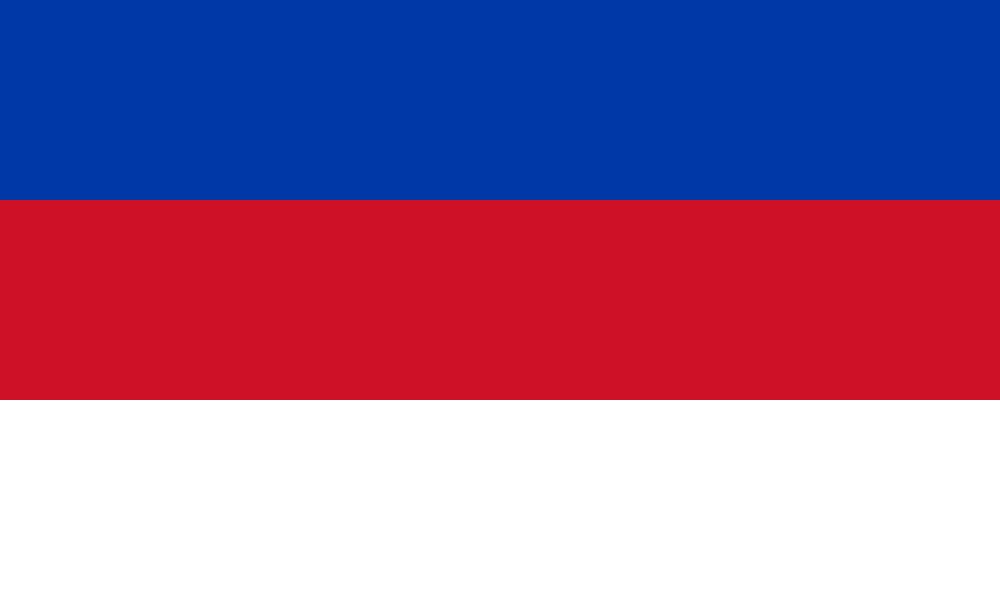
The Sorbian Flag
The Sorbian flag is a horizontal tricolor of blue, red, and white, arranged from top to bottom.
The laws of Saxony and Brandenburg recognize these colors and the flag as symbols of the Sorbian people.
It is not the territorial flag of a German state or municipality. It represents the Sorbian cultural and ethnic community.
Blue, red, and white have been used by several Slavic peoples, but the shared colors do not mean that the Sorbs are the same people as Russians, Serbs, Czechs, or other Slavic populations.
The Sorbian Anthem
The Sorbian anthem is called Rjana Łužica in Upper Sorbian and Rědna Łužyca in Lower Sorbian.
Its title can be translated into English as “Beautiful Lusatia.”
The words were written by the Upper Sorbian poet Handrij Zejler, and the melody was composed by Korla Awgust Kocor.
The song expresses connections to the Lusatian homeland, unity among the Sorbian people, and the continuation of Sorbian culture. Domowina’s information on the Sorbian anthem
Bilingual Place Names
Within the traditional Sorbian settlement area, road signs, railway stations, and public institutions may display names in German and either Upper or Lower Sorbian.
Examples include Bautzen/Budyšin and Cottbus/Chóśebuz.
Bilingual signs make visible the historical presence of Sorbian languages in the region.
However, a bilingual sign does not mean that every resident of the town is Sorbian or speaks a Sorbian language.
Decorated Eggs and Regional Clothing
Decorated Easter eggs and regional clothing are also widely recognized visual expressions of Sorbian culture.
However, neither a particular egg pattern nor one form of regional clothing should be presented as the official emblem of the entire Sorbian people.
Language
Sorbian languages belong to the West Slavic branch of the Slavic language family within the Indo-European language family.
They are broadly related to Polish, Czech, Slovak, Kashubian, and other West Slavic languages.
They are not dialects of German. They possess their own vocabularies, sound systems, grammar, written standards, and literary traditions.
Centuries of contact with German have introduced German loanwords and expressions into Sorbian. However, the existence of borrowed vocabulary does not mean that the Sorbian languages developed from German.
Upper Sorbian
Upper Sorbian is called hornjoserbšćina or hornjoserbsce in Upper Sorbian.
It is used mainly in Upper Lusatia in Saxony.
Within the West Slavic language group, it shares features with Czech and Polish. Its standardized form developed from several Upper Lusatian dialects and from literary and religious traditions.
Some communities continue to use Upper Sorbian actively within families and local society, while German has become dominant in other areas.
Lower Sorbian
Lower Sorbian is called dolnoserbšćina or dolnoserbski in Lower Sorbian.
It is used mainly in Lower Lusatia in Brandenburg.
It is sometimes described as sharing particularly close features with Polish, but it is not a dialect of Polish.
The number of people who acquired Lower Sorbian as a home language during childhood has declined substantially. School education and adult second-language learning are therefore especially important for its future.
Differences Between the Two Languages
Upper Sorbian and Lower Sorbian are closely related, but they are not simply two pronunciations of the same standardized language.
They differ in spelling, vocabulary, sound systems, and some areas of grammar. Each has its own dictionaries, textbooks, newspapers, and literature.
A speaker of one language may not automatically understand the other completely.
Both are written with the Latin alphabet and use letters with diacritics, including č, š, and ž. Some letters are used differently in the two writing systems.
The languages also preserve a grammatical dual number, which has disappeared from most modern European languages. In addition to singular forms for one and plural forms for more than one, dual forms specifically refer to two people or objects.
Legal Status
Upper Sorbian and Lower Sorbian are legally protected minority languages in Germany.
Within the traditional settlement areas, laws provide the right to use a Sorbian language in dealings with public authorities and courts.
However, legal rights do not mean that every government office has employees who can speak Sorbian.
Shortages of qualified teachers, interpreters, government employees, and media professionals affect the practical availability of the languages. The Council of Europe has also called for stronger support for minority-language use in education, administration, courts, and broadcasting. Council of Europe information on minority languages in Germany
Education and WITAJ
WITAJ means “welcome” in both Upper and Lower Sorbian.
In WITAJ early-childhood programs, children encounter a Sorbian language through play and ordinary daily activities.
Children from households where Sorbian is not spoken can also begin learning the language in kindergarten or school.
The region includes schools where Sorbian is taught as a subject, schools offering bilingual instruction in Sorbian and German, and schools where a Sorbian language has a more central role in education.
The teaching model and number of instructional hours differ by school and region. WITAJ Language Centre
Media and Digital Activities
Newspapers, books, radio programs, television programs, websites, videos, and music are produced in Upper and Lower Sorbian.
MDR broadcasts Upper Sorbian radio and television programs, while rbb produces programming in Lower Sorbian. MDR Sorbian-language broadcasting rbb Lower Sorbian programming
Online dictionaries, learning applications, audio resources, and social media are increasingly used in language education and revitalization.
SOTRA is a digital tool supporting translation among Upper Sorbian, Lower Sorbian, and German. Domowina’s information on SOTRA
Digital technology alone cannot revitalize a language, but it can create more opportunities for people to read, write, learn, and communicate in it.
Basic Expressions
In Upper Sorbian, the following expressions can be used:
Dobry dźeń! means “Good day” or “Hello.”
Dźakuju so! means “Thank you.”
Witajće k nam! means “Welcome.”
In Lower Sorbian, the corresponding expressions include:
Dobry źeń! means “Good day” or “Hello.”
Źěkuju se! means “Thank you.”
Witajśo! means “Welcome.”
These examples show that similar words may have different spellings and pronunciations in Upper and Lower Sorbian.
Traditional Games and Sports
Waleien
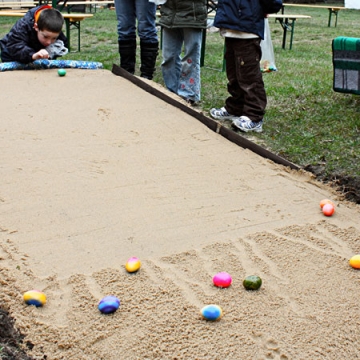
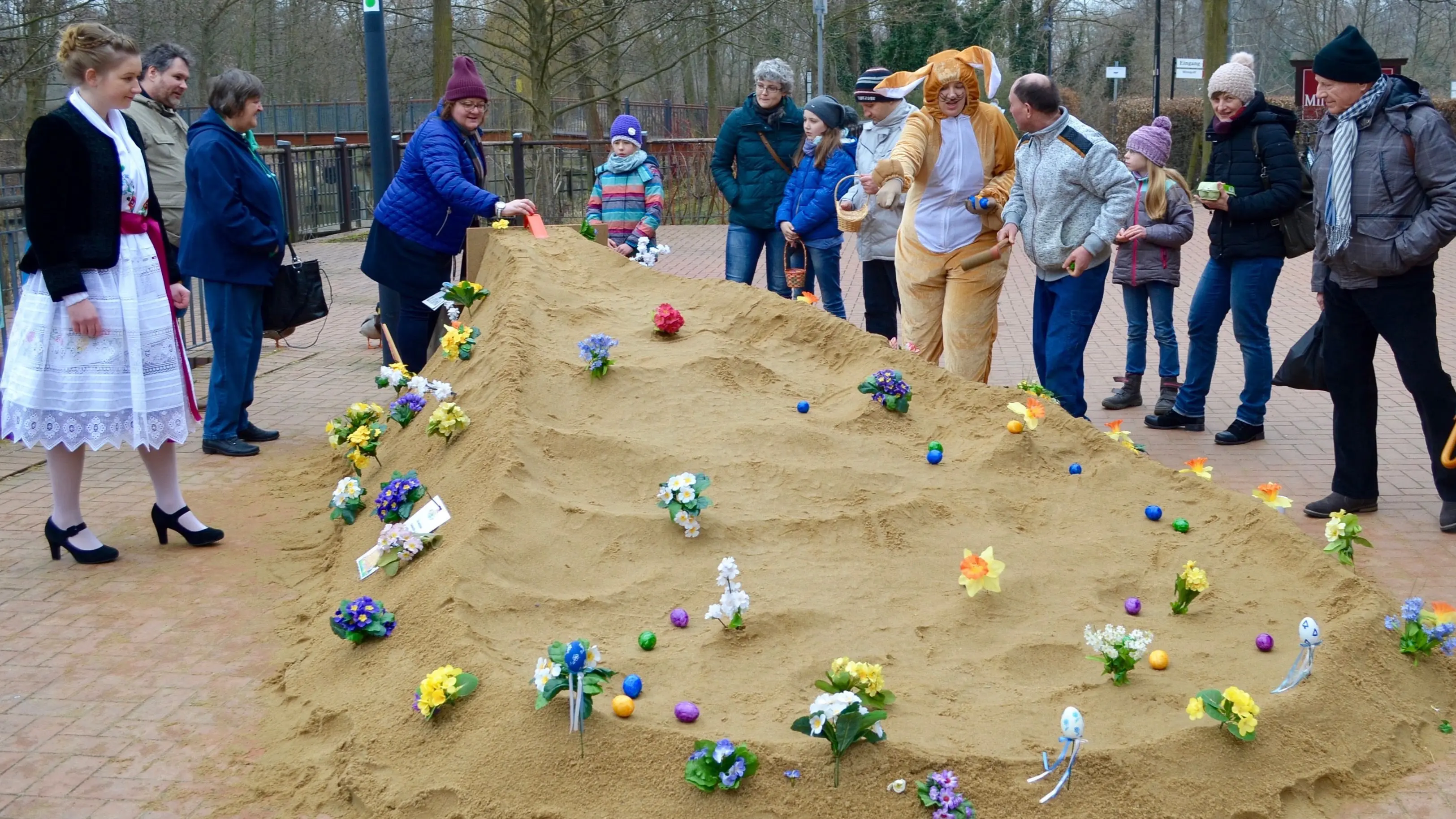
Waleien is a traditional Easter game played with eggs.
Depending on the region and language, it may also be known by names such as Walkowanje.
A sloping track is prepared from soil or sand, and colored hard-boiled eggs are rolled down it.
Regional rules vary. In some versions, a player whose egg strikes another egg may claim that egg or a small object placed as a prize.
The game is especially associated with children’s Easter activities in Lower Lusatia and the Schleife region.
Today, it may also be demonstrated at museums, cultural centers, and community events. Domowina’s information on Waleien
Decorated-Egg Competitions
Decorating Easter eggs is different from a sport or physical game, but it can become a cultural competition based on technical skill and creativity.
Participants use established decorative methods while also developing new combinations of color, composition, and pattern.
Entries may be evaluated according to technique, precision, design, and originality.
These competitions provide opportunities not only to reproduce inherited methods but also for contemporary artists to develop new forms of expression.
Contemporary Sports Activities
Sorbian activities are not limited to traditional games.
Serbski Sokoł is an organization connecting Sorbian sports associations. The name Sokoł is related to a broader gymnastics and sports movement that developed in several Slavic regions.
A historical Sorbian sports organization operated during the early twentieth century before being dissolved under National Socialism. The present Serbski Sokoł was re-established in 1993.
It organizes sporting events, supports youth exchanges, and participates in international sports events involving minority communities. Official information on Serbski Sokoł
However, no single sport should be described as the “ethnic sport” of all Sorbs.
Introduction video
Common Misunderstandings
“The Sorbs Recently Migrated from Poland or Czechia”
The Sorbs are not a recent immigrant community in Germany.
West Slavic populations connected to the ancestors of today’s Sorbs have lived in Lusatia for approximately 1,500 years.
Because they were present in the region long before the establishment of Germany’s current borders, they are recognized as an autochthonous national minority.
“Sorbian Is a Dialect of German”
Upper Sorbian and Lower Sorbian belong to the West Slavic language group.
They are genealogically distinct from German and have their own grammar, vocabulary, spelling systems, and literature.
The presence of German loanwords and the widespread use of Sorbian-German bilingualism do not make Sorbian a dialect of German.
“Upper and Lower Sorbian Are Exactly the Same”
The two languages are closely related, but they have separate standardized forms.
They differ not only in accent and pronunciation but also in spelling, vocabulary, grammar, literature, and educational materials.
When the general term “Sorbian” is used, it can be helpful to identify whether the subject is Upper Sorbian, Lower Sorbian, or both.
“All Sorbs Speak Sorbian”
Sorbian ethnic identity and the ability to speak a Sorbian language are not the same thing.
Some people speak Sorbian fluently at home. Others learned it at school, understand only part of it, primarily use German, or began learning it as adults.
A person’s Sorbian identity should not be denied solely because they do not speak the language fluently.
“Wend Is Always an Offensive Name”
Wend and Wenden are historical names that were often applied from outside the community.
However, some people in Lower Lusatia continue to use the name for themselves, and Brandenburg officially uses the combined designation “Sorbs/Wends.”
Other people prefer not to use the term and identify only as Sorbs.
It is therefore important to respect regional usage and individual preferences rather than apply one name to everyone.
“Sorbs Always Wear Traditional Clothing”
Only a limited number of people now wear regional Sorbian clothing in everyday life.
Many wear it during festivals, church events, theatrical performances, weddings, or other cultural occasions.
Sorbian traditional clothing also includes several distinct regional styles rather than one universal costume.
The colorful clothing shown in tourism photographs cannot represent the complete reality of contemporary Sorbian life.
Sorbs Today
Sorbs today live in villages, regional towns, and major cities.
They work in education, government, research, healthcare, industry, agriculture, tourism, the arts, media, information technology, business, and many other fields.
Some acquired Upper or Lower Sorbian as a first language. Others are bilingual in Sorbian and German, mainly speak German, or are learning a language that was lost within their family.
WITAJ early-childhood education, bilingual schools, intensive adult courses, dictionaries, translation technology, publishing, radio, television, theatre, music, museums, and community events all contribute to cultural and linguistic continuity.
At the same time, Sorbian communities face shortages of teachers and other qualified speakers, declining home transmission, and the migration of younger people to larger cities.
Lower Sorbian is particularly endangered because many of its first-language speakers are elderly. Upper Sorbian also has fewer opportunities for everyday use outside the areas where it remains comparatively strong.
The effects of lignite mining and the transition away from the coal industry continue to shape Lusatia.
This economic transformation concerns more than employment and the environment. It also affects where communities can continue to live and how bilingual education, cultural institutions, and Sorbian public life can be maintained.
Sorbian culture does not exist only in decorated Easter eggs, horseback processions, and traditional clothing.
It continues through languages spoken within families, bilingual road signs, schools, newspapers, theatre, music, sports, digital media, contemporary art, and participation in regional public life.
The Sorbs are not merely a small remnant of the past.
After centuries of language shift, changing political systems, war, industrialization, and the displacement of villages, they continue to regard Lusatia as their homeland and to pass their languages and culture to new generations in evolving forms.