Overview
The Cherokee are an Indigenous people whose ancestral homelands lie in the southeastern United States, especially in areas that are now part of North Carolina, Tennessee, Georgia, and Alabama.
The Cherokee are not a single historical community frozen in the past. They are a living people with sovereign governments, families, artists, educators, language speakers, and communities in the United States today.
There are three federally recognized Cherokee tribes:
- The Cherokee Nation
- The United Keetoowah Band of Cherokee Indians in Oklahoma
- The Eastern Band of Cherokee Indians
The Cherokee Nation and the United Keetoowah Band are based in and around Tahlequah, Oklahoma. The Eastern Band of Cherokee Indians is based in western North Carolina, primarily on the Qualla Boundary.
The Cherokee word ᏣᎳᎩ, commonly written as Tsalagi, is used in connection with the Cherokee people and language. English spellings and pronunciations may vary because Cherokee sounds do not always correspond exactly to English letters.
Where Do the Cherokee Live?
Ancestral Homeland
Before European colonization, Cherokee communities occupied a large territory across the southeastern United States. Their homelands included mountain regions, forests, valleys, and river systems throughout the southern Appalachian region.
Cherokee towns were connected through trade, diplomacy, family relationships, and shared cultural traditions. Rivers were important for travel, fishing, farming, and communication between communities.
Kituwah, located near the Tuckasegee River in western North Carolina, is known as the Cherokee “Mother Town.” All three federally recognized Cherokee tribes recognize Kituwah as an important place in Cherokee origins and identity.
Archaeological research shows a long history of human settlement in the region. The precise routes and dates of prehistoric Cherokee population movements, however, remain uncertain, and several interpretations have been proposed by scholars.
Present-Day Communities
Today, the largest concentration of Cherokee citizens is in northeastern Oklahoma, where the Cherokee Nation has a 14-county reservation area. The United Keetoowah Band of Cherokee Indians is also headquartered near Tahlequah.
In western North Carolina, the Eastern Band of Cherokee Indians is centered on the Qualla Boundary and in nearby communities. Many Cherokee people also live elsewhere in the United States.
Each of the three tribal governments is a sovereign political entity with its own leadership, laws, citizenship requirements, services, and official symbols.
History
Early History and European Contact
Cherokee history extends far beyond written records. Cherokee oral traditions connect the people to the lands, rivers, mountains, and towns of the southeastern United States.
The first documented European contact commonly cited by the Cherokee Nation occurred in 1540, when the expedition of Hernando de Soto passed through Cherokee territory.
Over the following centuries, the Cherokee developed political and trading relationships with European colonial powers. At the same time, warfare, disease, settlement, and a series of treaties gradually reduced Cherokee territory.
Government, Writing, and Education
During the early nineteenth century, the Cherokee Nation established a written system of government. A national constitution was adopted in 1827.
Around 1821, Sequoyah completed a writing system for the Cherokee language. His syllabary made it possible to read and write Cherokee using symbols representing spoken syllables.
The syllabary spread rapidly among Cherokee communities. In 1828, the Cherokee Phoenix began publication in Cherokee and English. It became the first newspaper published by a Native American nation in the United States.
The Trail of Tears
In 1830, the United States Congress passed the Indian Removal Act. The act increased pressure on Indigenous nations in the Southeast to leave their homelands and move west of the Mississippi River.
A small group of Cherokees signed the Treaty of New Echota in 1835, although they did not have the authorization of the elected Cherokee government. The treaty was then used by the United States government as the legal basis for removal.
In 1838, U.S. troops forcibly gathered approximately 16,000 Cherokee people and removed them to Indian Territory, in what is now Oklahoma. The journey became known as the Trail of Tears.
Thousands of people died in removal camps or during the journey because of disease, hunger, exposure, and harsh traveling conditions. Approximately 4,000 deaths are commonly cited, although the exact number remains unknown.
Some Cherokee people escaped the roundup or remained in North Carolina. They and their descendants later formed the Eastern Band of Cherokee Indians.
Rebuilding in Indian Territory
After the removal, Cherokee communities rebuilt their government, schools, homes, farms, and businesses in Indian Territory. In 1839, Cherokee political groups reunited under a new constitution, with Tahlequah becoming the national capital.
Cherokee communities continued to face land loss, political restrictions, and pressure from the United States government during the nineteenth and twentieth centuries. Despite these challenges, Cherokee governments, families, cultural traditions, and the Cherokee language survived.
Today, the three federally recognized Cherokee tribes continue to exercise sovereignty and maintain distinct governments and community institutions.
Culture
Cherokee culture includes language, family relationships, storytelling, food, music, dance, spirituality, traditional knowledge, games, and many forms of art.
It is also diverse. Cultural knowledge and practices may vary between Oklahoma and North Carolina, between local communities, and from one family to another. Cherokee culture continues to develop as each generation creates new ways to express its identity.
Families and the Seven Clans
Traditional Cherokee society is organized around seven clans. Historically, Cherokee clan identity was passed through the mother, making the clan system matrilineal.
Clans helped organize family relationships, responsibilities, marriage customs, community support, and social life. Members of the same clan were traditionally regarded as relatives even when they did not share an immediate biological relationship.
Clan identity remains important to many Cherokee people today. Knowledge of clan affiliation and public identification with a clan vary among individuals and families.
Food and the Natural Environment
Cherokee communities traditionally cultivated crops such as corn, beans, and squash. Hunting, fishing, and gathering wild plants also formed important parts of daily life.
Knowledge of plants, waterways, forests, and seasonal changes was passed between generations. These relationships with the environment continue through gardening, seed preservation, food traditions, conservation projects, and cultural education.
Arts and Crafts
Basket weaving is one of the best-known Cherokee art traditions. Cherokee baskets are made from locally gathered materials such as river cane, white oak, and honeysuckle. Natural materials, including black walnut and yellowroot, can be used to create different colors.
Other Cherokee arts include pottery, beadwork, carving, finger weaving, textiles, painting, and contemporary multimedia art.
These arts are not simply objects from the past. Cherokee artists continue to preserve traditional techniques while developing new designs and forms of expression.
A Living Culture
Cherokee people participate in many different religions, professions, communities, and ways of life. Some families maintain traditional practices, while others combine Cherokee traditions with Christianity or other aspects of contemporary life.
Some spiritual and ceremonial knowledge remains within families and local communities and is not generally shared publicly.
There is no single experience that represents every Cherokee person. Contemporary Cherokee identity may include tribal citizenship, family ties, language learning, community participation, artistic work, political sovereignty, and connections to ancestral homelands.
Flags, Symbols, and Writing
There is no single flag representing all Cherokee people.
The Cherokee Nation, the United Keetoowah Band of Cherokee Indians, and the Eastern Band of Cherokee Indians are separate governments. Each has its own official flag, seal, and governmental symbols.
The Cherokee Nation Flag and Seal
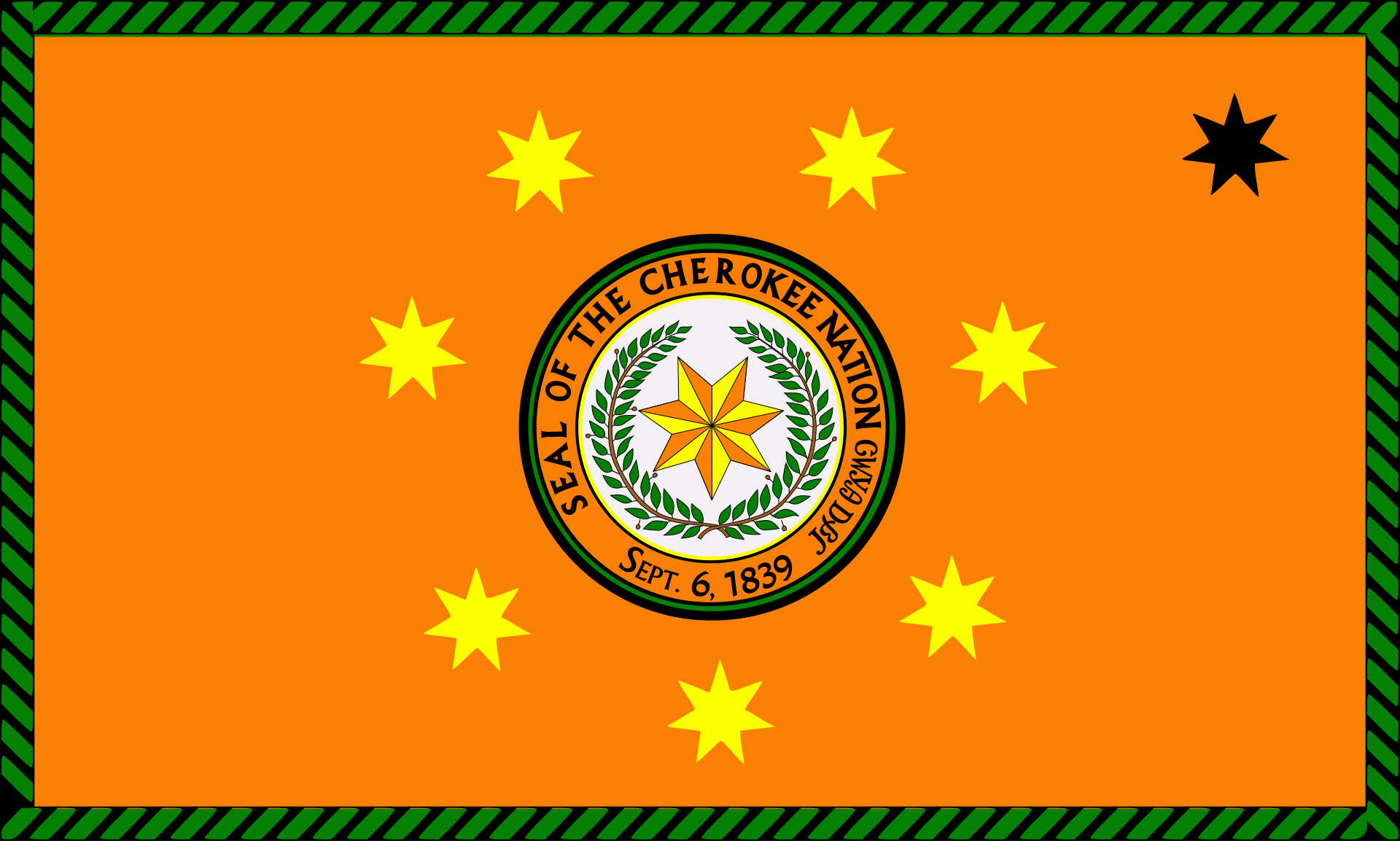
The flag commonly seen online as the “Cherokee flag” is usually the flag of the Cherokee Nation. It represents the government of the Cherokee Nation rather than all Cherokee people or the other federally recognized Cherokee tribes.
The Cherokee Nation seal was established in 1869. It contains a seven-pointed star surrounded by oak leaves. The seven points represent the seven traditional Cherokee clans, while the oak leaves are associated with the enduring sacred fire of the Cherokee people.
The date September 6, 1839, appears on the seal. It commemorates the Cherokee Nation’s constitution following removal to Indian Territory and the Act of Union that reunited different Cherokee political groups.
The Cherokee Nation flag includes the seal and seven stars representing the seven clans. An additional black star commemorates Cherokee people who died as a result of the Trail of Tears.
The Cherokee Syllabary
The Cherokee syllabary is another widely recognized symbol of Cherokee identity. It is a writing system created specifically for the Cherokee language.
The syllabary appears in books, newspapers, schools, public buildings, road signs, digital technology, artwork, and official documents. Its continued use connects language preservation with contemporary Cherokee life.
The Cherokee Language
The Cherokee language, ᏣᎳᎩ (Tsalagi), belongs to the Southern branch of the Iroquoian language family.
It differs greatly from English in its sound system and grammatical structure. Cherokee is a tonal language, meaning that differences in pitch can help distinguish meaning.
Cherokee verbs can contain several prefixes and suffixes. Information that might require an entire phrase or sentence in English can sometimes be expressed within a single Cherokee verb.
There are regional differences between the Cherokee spoken in Oklahoma and the varieties spoken in North Carolina. Pronunciation, vocabulary, and writing conventions may therefore vary between communities and educational materials.
Sequoyah and the Syllabary
Sequoyah developed the Cherokee syllabary around 1821. Unlike an alphabet, in which letters usually represent individual sounds, most Cherokee characters represent complete syllables.
The modern syllabary contains 85 characters. Its creation allowed Cherokee speakers to read and write their own language without replacing it with English.
The syllabary was adapted for printing and appeared in the Cherokee Phoenix beginning in 1828. Today, Cherokee characters can be used on computers, smartphones, and other digital devices.
Language Revitalization
The number of people who learned Cherokee as their first language has declined significantly. The Cherokee Nation estimates that approximately 2,000 first-language speakers remain.
The three Cherokee tribes and their communities support language revitalization through immersion schools, community classes, online lessons, master-apprentice programs, teaching materials, dictionaries, translation work, and language technology.
Children and adults are learning Cherokee, while fluent speakers, teachers, and families continue working to pass the language to future generations.
Basic Cherokee Words
| Cherokee | Romanization | English |
| ᎣᏏᏲ | Osiyo | Hello |
|---|---|---|
| ᏩᏙ | Wado | Thank you |
| ᏣᎳᎩ | Tsalagi | Cherokee / Cherokee language |
Romanized spellings are useful for beginners, but they cannot represent every feature of Cherokee pronunciation. Spellings and pronunciation may also differ between regional varieties.
Traditional Sports and Games
Stickball
Stickball is one of the best-known Cherokee sports. It is a living cultural tradition that continues to be played, particularly in Cherokee communities in North Carolina and Oklahoma.
Players use one or two sticks, usually made from hickory, with a small scoop formed from leather or sinew webbing. The ball is carried, passed, or thrown toward a goal according to locally agreed rules.
Historically, stickball could serve social, political, and diplomatic purposes. It was sometimes used to settle disputes without warfare, which led to descriptions such as “the Little Brother of War.”
The rules can vary between communities and even between individual games. Modern stickball remains an important expression of community identity, physical skill, cooperation, and cultural continuity.
Cherokee Marbles
Cherokee marbles is traditionally played with large, rounded stone balls. Players attempt to move their marbles through a series of holes in the ground while also using strategy to block or displace their opponents’ marbles.
The game is still played at some Cherokee cultural events and competitions.
Chunkey
Chunkey is played with a polished stone disc and long wooden poles. One player rolls the stone across a prepared field, and players throw their poles toward the place where they expect the stone to stop.
Points are awarded according to how close the poles land to the stone.
Atlatl Competitions
An atlatl is a tool used to throw a spear or dart with greater speed and distance. It predates the bow and arrow in North America.
Although it was originally connected with hunting, atlatl throwing is also practiced as a demonstration and accuracy competition at cultural and educational events.
Introduction video
The Cherokee Today
Cherokee history includes displacement, land loss, and efforts to suppress Cherokee government and culture. It is also a history of survival, rebuilding, creativity, and political continuity.
Today, Cherokee people maintain sovereign governments, create contemporary art, teach their language, operate schools and cultural institutions, protect natural resources, and strengthen connections between generations.
Cherokee culture belongs not only to history. It remains part of everyday life and continues to grow through the work of Cherokee people and communities.
Sources (International Databases)
Cherokee Nation Cherokee Nation History Cherokee Nation Culture Cherokee Nation Language Department Eastern Band of Cherokee Indians United Keetoowah Band National Park Service