Overview
The Inuit are Indigenous peoples whose homelands extend across the Arctic regions of Alaska, northern Canada, Greenland, and parts of Chukotka in the Russian Far East.
They are not a single nation or a culturally uniform group. Inuit communities have different regional identities, histories, languages, and traditions shaped by the environments in which they live.
In many Inuit languages, Inuit means “people.” The singular form is Inuk, meaning one person, while Inuuk may be used for two people in some language varieties.
For generations, Inuit developed extensive knowledge of sea ice, weather, wildlife, navigation, clothing, food preparation, and travel. This knowledge made it possible to build communities in one of the coldest and most environmentally demanding regions of the world.
Today, Inuit live in modern towns, villages, and cities. Traditional knowledge, land-based activities, Indigenous languages, contemporary education, technology, art, and political leadership all form part of present-day Inuit life.
Homeland and Regional Communities
The wider Inuit homeland is sometimes called Inuit Nunaat. It stretches across several modern countries and includes land, coastal waters, and sea ice.
Alaska
Iñupiat communities are located mainly in northern and northwestern Alaska, including areas along the Arctic Ocean and the Bering Strait.
Alaska is also home to Yup’ik, Cup’ik, Cup’ig, and Siberian Yupik peoples. Their languages and cultures are historically related to those of Inuit, but they have their own identities and should not automatically be described simply as Inuit.
Canada
The Inuit homeland in Canada is known as Inuit Nunangat. The term includes not only land but also water and sea ice, all of which are essential to Inuit culture and community life.
Inuit Nunangat consists of four regions:
- The Inuvialuit Settlement Region in the Northwest Territories
- Nunavut
- Nunavik in northern Quebec
- Nunatsiavut in northern Labrador
Many Inuit also live outside these regions, including in cities such as Ottawa, Montreal, Edmonton, and Winnipeg.
Greenland
Greenland is known in Greenlandic as Kalaallit Nunaat, meaning “Land of the Kalaallit.”
Kalaallit is commonly used for the Inuit people of Greenland, particularly in western Greenland. Regional identities also include the Tunumiit of eastern Greenland and the Inughuit of the far north.
Greenlandic culture, language, and society are strongly shaped by Inuit heritage, while contemporary Greenland also has its own political and national identity.
Chukotka
Indigenous Yupik communities live along the coast of the Chukotka Peninsula in the Russian Far East.
Chukotka is included within the circumpolar region represented by the Inuit Circumpolar Council. However, local names and identities, particularly Yupik identities, should be respected rather than replaced with a single general label.
Names and Terminology
Inuit is already a plural word. Therefore, “the Inuit” or “Inuit people” is normally used in English, while an individual person may be called an Inuk.
The word Inuit should not be confused with Innu. The Innu are a distinct First Nations people whose traditional homeland is located in parts of Quebec and Labrador.
In the past, Inuit, Iñupiat, Yupik, and several other northern peoples were often grouped together under the word “Eskimo.”
This term was applied broadly by outsiders and is now considered unacceptable or inappropriate by many Indigenous people. Today, names used by the people themselves—such as Inuit, Iñupiat, Yup’ik, Kalaallit, Inuvialuit, and Inughuit—are generally preferred.
The older term may still appear in historical documents, academic terminology, legal names, or the names of long-established organizations, particularly in Alaska and Russia. However, it should not be used casually as a general name for all Arctic Indigenous peoples.
History and Roots
People have lived in Arctic and Subarctic regions for thousands of years.
Before the expansion of the direct ancestors of modern Inuit, several earlier Paleo-Inuit cultures existed across parts of Arctic North America. Archaeologists have used names such as Pre-Dorset and Dorset to describe some of these cultures.
Inuit oral histories also describe earlier inhabitants known in some regions as the Tuniit. Archaeological categories and oral traditions do not always describe the past in exactly the same way, so they should not automatically be treated as identical.
The direct ancestors of modern Inuit are commonly associated by archaeologists with what is known as the Thule tradition.
The Thule tradition developed around the Bering Strait region and expanded eastward across the Canadian Arctic beginning around the 11th century. Within several centuries, Thule communities had reached Greenland.
These communities developed sophisticated tools and technologies for hunting marine mammals, fishing, travelling across sea ice, and surviving seasonal changes. Boats, harpoons, dog teams, insulated clothing, and carefully designed dwellings formed part of this adaptation.
Contact with Europeans occurred at different times in different regions. Norse settlers encountered Inuit ancestors in Greenland and the eastern Canadian Arctic, while later contact involved explorers, commercial whalers, fur traders, missionaries, and colonial governments.
European diseases, commercial expansion, missionary activities, and colonial policies brought major changes to many Inuit communities.
During the 19th and 20th centuries, governments increasingly attempted to control Inuit education, settlement, movement, healthcare, and economic life. In Canada, some Inuit families were forcibly relocated, while many children were separated from their families through residential and federal hostel schools. People receiving tuberculosis treatment were sometimes sent far south for long periods, and some never returned home.
The movement from seasonal camps into permanent settlements also occurred rapidly in many regions. These changes disrupted family relationships, local knowledge systems, language transmission, and connections to traditional lands.
Despite these experiences, Inuit maintained their identities and built organizations dedicated to land rights, language, culture, and self-determination.
The Inuit Circumpolar Council was founded in 1977 to connect Inuit representatives from Alaska, Canada, Greenland, and Chukotka.
In Canada, modern land agreements established Inuit rights in the Inuvialuit Settlement Region, Nunavut, Nunavik, and Nunatsiavut. The territory of Nunavut was officially created in 1999.
Greenland received Home Rule in 1979 and expanded self-government in 2009. These developments reflect continuing Inuit leadership and efforts to shape political, cultural, and economic futures.
Culture and Everyday Life
Inuit cultures were shaped through close relationships with the land, coastal waters, sea ice, animals, and changing Arctic seasons.
Hunting and fishing traditionally provided food and materials for clothing, tools, boats, shelters, and other essential objects. Depending on the region and season, communities harvested animals such as seals, walrus, whales, caribou, fish, birds, and other local species.
Food sharing remains an important practice in many communities. Harvested food, often called country food in Canada, connects families and communities with the land and with knowledge passed between generations.
Houses and Shelters
The word iglu does not refer only to a snow house. In several Inuit languages, it can mean a house, home, or building more generally.
Snow houses were used in certain regions and circumstances, particularly as temporary winter shelters. In some Canadian Inuit language varieties, a snow house may be described more precisely as an igluvigaq.
Inuit also constructed homes using materials such as stone, earth, sod, driftwood, animal skins, and whalebone. Housing forms differed according to region, available resources, season, and purpose.
Transportation
The qajaq—known internationally through the English spelling kayak—is a narrow, covered boat traditionally designed for an individual hunter.
Larger open skin boats, often known as umiat or umiaq, could carry several people, equipment, and supplies.
On land and sea ice, Inuit travelled using dog teams and sleds known in some regions as qamutiik or qamutik. Snowmobiles, motorboats, aircraft, and modern navigation equipment are widely used today, often alongside traditional knowledge of weather, ice, currents, and animal behaviour.
Clothing and Sewing
Inuit clothing was carefully designed to retain heat while allowing movement in Arctic conditions.
Caribou and sealskin were commonly used, although materials and designs varied by region. Clothing could include parkas, trousers, mittens, and waterproof boots called kamiit in some Inuit languages.
The amauti is a type of women’s parka with a specially designed pouch that allows a baby to be carried against the wearer’s back. Amauti designs vary between regions and may communicate family, community, or individual identity.
Sewing is not simply decorative work. The ability to prepare skins and produce durable, well-fitted clothing has historically been essential for safety and survival.
The Qulliq
The qulliq is a traditional stone lamp that was generally fuelled with animal oil and fitted with a wick made from plant material.
It provided light and warmth and could also be used during food preparation. The qulliq was traditionally maintained largely by women and held an important place within the home.
The qulliq is also a symbol of light, warmth, food, family, and community.
In Nunavut’s coat of arms, the qulliq represents light and the warmth of family and community.
Today, the lighting of a qulliq may be included in public gatherings, cultural teaching, and important community events.
Art, Music, and Oral Tradition
Inuit cultural expression includes storytelling, drum dancing, songs, carving, sewing, printmaking, drawing, sculpture, film, literature, and contemporary music.
Throat singing traditions are found in some regions, particularly among women in parts of Canada. In Nunavik, one form is known as katajjaq. Names, performance styles, and meanings differ between communities.
Stories and oral histories preserve knowledge about ancestors, animals, travel, landscapes, relationships, humour, and historical events.
Contemporary Inuit artists continue to develop new forms of expression through film, photography, fashion, digital media, popular music, and international art exhibitions.
Flags and Symbols
There is no single official flag representing every Inuit person or community across the Arctic.
Nunavut, Greenland, Nunatsiavut, and other Inuit regions have their own flags and official symbols. The Inuit Circumpolar Council also has its own emblem as an international Indigenous organization.
These flags and emblems represent specific governments, territories, regions, or organizations. They should not automatically be presented as a universal “Inuit flag.”
The Flag of Nunavut
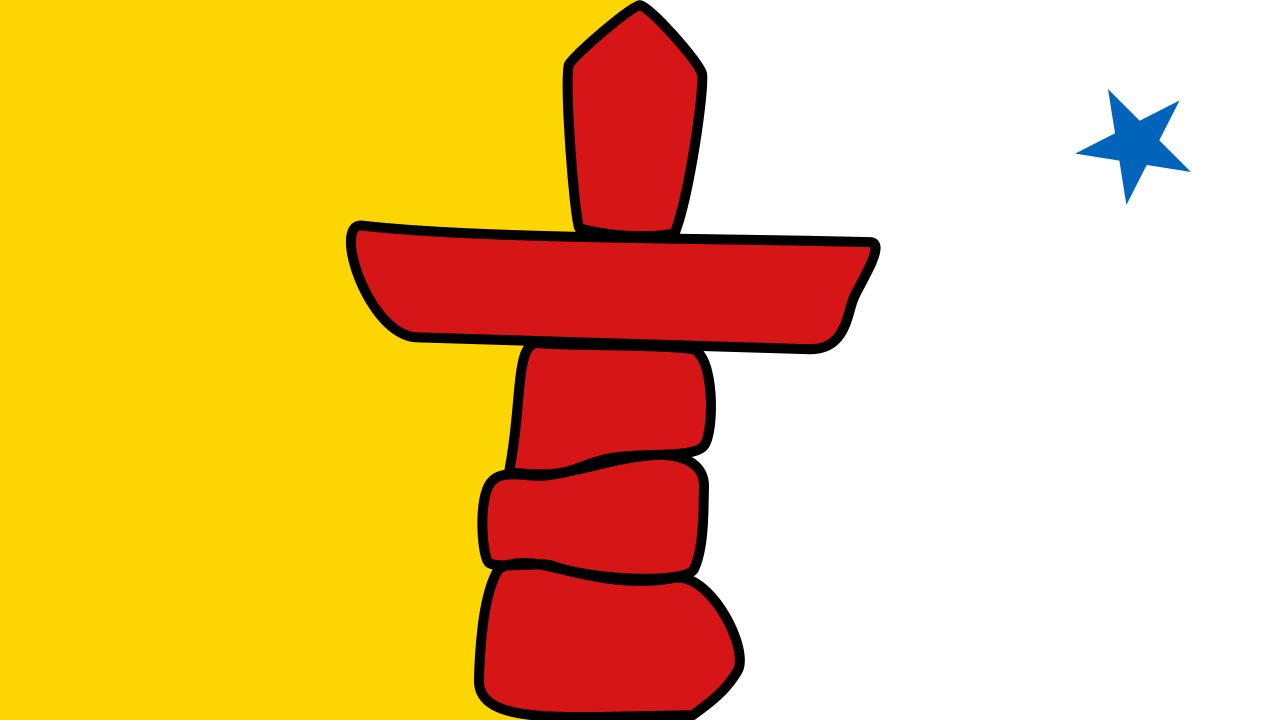
The flag of Nunavut was officially adopted when the territory was created on April 1, 1999.
At its centre is a red inuksuk. A blue North Star, known as Niqirtsuituq, appears beside it. The star represents traditional navigation and the leadership of community elders.
The Nunavut flag represents the Canadian territory of Nunavut. It should not be described as the common flag of all Inuit communities.
The Flag of Nunavut
Inuksuk
An inuksuk is a stone structure created for a particular purpose. Inuksuit, the plural form, have been used as landmarks, navigation guides, hunting aids, warnings, and markers of important places.
Not every inuksuk has a human shape.
A human-shaped stone figure is more precisely called an inunnguaq in many Inuit contexts. The distinction is important because the internationally familiar human-shaped figure represents only one type of stone structure.
Other Cultural Symbols
The qajaq, qulliq, ulu, dog sled, and carefully sewn Arctic clothing have all become widely recognized symbols of Inuit knowledge and culture.
However, their forms and meanings vary between regions. They should be shown as living cultural objects rather than as decorations belonging only to the distant past.
Language
Inuit languages belong to a larger language family that is commonly called Inuit–Yupik–Unangan. The older academic name “Eskimo–Aleut” can still be found in historical linguistic publications.
The Inuit branch forms a broad language continuum extending from Alaska through northern Canada to Greenland.
Major regional languages and language groups include:
- Iñupiaq in northern Alaska
- Inuvialuktun in the western Canadian Arctic
- Inuinnaqtun in parts of the western Canadian Arctic
- Inuktitut across much of Nunavut and Nunavik
- Inuttitut in Nunatsiavut
- Kalaallisut, the official language of Greenland
- Tunumiisut in eastern Greenland
- Inuktun or Avanersuarmiutut in northern Greenland
These names do not represent a single standardized language used in exactly the same way across the Arctic. Pronunciation, vocabulary, grammar, spelling, and writing systems differ by region.
Inuktut is used in Canada as a broad term that includes several Inuit language varieties, including Inuktitut, Inuinnaqtun, and Inuvialuktun. It should not automatically be used as the name of every Inuit language outside Canada.
Many Inuit languages are polysynthetic. This means that several units of meaning can be combined within one word. A single Inuit word may therefore express an idea that requires an entire phrase or sentence in English.
This structure does not mean that Inuit languages have “countless words for snow.” Their vocabulary reflects detailed knowledge of local environments in the same way that specialized vocabulary develops in other languages.
Writing systems also vary. The Roman alphabet is used in Alaska, Greenland, and many parts of Canada. Inuktitut syllabics are widely used in parts of Nunavut and Nunavik.
The strength of Inuit languages differs considerably between regions. Kalaallisut remains widely spoken in Greenland, while Inuktitut is strong in several Canadian communities. Other regional varieties have fewer speakers and face a greater risk of language loss.
Language education, immersion programs, community classes, broadcasting, literature, music, dictionaries, and digital technology are being used to support language transmission to younger generations.
Traditional Games
Traditional Inuit games provided recreation while also developing strength, balance, endurance, coordination, concentration, and cooperation.
Many could be played indoors or within a relatively small space during the long Arctic winter. Some games practised physical abilities that were useful for hunting, travelling, and working in demanding conditions.
Names and rules differ between regions, so no single list represents every Inuit community.
One-Foot High Kick
In the one-foot high kick, a participant jumps and kicks a suspended target with one foot before landing with control.
The target is gradually raised, requiring flexibility, balance, strength, and coordination.
Two-Foot High Kick
In the two-foot high kick, the participant jumps, touches a suspended target with both feet, and lands without falling.
The game requires explosive strength and precise body control.
Knuckle Hop
In the knuckle hop, participants move forward while supporting their body on their knuckles and toes.
This physically demanding game tests endurance, upper-body strength, and determination.
Arm Pull and Inuit Stick Pull
Arm-pull and stick-pull games test grip strength, balance, and controlled power between two competitors.
Rules and names vary, and similar forms are found across several northern communities.
Ajagaq
Ajagaq is a cup-and-pin or bone-and-pin game. A carved piece of bone with one or more holes is attached by a cord to a pointed handle.
The player tosses the bone and attempts to catch it on the point. The game requires patience, timing, and hand-eye coordination.
String Figures
String figures are created by arranging a loop of string around the fingers and hands.
They may represent animals, tools, landscapes, or other familiar subjects. In some communities, string figures are connected with stories, seasonal practices, teaching, and social interaction.
Arsaq
Arsaq is a traditional ball or kickball game known in parts of the Inuit world.
Forms of the game varied between communities and could involve teams playing on snow or ice during winter.
Traditional games continue to be practised at schools, cultural programs, community events, and sporting competitions such as the Arctic Winter Games.
Introduction video
Inuit Life Today
Inuit are contemporary Indigenous peoples—not a population belonging only to Arctic history.
Today, Inuit work in government, education, healthcare, business, science, law, the arts, media, tourism, environmental research, and many other fields.
Modern equipment such as snowmobiles, motorboats, rifles, GPS devices, smartphones, and satellite communication may be used alongside knowledge of weather, wildlife, sea ice, and traditional routes.
Many Inuit continue to hunt, fish, sew, share country food, speak Inuit languages, create art, and teach younger generations about the land. Others live partly or permanently in southern cities while maintaining connections with their families and home communities.
Inuit communities also face serious challenges, including housing shortages, high food costs, limited infrastructure, language loss in some regions, and the continuing effects of colonial policies.
Climate change is altering sea-ice conditions, coastlines, wildlife movement, and travel routes across the Arctic. Inuit knowledge and community-led research are therefore increasingly important to environmental monitoring and decision-making.
Across the Arctic, Inuit organizations, governments, educators, artists, elders, and young people continue to protect their languages, strengthen their communities, and shape their own futures.
Inuit culture is not frozen in the past. It is living, diverse, adaptive, and continually developing.
Sources (International Databases)
Confirmation materials:Inuit Circumpolar Council
Confirmation materials:Inuit Tapiriit Kanatami「Maps of Inuit Nunangat」
Confirmation materials:Statistics Canada「2021 Census」
Confirmation materials:Alaska Native Language Center「Inuit or Eskimo: Which Name to Use?」
Confirmation materials:Parks Canada「Sirmilik National Park – History」
Confirmation materials:Qikiqtani Inuit Association「Qikiqtani Truth Commission」
Confirmation materials:Inuit Circumpolar Council「Fun Facts」
Confirmation materials:WAG-Qaumajuq「Contemporary Inuit Art」
Confirmation materials:Alaska Native Language Archive「Inuit–Yupik–Unangan」
Confirmation materials:Inuit Tapiriit Kanatami「Inuktut Language Initiatives」
Confirmation materials:Alaska Native Language Center「Inuit Snow Terms」
Confirmation materials:Smithsonian Institution「Ajagaq」
Confirmation materials:Inuvialuit Regional Corporation「Inuvialuit Games」
Confirmation materials:Avataq Cultural Institute「Katajjaq」
Confirmation materials:Inuit Tapiriit Kanatami「National Inuit Climate Change Strategy」