Overview
The CHamoru are the Indigenous people of the Mariana Islands, an archipelago located in the Micronesian region of the western Pacific Ocean.
Their principal homelands are Guam, known in the CHamoru language as Guåhan, and the Northern Mariana Islands, which include Saipan, Tinian, Rota, and other islands. Today, CHamoru communities can also be found in Hawaiʻi, California, Washington State, other parts of the United States, and around the world.
CHamoru history began long before the arrival of Europeans. Archaeological evidence shows that some of the earliest known settlements in the Mariana Islands date to approximately 1500 BCE.
Ancient CHamoru society developed extensive knowledge of open-ocean navigation, fishing, agriculture, pottery, weaving, and stone-supported architecture. Latte stones, which supported houses and other buildings, and fast outrigger canoes are among the best-known features of CHamoru heritage.
The Mariana Islands later experienced colonial rule and warfare involving Spain, Germany, Japan, and the United States. Despite these major historical changes, CHamoru people continued to pass down their relationships with family, land, language, food, music, and seafaring knowledge.
The CHamoru are not a people who have simply preserved an ancient culture without change. They live within modern societies while rediscovering, adapting, and transmitting their traditions to new generations.
Location
The Mariana Islands, the homeland of the CHamoru people, form a chain of islands extending from north to south across the western Pacific Ocean.
The islands are geographically part of Micronesia, although the CHamoru language has linguistic features that distinguish it from many of the neighboring Micronesian languages.
Guam — Guåhan
Guam is the southernmost island in the Mariana archipelago. In the CHamoru language, it is known as Guåhan.
Guam is currently an unincorporated territory of the United States. However, the CHamoru are the Indigenous people of the island and have lived there since long before the beginning of American rule.
Guam is also home to people with Filipino, other Pacific Islander, Asian, European, and many other backgrounds. Therefore, being a resident of Guam and being ethnically CHamoru do not mean the same thing.
The Northern Mariana Islands
The Northern Mariana Islands include Saipan, Tinian, Rota, and several other islands.
CHamoru people also live on these islands. The CHamoru communities of Guam and the Northern Mariana Islands share a connected history, language, and culture. However, differences in colonial rule and education produced regional variations in pronunciation, spelling, customs, and historical experience.
The Northern Mariana Islands are also home to the Refaluwasch and other people with roots in the Caroline Islands. The Refaluwasch are a distinct Indigenous people and should not be identified as CHamoru.
Both CHamoru and Refaluwasch communities have helped shape the history and culture of the Northern Mariana Islands, but they have their own languages, seafaring traditions, genealogies, and identities.
Communities Beyond the Islands
After World War II, many CHamoru people moved to Hawaiʻi and the continental United States for education, employment, military service, and family reasons.
Large CHamoru communities now exist beyond the Mariana Islands. Cultural organizations, dance groups, language classes, family gatherings, food, and music help maintain connections between CHamoru people living across different regions.
Names and Terminology
In Guam, “CHamoru” is now widely used as the official spelling for both the Indigenous people and their language.
In CHamoru orthography, the capital letters C and H form the single unit “CH.” Following legislation enacted in Guam in 2017 and subsequent work by the CHamoru language commission, the spelling “CHamoru” has been adopted by government agencies and educational institutions.
In the Northern Mariana Islands, however, the spelling “Chamorro” remains in official use. Chamorro is also widely found in English-language books, museums, census records, historical documents, and academic publications.
Therefore, CHamoru and Chamorro should not be treated as if one spelling is incorrect in every region.
Naming note:
Linglobe uses “CHamoru People” as the page title, following the spelling officially used in Guam. The spelling “Chamorro” remains in official use in the Northern Mariana Islands and is also widely found in historical sources.
Another expression associated with the CHamoru people is taotao tåno’, which can be translated as “people of the land.” This expression reflects the deep relationship between CHamoru genealogy, land, and cultural identity.
History and Roots
The First Voyages to the Mariana Islands
Some of the earliest known archaeological sites in the Mariana Islands date to approximately 1500 BCE.
The first settlers are believed to have crossed the open ocean from Island Southeast Asia using long-distance seafaring knowledge.
Linguistic, archaeological, and genetic studies have identified connections with regions that include the Philippine Islands. Research continues into the precise routes taken and whether the first settlement resulted from a single migration or multiple periods of migration and exchange.
Archaeologists refer to the earliest period of settlement as the Pre-Latte Era. Sites dating to this period have produced red-slipped pottery, shell tools and ornaments, and evidence of fishing and plant use.
The Latte Era
Beginning around 900 to 1000 CE, people in the Mariana Islands began constructing buildings supported by latte stones.
This period is known as the Latte Era and continued until sustained European colonization began during the 17th century.
A latte consists of a stone pillar topped by a rounded or bowl-shaped stone capital. Several latte stones were arranged in parallel rows to support houses or other wooden structures.
During this era, permanent communities developed in both coastal and inland areas. Land, farming areas, and fishing grounds were connected with family and clan relationships. Archaeological evidence and early historical accounts also indicate the existence of social distinctions within CHamoru society.
Contact with Europeans
In 1521, the expedition led by Ferdinand Magellan reached the Mariana Islands. This was one of the earliest encounters recorded in European documents, but it was not the beginning of CHamoru history.
Spain declared possession of the Mariana Islands in 1565. In 1668, a Catholic mission and a permanent Spanish colonial presence were established on Guam.
Conflicts over land, religion, the education of children, and changes to everyday life intensified. Armed conflict between CHamoru communities and Spanish forces continued from approximately 1668 until 1695.
During this period, warfare was accompanied by infectious diseases introduced from outside the islands, disruption to food production, and forced relocation. Together, these factors caused a severe decline in the CHamoru population.
Many people from the northern islands were relocated to Guam and Rota under the Spanish policy known as reducción. This displacement profoundly affected relationships with ancestral lands, settlements, and genealogies.
Cultural Change Under Spanish Rule
Spanish rule continued until 1898.
During this period, Catholicism, Spanish-derived vocabulary and surnames, new foods, musical traditions, and religious festivals became part of CHamoru society. Contact with people from other parts of the Spanish Empire, including the Philippines and Mexico, also influenced CHamoru culture.
However, CHamoru culture was not simply replaced by Spanish culture. CHamoru people incorporated outside institutions and practices while maintaining family relationships, connections to land, systems of mutual support, and their language in their own ways.
The Partition of the Mariana Islands
Following the Spanish-American War in 1898, Spain ceded Guam to the United States.
In 1899, Spain sold the Northern Mariana Islands to Germany. The Mariana Islands, whose people had shared a long history and cultural heritage, were consequently divided between Guam and the northern islands under separate colonial governments.
In 1914, during World War I, Japan took control of the German-administered Northern Mariana Islands. The islands later became part of a Japanese mandate, and large-scale development centered on sugar production took place on Saipan and Tinian.
World War II
In December 1941, Japanese forces occupied Guam, which had been under American administration.
CHamoru residents of Guam experienced movement restrictions, food shortages, forced labor, internment, and violence. The Japanese occupation lasted for approximately two years and seven months, until American forces retook the island in July 1944.
Japanese administration had already existed in the Northern Mariana Islands since 1914. In 1944, however, major battles on Saipan, Tinian, and other islands caused extensive civilian suffering.
Although they belonged to the same Indigenous people, CHamoru communities in Guam and the Northern Mariana Islands experienced different systems of government and different wartime conditions.
From the Postwar Period to the Present
Following World War II, Guam returned to American administration. The Organic Act of Guam, enacted in 1950, established a civilian government and granted United States citizenship to the people of Guam.
The Northern Mariana Islands passed through the United Nations Trust Territory system and later became a Commonwealth in political union with the United States.
Guam and the Northern Mariana Islands now have different governments and legal systems. Nevertheless, family relationships and inter-island connections continue through language, music, food, and cultural events.
Culture
Family and Mutual Support
In CHamoru culture, family is deeply connected not only to personal life but also to land, social responsibilities, and cultural identity.
Extended families—including grandparents, aunts, uncles, cousins, and other relatives—continue to play an important role.
Ancient CHamoru society is believed to have included strong matrilineal elements in genealogy and the inheritance of land. Family structures changed over time, but mothers, grandmothers, and elders may still hold significant responsibilities within families and communities.
One of the important concepts in CHamoru culture is inafa’maolek.
It refers to respecting and helping one another while maintaining harmony within the family and community. It means more than simply getting along with other people. It also involves considering how an individual’s actions affect the wider family and community.
Chenchule’ is a system of mutual support through which families provide money, food, labor, or other forms of assistance during weddings, funerals, illnesses, and family events. A family that receives support is generally expected to help another family when a future need arises.
Elders are known as manåmko’, and their knowledge and experience are highly valued.
The Sea and Navigation
The Mariana Islands are surrounded by a vast ocean, and CHamoru ancestors developed sophisticated knowledge of navigation and canoe building.
CHamoru sailing canoes are generally known as proas. A proa featured an outrigger and a triangular sail. Its design allowed sailors to change direction by reversing the working bow and stern rather than turning the entire canoe around.
Early European accounts described CHamoru canoes as exceptionally fast. Because they appeared to fly across the surface of the water, they later became known as “Flying Proas.”
Sakman is a CHamoru term for a large voyaging canoe.
The knowledge required to construct large traditional canoes gradually declined following Spanish colonization. Today, however, communities in Guam, the Northern Mariana Islands, and the CHamoru diaspora are working to revive canoe building and seafaring traditions.
Latte Stones and Houses
Latte stones are among the most recognizable forms of CHamoru architectural heritage.
A latte consists of a supporting pillar called a haligi and a bowl-shaped stone capital called a tåsa. Several of these structures were arranged in rows to support buildings made from wood and plant materials.
Latte stones were not freestanding statues or simply grave markers. Their primary function was to support houses and other buildings. Archaeologists have found evidence of homes, pottery, tools, food remains, and burials around latte sites.
Today, latte stones symbolize ancestry, land, and cultural continuity. Their form appears in public buildings, monuments, logos, and works of art throughout Guam and the Northern Mariana Islands.
Fishing, Farming, and Food Culture
Ancient CHamoru communities combined coastal fishing, open-ocean fishing, shellfish gathering, and agriculture.
Taro, yams, breadfruit, coconuts, bananas, and rice were used as food, while fish and shellfish were also essential parts of the diet.
Contemporary CHamoru cuisine combines ingredients used in the Mariana Islands since ancient times with foods and cooking techniques introduced through contact with Spain, Mexico, the Philippines, Japan, and the United States.
Kelaguen, made with meat or seafood, citrus, coconut, and seasonings; red rice colored with achiote; and dishes prepared with soy sauce and vinegar are commonly served at family gatherings and fiestas.
Preparing and sharing food with family members and guests is also connected with the values of inafa’maolek and chenchule’.
Weaving and Handcrafts
Weaving coconut and pandanus leaves was an essential part of everyday CHamoru life.
Leaves were used to produce baskets, mats, hats, fans, bags, roofing materials, and containers for wrapping food. Plant fibers were also used to make ropes, fishing equipment, and nets.
Modern manufactured products have replaced some of these practical objects. However, weaving continues through cultural education, art, community events, tourism, and teaching within families.
Music, Songs, and Stories
CHamoru culture has a strong tradition of transmitting knowledge through stories, legends, songs, poetry, and dance.
Kantan Chamorita is a form of call-and-response singing in which performers improvise lyrics. Singers respond to one another with wit and humor, creating a conversation or friendly competition through song.
Depending on the historical period, Kantan Chamorita has been performed during work, weddings, family gatherings, festivals, and other community occasions.
Contemporary CHamoru music includes traditional singing as well as music influenced by Spanish traditions, country, rock, reggae, and popular music. Songs performed in the CHamoru language have also become an important way of transmitting the language and culture to younger generations.
Flag and Symbols
There is no single universally recognized official flag representing all CHamoru people.
Guam and the Northern Mariana Islands each have their own official flags. However, these flags represent territorial governments and political jurisdictions rather than every CHamoru community.
The Flag and Seal of Guam
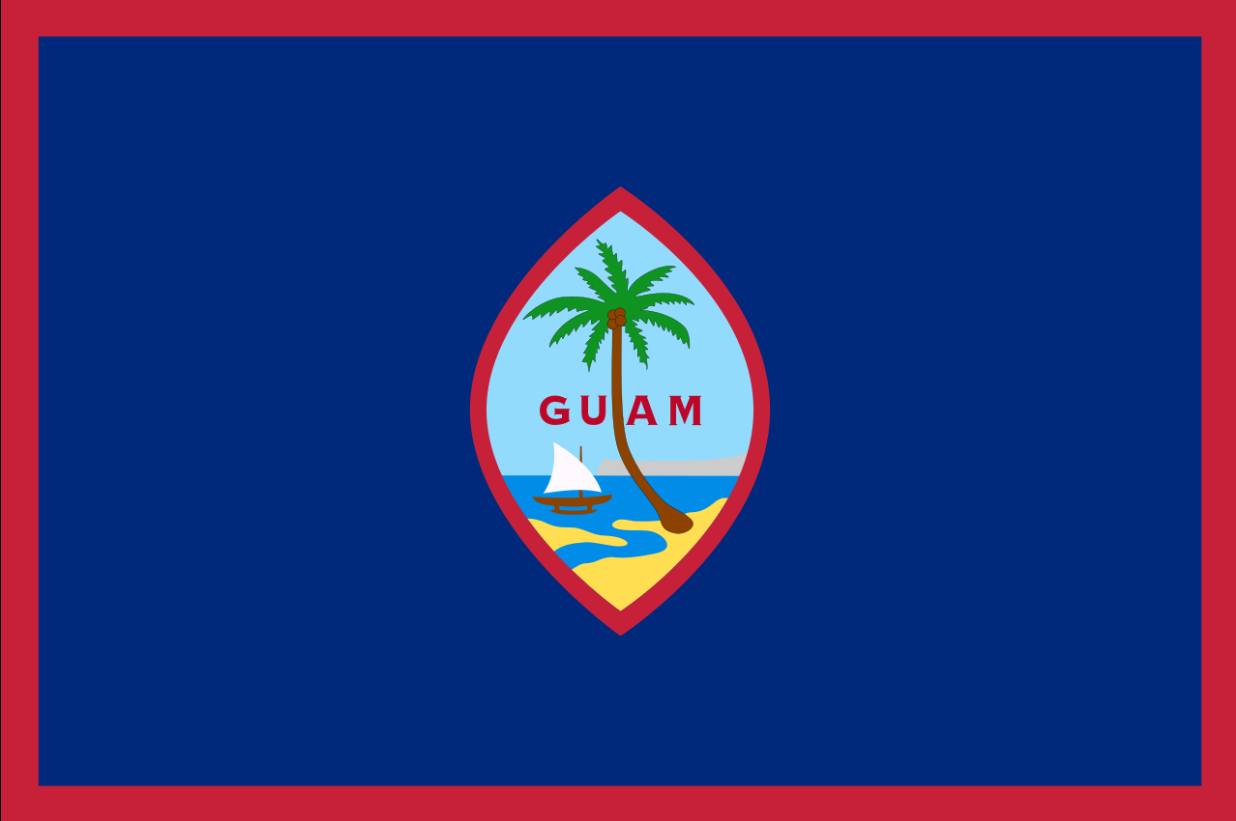
The official seal of Guam appears at the center of the Guam flag.
The pointed oval outline of the seal represents the åcho’ atupat, a double-pointed slingstone used by ancient CHamoru people.
Inside the seal are the sea and the landscape surrounding Hagåtña Bay, a coconut tree, and a sailing proa.
The coconut tree represents island life and natural resources, while the proa symbolizes CHamoru seafaring knowledge and the people’s relationship with the ocean.
If the Guam flag is displayed on Linglobe, it should be identified as the “Flag of Guam” and not as the shared flag of all CHamoru people.
The flag of Rapa Nui, known as Te Reva Reimiro
Reference: Pontifical Catholic University of Chile Heritage Archive – Reimiro
Latte Stones
Latte stones symbolize CHamoru ancestors, architecture, land, and cultural continuity.
Archaeological remains of latte structures have been found across the Mariana Islands, including Guam, Saipan, Tinian, and Rota.
Slingstones
The åcho’ atupat is a double-pointed slingstone. These stones were made from limestone, basalt, or fire-hardened clay and were thrown using slings made from plant fibers.
In ancient times, they were associated with hunting and warfare and were also used during resistance against Spanish forces.
Today, the shape of the slingstone appears in the Guam seal and has become a symbol of CHamoru history and culture.
Proas and Sakman
Proas and sakman symbolize open-ocean navigation, canoe-building knowledge, and connections between islands.
Modern canoe revival projects involve more than reconstructing old vessels. They also preserve CHamoru terminology for canoe components, environmental knowledge, cooperative work, and the intergenerational transmission of skills.
Language
The CHamoru language belongs to the Malayo-Polynesian branch of the Austronesian language family.
Although the Mariana Islands are geographically located in Micronesia, CHamoru cannot simply be classified as one of the Micronesian languages commonly spoken in the surrounding region.
Linguistic research has identified ancient connections with languages of the Philippines and Island Southeast Asia. CHamoru has also incorporated vocabulary from Spanish, Philippine languages, Japanese, and English through centuries of contact and colonial rule.
CHamoru contains many words derived from Spanish, but its fundamental grammatical structure retains Austronesian features. It is therefore inaccurate to describe CHamoru as a dialect of Spanish or simply as a Spanish-based creole.
Official-Language Status
In Guam, CHamoru and English are used as official languages.
In the Northern Mariana Islands, Chamorro, Carolinian, and English are official languages.
Actual language use varies between regions and generations. CHamoru remains widely used in some families and communities, while many younger people now speak English as their first language.
Writing and Orthography
CHamoru is now written using the Latin alphabet.
The Guam orthography uses characters and marks such as å, ñ, and the glottal-stop symbol ’ to represent CHamoru pronunciation.
CHamoru was historically maintained through a strong oral tradition. Written records using the Latin alphabet began during Spanish rule, and different spelling systems later developed across the Mariana Islands.
Guam and the Northern Mariana Islands now use different official orthographies. As a result, the same word may be spelled differently depending on the region.
Language Suppression and Revitalization
During the early 20th century under American administration, English became the principal language of government and education in Guam. There were also periods when the use of CHamoru was restricted in schools.
These policies, together with postwar social changes, weakened the intergenerational transmission of CHamoru in Guam. English use also expanded in the Northern Mariana Islands as education and society changed after the war.
Today, language revitalization is being supported through school programs, dictionaries, standardized orthographies, language classes, music, radio, videos, and digital learning materials.
Basic Expressions
Håfa adai is a widely used greeting, particularly in Guam. Depending on the situation, it may be used in a way similar to “hello” or “welcome.”
Si Yu’os ma’åse’ is a common expression meaning “thank you.”
Spelling and pronunciation may vary by region, and materials from the Northern Mariana Islands may use different written forms.
Traditional Games and Competitions
Kai-kai
In CHamoru culture, the boundaries between play, competition, work, and practical skills have not always been clearly separated.
Activities connected with fishing, slinging, and improvised singing originally served practical or defensive purposes but may now be practised as cultural competitions or educational activities.
Åcho’ Atupat
The skill of throwing an åcho’ atupat was associated with hunting and warfare in ancient times.
A long, double-pointed stone was placed in a sling made from plant fiber, swung, and released toward a distant target.
Today, the skill has been revived as a sport in which participants compete for distance or accuracy under established safety rules. Groups from Guam and elsewhere in the Mariana Islands also participate in cultural events and international Indigenous sporting competitions.
Because the åcho’ atupat was historically a weapon, it is more appropriate to introduce it as a modern cultural sport based on a historical skill rather than as a children’s toy.
Chongka’
Chongka’ is a mancala-style board game played by placing shells, pebbles, seeds, or other small counters into a series of holes carved into a wooden board.
Players distribute the counters in a specified direction and attempt to collect as many as possible in their own store. The game requires counting, planning, and strategic decision-making.
Games related to Chongka’ are found across Southeast Asia, the Indian Ocean region, and the Pacific. Records of Chongka’ in Guam date to the early 20th century, and the game may have been introduced from another region at an earlier time.
It therefore cannot be identified with certainty as a game exclusive to ancient CHamoru society. However, it has been enjoyed within CHamoru families and communities for generations and is now regarded as part of CHamoru cultural life.
Talåya
Talåya is the CHamoru word for a circular cast net.
The net was originally a practical fishing tool. Throwing it so that it opens into a wide circle requires correct posture, timing, coordination, and control.
Today, cast-net throwing may also be practised as a cultural competition that preserves fishing knowledge while testing the accuracy and spread of the net.
Kantan Chamorita
Kantan Chamorita is not a physical sport, but it can take the form of a traditional competition through improvised words and songs.
A singer creates new lyrics in response to another performer. The exchange requires memory, vocabulary, humor, rhythm, and storytelling ability.
It is both a form of entertainment and an important expression through which the CHamoru language and oral culture are transmitted.
CHamoru People Today
The CHamoru are not a people who simply continue the lifestyles of the past.
Today, CHamoru people in Guam, the Northern Mariana Islands, the continental United States, and other regions work in education, government, healthcare, tourism, the arts, research, the military, business, digital media, and many other fields.
Their relationships with the CHamoru language also vary. Some primarily speak English, some use both CHamoru and English, and others begin learning or relearning CHamoru as adults.
Cultural revitalization includes CHamoru-language education, dictionaries and learning materials, preservation of latte sites, canoe building, navigation, sling competitions, weaving, traditional food, music, dance, and the recording of oral histories.
Cultural events associated with Mes CHamoru are held in Guam, particularly during March. Communities beyond the islands also organize cultural festivals, family gatherings, language classes, music, and dance activities.
Contemporary CHamoru culture includes elements inherited from the ancient Mariana Islands as well as influences that developed through contact with Spain, the Philippines, Mexico, Japan, the United States, and other Pacific Island communities.
Cultural change does not mean that CHamoru identity has disappeared.
CHamoru people have experienced centuries of colonial rule, war, the political partition of their islands, migration, and language change. Through family, land, language, mutual support, and cultural memory, they continue to carry their culture into the present.
Sources (International Databases)
guampedia.com
guamlegislature.gov
guam-seal-and-flag
chamorro-orthography
nps.gov
guammuseumfoundation.org