Overview
The Noongar are the Aboriginal people whose homeland is the southwest of Australia.
Noongar Country, often called Noongar Boodja, covers a large part of southwestern Western Australia. It includes the Perth metropolitan area, the Swan and Canning river systems, the Wheatbelt, the jarrah and karri forests, and the southern and southwestern coasts.
Noongar ancestors have lived on this land for at least 45,000 years.
Noongar society is not a single, uniform culture. Noongar people are commonly described as belonging to fourteen regional and language groups, each connected to particular lands, waterways, family networks, language varieties, stories, and cultural responsibilities.
Important Noongar concepts include boodja, meaning land or Country; moort, meaning family and kin; and kaartdijin, referring to knowledge, learning, and understanding.
Noongar culture includes the six-season calendar, hunting, fishing, plant gathering, cultural burning, toolmaking, stories, songs, dance, art, and the transmission of knowledge between generations.
British colonisation brought the loss of land, violent conflict, massacres, introduced diseases, restrictions on movement, the forced removal of children, and the suppression of Noongar languages and cultural practices.
Despite these experiences, Noongar culture did not disappear. Noongar people continue to maintain and renew their connections to Country, family, language, history, and community while participating in every part of contemporary Australian life.
Noongar Boodja
Noongar Boodja extends across the southwest of Western Australia.
Its boundaries are described differently according to the source and cultural context, but the region is generally understood to stretch from around Jurien Bay in the northwest, across parts of the inland Wheatbelt, and southward through the southwest coast and Albany region toward the area around Esperance.
This vast territory includes coastal plains, wetlands, rivers, granite outcrops, open woodlands, heathlands, inland farming districts, and jarrah, marri, tuart, wandoo, and karri forests.
Noongar people developed detailed knowledge of these different environments. The availability of water, plants, animals, fish, and other resources changed according to the place and season.
Country was therefore not used in the same way throughout the year. Families moved through known areas according to ecological conditions, cultural responsibilities, ceremonies, and relationships with other families.
The Fourteen Regional and Language Groups
Noongar society is commonly described as including fourteen regional and language groups:
- Amangu
- Yued or Yuat
- Whadjuk
- Bindjareb or Pindjarup
- Wardandi or Wadandi
- Ballardong
- Nyakinyaki or Njakinjaki
- Wilman or Wiilman
- Kaneang or Ganeang
- Bibbulmun or Pibelmen
- Minang or Menang
- Koreng or Goreng
- Wudjari
- Njunga
The spelling and pronunciation of these names vary among historical records, language resources, families, and community organisations.
The fourteen groups should not be understood as isolated communities separated by rigid borders.
People were connected through marriage, kinship, trade, ceremony, shared language features, and movement between neighbouring areas. Boundaries could overlap, and the way in which people describe their identity may depend on family history, Country, community, and context.
Perth and Whadjuk Noongar Country
Perth, also known as Boorloo, stands on Whadjuk Noongar Country.
The Swan River is widely known in Noongar as Derbarl Yerrigan, while the Canning River is known as Djarlgarro Beelier. Spellings may differ among language resources and communities.
Before the growth of the modern city, the Perth region contained an extensive network of rivers, lakes, swamps, springs, and seasonal wetlands.
These waters supported fish, turtles, waterbirds, frogs, plants, and other food resources. They were also connected to travel routes, camps, ceremonies, stories, and family responsibilities.
Many of the wetlands were later drained, filled, or incorporated into roads, buildings, parks, and residential areas. However, their cultural significance has not disappeared.
Whadjuk Noongar people continue to care for and interpret these places through cultural education, heritage work, environmental restoration, language revival, and community activities. Western Australian Museum information on Noongar people and wetlands
Southern, Southwestern, and Inland Areas
Noongar communities also have deep connections to the southern coast, the southwest forests, and the inland Wheatbelt.
Minang Noongar Country is associated with the Albany region, while Wardandi Country includes areas around Busselton, Margaret River, and parts of the southwest coast.
Bindjareb Country includes areas around the Murray River and Pinjarra. Ballardong Country extends through parts of the central Wheatbelt, including areas around Northam and York.
Other Noongar groups are connected to regions around Katanning, Narrogin, Gnowangerup, Esperance, Jurien Bay, and many other towns and landscapes.
These regional names do not simply describe places on a modern map. They refer to relationships among Country, waterways, ancestors, families, language, and cultural responsibilities.
Where Noongar People Live Today
Today, many Noongar people live in Perth and its surrounding suburbs.
Large Noongar communities also live in Albany, Bunbury, Busselton, Northam, Narrogin, Katanning, Mandurah, Pinjarra, and other towns across southwestern Western Australia.
Others live elsewhere in Australia or overseas because of education, employment, family movement, government policies, or personal choice.
Living away from ancestral Country does not automatically end a person’s identity as Noongar. Family relationships, community organisations, visits to Country, language, art, music, ceremony, and oral history can all help maintain cultural connections.
The South West Native Title Settlement covers approximately 200,000 square kilometres and represents around 30,000 Noongar people.
However, this figure relates to the Settlement and should not be treated as a complete or current worldwide count of all Noongar people.
The Name “Noongar”
Noongar is a name used by the people themselves.
Depending on the language variety and context, it can refer to a person, a man, or an Aboriginal person of southwestern Western Australia.
Several spellings are used, including Noongar, Nyoongar, Nyungar, Noongah, Nyoongah, and Nyungah.
These are not necessarily spelling mistakes. They reflect regional pronunciation, different writing systems, historical records, and community preferences.
During meetings held in the 1980s and 1990s, Noongar people discussed the development of a shared writing system. A major meeting at Marribank in 1997 supported the spelling Nyoongar, while Noongar later became widely used in schools, government publications, and community resources.
Today, different organisations and families continue to use different spellings. Noongar Boodjar Language Cultural Aboriginal Corporation’s history of Noongar orthography
Linglobe uses “Noongar People” as the page title because Noongar is currently one of the most widely recognised spellings. Other forms are retained when they appear in the names of organisations, language resources, or particular communities.
The word Noongar does not refer to every Aboriginal person in Western Australia.
Western Australia is home to many distinct Aboriginal peoples, each with their own Country, languages, histories, cultural knowledge, and identities.
History and Origins
Life Before British Colonisation
Noongar ancestors have lived in southwestern Australia for at least 45,000 years.
Over this long period, people developed detailed systems of environmental knowledge, family relationships, law, ceremony, trade, and land management.
Noongar families used rivers, wetlands, forests, coastal areas, and inland plains according to the seasons.
They hunted animals, caught fish, gathered shellfish, collected plant foods, made tools and shelters, maintained water sources, used fire to care for Country, and exchanged materials and knowledge with neighbouring groups.
Seasonal movement was carefully organised. It was not aimless wandering.
Families travelled within known areas and followed established routes connected to water, food, weather, ceremony, kinship, and responsibility for Country.
The Arrival of the British
In 1826, the British established a military base at King George Sound, near present-day Albany.
In 1829, the Swan River Colony was founded around present-day Perth.
British settlers claimed land for farms, towns, roads, and grazing without recognising Noongar systems of land ownership, inheritance, and responsibility.
Areas that colonists described as unused or unoccupied were often important hunting grounds, wetlands, camps, water sources, ceremonial places, or travel routes.
As settlement expanded, Noongar people lost access to food, water, and culturally significant places.
Conflict developed when settlers occupied land, damaged resources, or punished Noongar people for continuing to use their own Country.
The establishment of the Swan River Colony marked the beginning of rapid and lasting changes to Whadjuk Noongar Country. National Museum of Australia information on the founding of Perth
Yagan and Noongar Resistance
Yagan was a Whadjuk Noongar man who became a prominent leader in resistance to the expansion of the Swan River Colony.
He and other Noongar people responded to the seizure of land, the loss of food sources, and violence by settlers.
Yagan’s father, Midgegooroo, was captured and executed without trial in May 1833.
Yagan was killed in July 1833. His head was removed and sent to Britain, where it remained for more than 160 years.
It was returned to Australia in 1997 and buried during a Noongar ceremony in 2010.
Yagan is remembered not only as a historical figure but also as a symbol of resistance, survival, and the continuing relationship between Noongar people and their Country. Government of Western Australia information on Yagan’s burial
The Pinjarra Massacre
On 28 October 1834, a force led by Governor James Stirling attacked Bindjareb Noongar people near the Murray River at Pinjarra.
The event is widely known as the Pinjarra Massacre.
Historical records disagree about the number of people killed. Colonial accounts often reported lower numbers, while Noongar oral histories and later research describe a much greater loss of life.
Women and children were among those killed.
The massacre was connected to the expansion of colonial settlement, competition over land and food, and attempts by the colonial government to suppress Noongar resistance.
For Bindjareb families and the wider Noongar community, the event remains part of living family history and cultural memory.
Protection Policies and Government Control
From the late nineteenth century into the twentieth century, the Western Australian government introduced laws that placed Aboriginal people under extensive administrative control.
The Aborigines Act 1905 gave the Chief Protector of Aborigines broad authority over Aboriginal children, employment, movement, residence, and family life.
Officials could decide where people were permitted to live or work. Aboriginal families could be removed from towns, separated from one another, or sent to settlements and missions.
Some Aboriginal people were pressured to obtain certificates of citizenship or “exemption” from laws applying to Aboriginal people.
These certificates could offer limited access to rights available to non-Aboriginal citizens, but they also encouraged people to separate themselves from Aboriginal relatives, communities, and identity.
Such policies affected Noongar family life, cultural transmission, access to Country, and the use of language.
Moore River Native Settlement and the Stolen Generations
Moore River Native Settlement was established in 1918 north of Perth.
Noongar people and Aboriginal people from other parts of Western Australia were sent there, sometimes by force.
Children were separated from their families and housed in dormitories. Residents experienced restrictions on movement, poor living conditions, disease, inadequate food, and labour training designed by government authorities.
Other institutions connected to the removal and institutionalisation of Noongar children included Carrolup, New Norcia, and Marribank.
Children removed under these policies are part of what is now known as the Stolen Generations.
The effects did not end when the institutions closed. Family separation, interrupted language transmission, loss of cultural knowledge, and intergenerational trauma continue to affect many families.
At the same time, survivors and their descendants have recorded their histories, located relatives, revived cultural knowledge, and demanded recognition and justice. Australian Human Rights Commission history of child removal in Western Australia Government of Western Australia history of Moore River Native Settlement
The Coolbaroo League and the Movement for Rights
The Coolbaroo League was established in Perth in 1947.
It organised dances and other social events where Aboriginal people could meet at a time when discrimination and government restrictions limited access to many public venues.
The League also became an important centre for political organisation, cultural expression, and advocacy.
From 1953, it published the Westralian Aborigine, a newspaper that reported on Aboriginal communities, rights, discrimination, employment, sport, and social events.
The Coolbaroo League demonstrates that Noongar people and other Aboriginal people were not passive recipients of government policies. They organised, published, performed, debated, and campaigned for social and political change. State Library of Western Australia information on the Coolbaroo League and the Westralian Aborigine
The South West Native Title Settlement
The South West Native Title Settlement is an agreement between the Western Australian Government and the Noongar people.
The Noongar (Koorah, Nitja, Boordahwan) (Past, Present, Future) Recognition Act 2016 formally recognised the Noongar people as the Traditional Owners of the southwest of Western Australia. Government of Western Australia’s Noongar Recognition Bill speech
The Settlement commenced on 25 February 2021.
It is based on six Indigenous Land Use Agreements associated with:
- Yued
- Whadjuk People
- Gnaala Karla Booja
- Ballardong People
- South West Boojarah
- Wagyl Kaip and Southern Noongar
These six Settlement regions are administrative and governance areas. They are related to, but not identical with, the fourteen traditional regional and language groups commonly used to describe Noongar society.
The Settlement includes land transfers, financial arrangements, the Noongar Boodja Trust, regional corporations, heritage protection, and opportunities for cooperation in land and natural-resource management.
It is a major development in the political recognition and governance of Noongar people.
However, it should not be understood as the complete return of all traditional lands or as the resolution of every issue created by colonisation. Government of Western Australia information on the South West Native Title Settlement
Culture
Boodja, Moort, and Kaartdijin
Three important concepts for understanding Noongar culture are boodja, moort, and kaartdijin.
Boodja is often translated as “land,” but its meaning is broader than land as property.
It refers to Country as a living network of people, ancestors, waters, animals, plants, seasons, stories, places, and responsibilities.
Moort means family or kin.
Noongar ideas of family can include a wide network of parents, grandparents, children, siblings, aunts, uncles, cousins, and other relatives. These relationships may involve responsibilities for care, knowledge, Country, and community.
Kaartdijin refers to knowledge, learning, and understanding.
It includes knowledge of language, Country, plants, animals, seasons, family history, stories, ceremony, law, and appropriate behaviour.
Not all kaartdijin is public. Some knowledge belongs to particular families, places, genders, or ceremonial roles and should only be shared by authorised people.
The Six Seasons
Noongar people traditionally recognise six seasons rather than the four seasons commonly used in the European calendar.
The seasons are often described as:
- Birak — approximately December and January
- Bunuru — approximately February and March
- Djeran — approximately April and May
- Makuru — approximately June and July
- Djilba — approximately August and September
- Kambarang — approximately October and November
The months provide only an approximate guide.
The beginning and end of each season are recognised through changes in wind, rain, temperature, flowering plants, animal behaviour, and the availability of food.
The six-season system is therefore an ecological calendar rather than a fixed division of the year into equal two-month periods.
Seasonal knowledge helped people decide where to travel, what foods to gather, when to fish or hunt, when to conduct cultural burning, and how to prepare for changes in weather.
Regional differences also exist. The seasonal signs observed along the coast may not be identical to those found in the Wheatbelt, the forests, or the southern regions of Noongar Country. Australian Bureau of Meteorology’s Nyoongar seasonal calendar
Fire and Caring for Country
Noongar people used carefully managed fire to care for Country.
Small areas were burned at appropriate times to reduce heavy fuel, create new plant growth, maintain open pathways, support particular animals and food plants, and produce a mosaic of habitats at different stages of regeneration.
Birak is often associated with the beginning of the hot, dry period and with traditional burning practices.
Cultural burning was not uncontrolled destruction. It required knowledge of weather, wind, soil, vegetation, animals, and the correct time to burn.
Colonial restrictions, land clearing, private property boundaries, and changes in government fire policy disrupted many of these practices.
Today, Noongar Elders, rangers, land managers, and community organisations are working with government agencies and researchers to renew cultural burning and apply Noongar ecological knowledge to contemporary land care.
Food Culture
Noongar food culture reflects the diversity of coastal, forest, wetland, and inland environments.
Animal foods included kangaroo, emu, possum, lizards, turtles, waterbirds, fish, shellfish, freshwater crayfish, eggs, and insects.
Plant foods included roots, tubers, seeds, fruits, nuts, nectar, and edible leaves.
Nectar from banksia flowers could be mixed with water to make a sweet drink. The roots of wetland plants such as bulrushes were also used as food.
The seeds of zamia plants could be eaten only after careful processing to remove their toxins. This required specialised knowledge passed down through generations.
Food was connected not only to survival but also to season, Country, family, ceremony, and responsibility.
Modern Noongar food culture includes both traditional foods and ingredients introduced through colonial and contemporary Australian life.
Shelters and Camps
Noongar shelters are often called mia or mia-mia.
They were built from materials available in the local environment, including branches, bark, leaves, and grass.
Their size and construction varied according to the season, weather, location, and length of stay.
Some shelters were light structures used for short periods. Historical records also describe more substantial huts around wetlands and other places where families stayed for longer periods.
Noongar people maintained camps, pathways, wells, water sources, and regular stopping places across Country.
For this reason, it is misleading to imagine that Noongar people moved without established homes, routes, or territorial relationships.
Tools, Clothing, and Handwork
Noongar people made tools from wood, stone, bone, plant fibre, resin, and animal materials.
These included spears, spear-throwers, clubs, stone cutting tools, fishing equipment, and the kylie, a curved wooden throwing tool.
The wana was a digging stick used to collect roots and tubers, dig for small animals, and perform other tasks.
A buka was a cloak made from kangaroo skins. It provided warmth and protection, particularly during the cold and wet months.
Plant fibres were used to make string, baskets, mats, nets, and other useful objects.
Toolmaking required detailed knowledge of materials, balance, shape, strength, and the places where suitable resources could be obtained.
These skills continue through cultural education, workshops, art, museum projects, and family teaching.
Song, Dance, Story, and Art
Songs, dances, stories, and visual art are important ways of expressing and transmitting Noongar knowledge.
They can communicate histories, relationships with Country, moral teachings, family connections, environmental knowledge, and experiences of colonisation and survival.
Some stories and performances are public and may be shared in schools, theatres, festivals, and community events.
Others belong to particular families, places, or ceremonial contexts and are not intended for unrestricted public use.
Contemporary Noongar artists work in painting, sculpture, theatre, literature, film, photography, music, dance, fashion, and digital media.
Their work may draw on ancestral knowledge while also addressing urban life, identity, racism, family, politics, humour, and contemporary experience.
Flags and Symbols
There is no single universally recognised official flag representing all Noongar people.
Noongar regional corporations, community organisations, families, and cultural groups may use their own logos, colours, artworks, or emblems.
These designs should not automatically be presented as a national flag for the entire Noongar people.
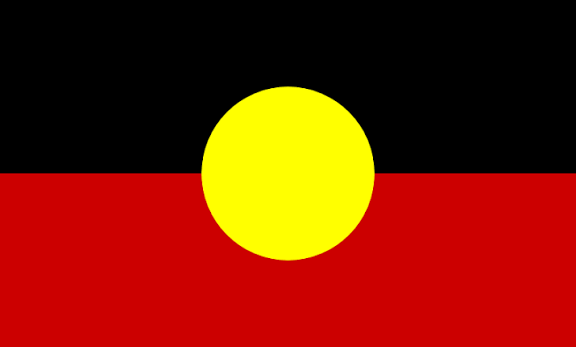
The Australian Aboriginal Flag
The Australian Aboriginal Flag is widely used by Aboriginal people throughout Australia.
It was designed in 1970 by Harold Thomas, a Luritja artist.
The black section represents Aboriginal people, the red represents the earth and cultural relationships with Country, and the yellow circle represents the sun.
The flag is an important pan-Aboriginal symbol, but it is not a flag belonging exclusively to Noongar people. AIATSIS information on the Australian Aboriginal Flag
Waugal or Wagyl
The Waugal, also written Wagyl or Waagle, is an ancestral being associated with Noongar Country and waterways.
Stories connected to the Waugal help explain the formation, meaning, and responsibilities associated with rivers, lakes, springs, and other features of Country.
The details of these stories vary among regions, families, and knowledge holders.
The Waugal should not be reduced to a decorative “rainbow serpent” image separated from Noongar law, place, and cultural authority.
It is a significant cultural being, but it is not an official emblem adopted by every Noongar person or organisation.
Maali and the Waterways
Maali is a Noongar word for the black swan.
Black swans are closely associated with the rivers and wetlands of southwestern Australia, including the Swan River.
They appear in stories, art, place identities, and environmental education.
However, the black swan is also used as a symbol of Western Australia more generally. It should not automatically be treated as the official symbol of the Noongar people.
Balga, Mungart, and the Six Seasons
Balga, the grass tree, and mungart, the jam tree, are among the plants associated with Noongar Country.
Plants, animals, waterways, and the six seasons are frequently represented in Noongar art and cultural education.
Their meanings may differ according to the artist, family, region, and story.
They are cultural elements rather than a single set of universal official symbols.
Language
Noongar belongs to the Pama–Nyungan language family.
Before colonisation, the regional speech varieties of southwestern Western Australia probably formed a language continuum.
Neighbouring groups could share many words and grammatical features, while communities farther apart might speak more noticeably different varieties.
The fourteen regional groups commonly associated with Noongar society were connected to this linguistic diversity.
Noongar is not a dialect of English. It is an Aboriginal language with its own vocabulary, sounds, grammar, and ways of expressing relationships among people, place, time, and Country.
An Oral Language and Its Writing Systems
Noongar was traditionally transmitted through speech, story, song, ceremony, observation, and practice.
There was no single precolonial Latin-alphabet writing system.
Missionaries, government officials, settlers, and researchers later recorded Noongar words using English spelling conventions. As a result, the same word or name may appear in several written forms.
Modern Noongar language organisations and educators have developed writing systems for dictionaries, teaching resources, books, signage, and digital media.
Different orthographies continue to exist. Their differences reflect regional pronunciation, historical sources, and community decisions rather than simply correct and incorrect spelling.
Language Suppression
Colonisation seriously disrupted the transmission of Noongar languages.
Families were displaced from Country, children were removed, and Aboriginal people were confined to missions, settlements, reserves, or restricted areas.
English dominated schools, government services, and employment.
Some children were punished or discouraged for using Aboriginal languages, while others grew up away from parents and Elders who would otherwise have taught them.
As a result, many families experienced breaks in the transmission of language between generations.
However, Noongar language did not disappear completely. Words, expressions, place names, songs, family memories, and historical recordings survived within communities and archives.
Language Revitalisation
Noongar people are actively revitalising their language.
The Noongar Boodjar Language Cultural Aboriginal Corporation supports language learning, cultural programs, community activities, and the development of educational resources. Noongar Boodjar Language Cultural Aboriginal Corporation programs
Wirlomin Noongar Language and Stories works with Elders, families, writers, artists, and educators to return stories and language materials to the community and develop new books and performances. Wirlomin Noongar Language and Stories
Language is also being used in schools, radio, music, theatre, public signage, Welcome to Country ceremonies, place-name restoration, and digital media.
Revitalisation does not mean attempting to reproduce the past without change. It involves bringing ancestral knowledge into contemporary family, educational, artistic, and community life.
Basic Expressions
Kaya means “hello” and can also mean “yes.”
Wanju means “welcome.”
Boodja means “land” or “Country.”
Moort means “family” or “kin.”
Kaartdijin refers to “knowledge,” “learning,” or “understanding.”
Moorditj can mean “good,” “strong,” “excellent,” or “well,” depending on the context.
Boorda refers to “later” or “the future” and may be used in expressions of farewell or seeing someone again.
Pronunciation, spelling, and usage can vary among regions and speakers. These expressions should not be treated as the only forms used throughout all of Noongar Country.
Traditional Games and Competitions
Play is called waabiny in Noongar.
Traditional games helped children and adults develop coordination, strength, observation, memory, teamwork, and skills related to hunting and life on Country.
Some games have been reconstructed from historical records and community knowledge. Modern versions may use soft balls or other safer equipment.
Boorna Jokee
Boorna Jokee was a spear-dodging game.
Players threw blunted spears while another participant attempted to dodge, block, or deflect them.
The game developed agility, attention, timing, and defensive skills.
Modern educational versions may use soft balls or padded equipment rather than wooden spears.
These versions should be understood as safe adaptations of a historical activity rather than exact reproductions of every traditional rule.
Wana
Wana was a game traditionally associated with girls.
A player used a digging stick to protect a smaller stick placed on the ground while other participants attempted to strike it with thrown objects.
The game required quick movement, accuracy, and control of the digging stick.
The name wana is also used for the practical digging stick employed in gathering food and other daily activities.
Meetcha Boma
Meetcha Boma was played using sticks and red gum nuts.
Players struck or moved the gum nuts toward a target or goal.
Some versions involved teams and required accuracy, timing, and cooperation.
The rules could differ according to the place and the people playing.
Other Forms of Play
Noongar children and adults also participated in running, wrestling, climbing, tracking, memory games, throwing activities, and games that imitated the movements of animals.
Some play activities were closely connected to skills used in hunting, gathering, toolmaking, or observing Country.
Collections of “Traditional Indigenous Games” often include games from many different Aboriginal and Torres Strait Islander peoples.
A game should not automatically be described as Noongar unless its Noongar origin or community use can be confirmed. Collections WA information on Noongar games
Common Misconceptions
“Noongar Refers to Every Aboriginal Person in Western Australia”
Noongar refers specifically to the Aboriginal people of southwestern Western Australia.
Many other Aboriginal peoples live in Western Australia, including peoples of the Kimberley, Pilbara, Goldfields, Mid West, and desert regions.
Each has distinct Countries, languages, histories, and cultural identities.
Using Noongar as a general name for all Aboriginal people in the state erases this diversity.
“The Noongar Are One Uniform Tribe”
Noongar people share many cultural and linguistic connections, but Noongar society includes regional groups, families, language varieties, and local identities.
The fourteen-group model is one widely used way of explaining this diversity.
It does not mean that all Noongar people have identical customs, stories, pronunciation, or family histories.
The English word “tribe” can also oversimplify these complex networks of Country, kinship, language, and responsibility.
“The Six Seasons Are a Fixed Calendar of Two Months Each”
The six Noongar seasons are often matched with two months of the European calendar to make them easier to explain.
However, their actual timing depends on environmental signs.
Rain, wind, temperature, flowering plants, animal behaviour, and food availability indicate when a season is changing.
Seasonal timing may also differ across coastal, inland, northern, and southern parts of Noongar Country.
“Noongar People Were Nomads Who Moved Without Purpose”
Noongar families moved through Country according to detailed seasonal knowledge, established routes, water sources, food availability, ceremony, and relationships with other families.
They returned to known camps, wetlands, rivers, forests, and coastal places.
Movement was organised and connected to rights and responsibilities for Country.
Describing it as aimless wandering hides the knowledge and social systems that guided Noongar life.
“Noongar Culture Disappeared After Colonisation”
Colonisation caused severe loss of life, land, language, and cultural knowledge.
Government policies separated families and restricted cultural practices.
However, Noongar people survived.
Culture continued through families, oral history, art, music, language, Country, community organisations, political action, and the work of Elders.
Cultural change does not mean cultural disappearance.
“Any Aboriginal Person Can Perform a Welcome to Country”
A Welcome to Country can be delivered only by Traditional Owners of the Country where the event is taking place, or by a person authorised by them.
An Aboriginal person from another Country does not automatically have the authority to welcome people to Noongar Country.
An Acknowledgement of Country is different. It can be offered by Aboriginal or non-Aboriginal people to recognise the Traditional Owners and show respect for their continuing connection to Country.
Following the correct protocol recognises that Aboriginal Australia consists of many distinct peoples and Countries. Reconciliation Australia guidance on Welcome to Country and Acknowledgement of Country
Noongar People Today
Noongar people are part of every area of contemporary life.
They work in education, health care, law, government, construction, agriculture, tourism, environmental management, business, research, the arts, sport, and media.
Noongar Radio broadcasts music, news, interviews, language, and community information.
Yirra Yaakin Theatre Company creates and presents Aboriginal theatre, supports performers and writers, and brings Noongar stories and contemporary experiences to the stage. Yirra Yaakin Theatre Company
Noongar writers, musicians, filmmakers, actors, dancers, and visual artists express both ancestral knowledge and modern experiences.
Their work explores family, Country, language, history, survival, racism, urban life, humour, politics, and future generations.
Noongar rangers, Elders, and environmental organisations are involved in cultural burning, river and wetland restoration, wildlife conservation, heritage protection, and the revival of traditional place names.
Schools, universities, museums, local governments, and community organisations increasingly teach Noongar language, seasons, history, cultural protocols, and art.
The South West Native Title Settlement has also created new governance structures, regional corporations, and opportunities for Noongar people to participate in decisions concerning land, heritage, investment, and community development.
At the same time, Noongar communities continue to experience challenges involving housing, health, education, employment, discrimination, the justice system, child protection, heritage, and access to Country and water.
These experiences are not the same for every family or community.
Noongar culture exists in cities and country towns, beside rivers and wetlands, in forests and coastal regions, and in schools, homes, theatres, radio stations, businesses, and community organisations.
It is not limited to archaeological sites, museums, or stories about the distant past.
Through boodja, moort, kaartdijin, language, the six seasons, art, family, and cultural responsibility, Noongar people continue to connect the past, present, and future.