Overview
The Rapa Nui are an Indigenous Polynesian people whose homeland is Rapa Nui, an island in the South Pacific Ocean.
Rapa Nui lies approximately 3,700 kilometers west of continental Chile and is one of the world’s most isolated inhabited islands. Politically, the island is part of Chile, but geographically and culturally, it belongs to Polynesia in Oceania.
The island is internationally known for its enormous stone statues called moai. However, the moai are not simply remains from a distant past. For the Rapa Nui people, they are important cultural heritage connected to ancestors, land, families, and the history of their communities.
The Rapa Nui language, music, dance, carving traditions, fishing knowledge, agriculture, and oral culture continue to be passed down today.
Location
Rapa Nui Island
Rapa Nui is a volcanic island located in southeastern Polynesia. It is also widely known as Easter Island and as Isla de Pascua in Spanish.
The island’s main settlement is Hanga Roa, on the western coast. It is home to many of the island’s houses, schools, shops, churches, and harbor facilities.
Rapa Nui is surrounded by a vast expanse of the Pacific Ocean and lies far from any other inhabited island. Within this isolated environment, the Rapa Nui people developed their own distinctive society and culture.
Today, Rapa Nui people live not only on the island but also in continental Chile and other parts of the world.
Reference: UNESCO – Rapa Nui National Park
History
Polynesian Settlement
Archaeological research suggests that Polynesian voyagers reached and settled Rapa Nui by around the twelfth or thirteenth century.
They traveled across the vast Pacific in canoes, navigating by observing stars, ocean currents, winds, waves, and the movements of birds. They also brought crops such as sweet potatoes, taro, yams, bananas, and sugarcane.
According to Rapa Nui oral tradition, a chief named Hotu Matu‘a led the first settlers to the island. He is remembered as a founding ancestor of the Rapa Nui people.
The exact point of departure, route, and date of the first settlement remain subjects of continuing research.
Reference: PNAS – Variation in Rapa Nui Land Use
Moai and Ahu
After settling the island, Rapa Nui communities constructed ceremonial stone platforms known as ahu. Moai were erected on many of these platforms.
Approximately 900 moai and more than 300 ahu have been documented across the island.
Most moai were carved from volcanic tuff at the quarry of Rano Raraku. They are generally understood to represent important ancestors or leaders. Many were positioned facing inland toward the communities associated with them rather than outward toward the sea.
Some moai were crowned with cylindrical ornaments called pukao, made from red volcanic scoria. Archaeological evidence also shows that eyes were inserted into some statues after they had been placed on their platforms.
Several theories have been proposed to explain how the moai were transported. Experiments have demonstrated that some statues could have been moved upright with ropes, but it remains uncertain whether every moai was transported using the same method.
Environmental Change and Adaptation
Rapa Nui experienced extensive environmental change as its population and use of the land increased. Human activity, the spread of the Polynesian rat, and other environmental factors contributed to the disappearance of much of the island’s original forest.
Earlier accounts often portrayed Rapa Nui as a society that destroyed its environment and collapsed before Europeans arrived. However, recent archaeological and genetic research does not support a simple account of a large-scale population collapse before European contact.
Instead, evidence shows that Rapa Nui communities developed methods of adapting to difficult environmental conditions. These included stone-mulched fields and manavai—circular stone enclosures that protected crops from the wind and helped the soil retain heat and moisture.
Reference: Nature – Ancient Rapanui Genomes Reveal Resilience and Pre-European Contact with the Americas
The Birdman Period
After the main period of moai construction ended, a different religious and political system developed around the ceremonial village of Orongo.
At the center of this tradition was the tangata manu, or Birdman. Participants traveled to an offshore islet to obtain the first egg of the manutara seabird. The result of the competition helped determine religious and political authority for the coming year.
Rock carvings at Orongo preserve many images connected with the Birdman tradition and other elements of Rapa Nui culture.
European Contact
The first recorded European to land on the island was Dutch navigator Jacob Roggeveen.
He arrived on April 5, 1722, which was Easter Sunday. This led Europeans to name the island Easter Island.
During the nineteenth century, slave raiders from South America attacked the island and took many Rapa Nui people away. Diseases introduced by returning captives and later visitors caused further devastation.
By the late nineteenth century, the Rapa Nui population had fallen to little more than 100 people.
Reference: National Library of Chile – Rapa Nui
Incorporation into Chile and the Modern Period
Rapa Nui was incorporated into Chile in 1888.
In the decades that followed, much of the island was leased to a sheep-ranching company. Rapa Nui people were largely restricted to living around Hanga Roa while the company controlled most of the island’s land.
In 1966, Chilean civil administration was introduced, and Rapa Nui residents were recognized as Chilean citizens with full civil rights.
Rapa Nui National Park was inscribed on the UNESCO World Heritage List in 1995.
Today, the park is managed by the Ma‘u Henua Indigenous Community, giving the Rapa Nui community a central role in protecting and managing its ancestral heritage.
Culture
Ancestors and Community
Connections among ancestors, families, communities, and land are central to Rapa Nui culture.
Moai and ahu are not isolated statues and structures. Each is connected to the history of the community that occupied and cared for the surrounding land.
Across the island are the remains of houses, gardens, caves, rock carvings, workshops, and ceremonial places. Together, these form a cultural landscape that preserves many layers of Rapa Nui history.
Agriculture and the Ocean
Rapa Nui has limited rainfall and is frequently exposed to strong winds. Growing food in this environment required carefully developed agricultural methods.
Rapa Nui farmers used manavai, circular stone enclosures that sheltered plants from the wind. They also placed stones across cultivated ground to help retain moisture, reduce erosion, release stored heat at night, and add minerals to the soil.
Sweet potatoes, taro, yams, bananas, and sugarcane were among the crops grown on the island. Fishing and the gathering of marine resources were also important parts of everyday life.
Carving, Music, and Dance
Wood and stone carving are among the best-known forms of Rapa Nui art. Carvings have represented people, birds, fish, ancestors, and figures connected with traditional stories.
Songs and dances communicate stories about history, family, land, love, and everyday life. Takona body painting and tattooing have also been used to express identity, family connections, status, and cultural narratives.
Contemporary Rapa Nui performance includes both inherited local traditions and influences from other Polynesian cultures and modern musical styles.
Tapati Rapa Nui
Tapati Rapa Nui is the island’s largest annual cultural festival.
Its events include music, dance, carving, food, traditional dress, canoeing, and athletic competitions. Although Tapati developed as a modern festival, it has become an important place for passing Rapa Nui language, oral traditions, arts, and practical knowledge to younger generations.
Flag and Symbols
The Rapa Nui Flag
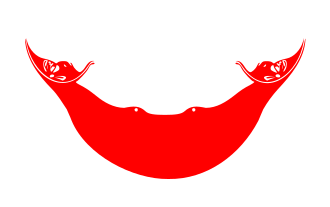
The Rapa Nui flag is known as Te Reva Reimiro. It has a white field with a red reimiro at its center.
A reimiro is a crescent- or canoe-shaped wooden chest ornament. Some examples have stylized human faces carved at both ends. Historically, reimiro were associated with chiefs, authority, and social status.
Te Reva Reimiro is widely used as a cultural flag representing the island and the Rapa Nui people. It is separate from the national flag of Chile.
A suitable image caption is:
The flag of Rapa Nui, known as Te Reva Reimiro
Reference: Pontifical Catholic University of Chile Heritage Archive – Reimiro
Moai and Ahu
The moai are the most internationally recognized symbols of Rapa Nui. They are generally associated with ancestors and leaders and were placed together with ahu to form ceremonial spaces connected with particular communities.
Manutara and the Birdman
Images of the manutara seabird and the Birdman are associated with the traditions centered at Orongo. Their forms can still be seen in rock carvings and other works of Rapa Nui art.
Rongorongo
The symbols of rongorongo have also become important representations of Rapa Nui history and knowledge.
Language
The Rapa Nui Language
Rapa Nui is an Austronesian language belonging to the Polynesian language group. It is related to other Eastern Polynesian languages, including Tahitian, Māori, and Hawaiian.
Spanish is now widely used on the island, particularly in government, business, education, and communication with continental Chile. The number of younger people using Rapa Nui as their primary everyday language has declined.
Language revitalization programs are being developed through schools, cultural activities, community projects, and digital learning resources.
Reference: Chilean Ministry of Education and UNESCO – Rapa Nui Language Revitalization Plan
Writing and Pronunciation
Modern Rapa Nui is written using the Latin alphabet.
The letter ŋ represents a sound similar to the “ng” in the English word “sing.” A mark resembling an apostrophe represents a glottal stop, while long vowels may be marked with a macron.
Some differences in spelling can be found among educational materials, dictionaries, and academic publications.
Basic Expressions
| Rapa Nui | English |
| ‘Iorana | Hello / Greetings |
|---|---|
| Pe hē koe? | How are you? — addressed to one person |
| Pe hē kōrua? | How are you? — addressed to two people |
Rongorongo
Rongorongo is a system of symbols carved onto wooden tablets and other objects from Rapa Nui.
Researchers have not yet determined exactly what the symbols recorded, how they represented the Rapa Nui language, or whether they formed a complete writing system.
A study published in 2024 indicated that the wood used for one surviving tablet may date to the fifteenth century. However, the age of the wood does not directly establish when its symbols were carved.
Rongorongo remains undeciphered, and no complete or universally accepted translation of its texts currently exists.
Reference: Scientific Reports – Rongorongo Tablet Radiocarbon Dating/a>
Traditional Games and Competitions
Kai-kai
Kai-kai is a string-figure tradition in which a loop of string is arranged around the fingers to create different shapes.
The figures are often accompanied by chants, songs, or spoken narratives. They can represent animals, people, places, canoes, and other subjects.
Kai-kai is more than a visual game. It has also helped transmit language, place names, stories, and oral traditions between generations.
Haka Pei
Haka Pei is a competition in which participants descend a steep slope on a sled made from banana trunks.
Today, it is one of the best-known events held during Tapati Rapa Nui. Participants can reach high speeds, making it a demanding and dangerous competition for experienced adult competitors.
Tau‘a Rapa Nui
Tau‘a Rapa Nui is an endurance competition incorporating skills connected with life on the island.
Competitors paddle a small craft made from reeds, swim using a reed float, and run while carrying bunches of bananas. The competition requires physical endurance as well as skills connected with the island’s land and marine environment.
Other Competitions
Tapati Rapa Nui also includes canoe races, fishing, swimming, carving, singing, and dancing competitions.
Some events are based on older Rapa Nui practices, while others developed or took their present form as part of the modern festival.
Rapa Nui People Today
The Rapa Nui are not simply a people from the distant age in which the moai were created. They are a living Indigenous community that continues to shape the society and culture of the island.
Through cultural heritage management, language revitalization, renewed interest in traditional agriculture, education, and artistic activity, Rapa Nui people are carrying ancestral knowledge into the present.
The moai and ahu, the ocean and volcanic landscape, songs and dances, language and oral traditions are not separate tourist attractions. Together, they form part of the continuing relationship between the Rapa Nui people, their ancestors, and their island homeland.