Overview
The Samoan people are a Polynesian ethnic group native to the Samoa Islands (Independent State of Samoa and American Samoa) in the South Pacific.
They are known for the fa'a Samoa (the Samoan way)—a traditional social system based on extended family, hierarchy, and communal living. Samoan culture features rich oral mythology, elaborate tattoo traditions, communal gatherings, and strong connections to land and ancestry.
There are over 250,000 Samoans living in the islands and over 600,000 worldwide, including significant diaspora communities in New Zealand, Australia, and the United States.
Location (Continent/Region)
- Continent: Oceania
- Region: Polynesia
- Samoa (Independent State), American Samoa, with large communities in New Zealand, Australia, and the United States.
Samoan Flag and Symbols
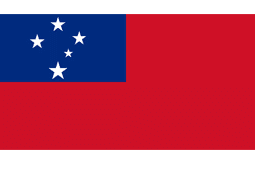
Traditional Tattoos (Pe'a and Malu)
- Male: Pe'a
- Female: Malu The Samoan Fale (traditional house)
Language
- Name:Samoan (Gagana Samoa)
- Language Family:Austronesian > Polynesian
- Speakers:Over 500,000 (Samoa, American Samoa, New Zealand, Australia, USA, etc.)
- Grammar:Tends toward VSO (Verb–Subject–Object) word order, uses prefixes and particles for grammatical structure.
- Usage:Official language in Samoa and American Samoa; widely spoken in diaspora communities.
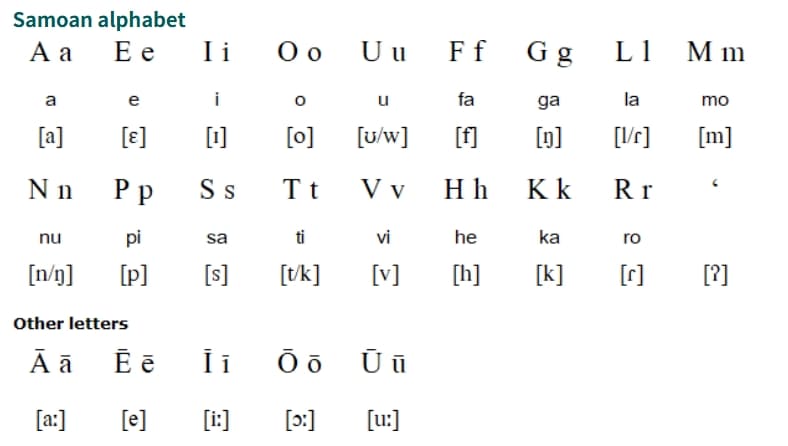
Script
Writing System
- Script:Latin alphabet
- The Samoan orthography was formalized by missionaries in the 19th century.
- Consists of 5 vowels (a, e, i, o, u) and 14 consonants.
omniglot.com omniglot.com
Common Samonan Greetings and Phrases
| English | Samonan | Pronunciation |
| Hello | Talofa | tah-LOH-fah |
|---|---|---|
| Good morning | Manuia le taeao | mah-NOO-ee-ah leh tah-EH-ah-oh |
| Thank you | Fa'afetai | fah-ah-feh-TIE |
| Nice to meet you | Manuia le aso | mah-NOO-ee-ah leh AH-soh |
| Good night | Manuia le po | mah-NOO-ee-ah leh poh |
| Delicious | Manaia | mah-NAH-yah |
| Fun/Enjoyable | Fiafia | fee-ah-FEE-ah |
Note
“Manuia” means “good/lucky” and is used in various greetings and wishes.
Language Origin & Historical Background
- Samoan is a Polynesian language closely related to Tongan, Hawaiian, and Māori.
- The Samoa Islands have been inhabited for over 3,000 years, with language and culture developing in relative isolation.
- English influence increased in the 19th century, but Samoan remains a vibrant, living language today.
Access Guide
The currency of the Samoan people is the Samoan Tala (WST).
0.31 EUR / 0.36 USD / 53 JPY / 2.63 CNY / 0.57 AUD / 0.47 SGD / 2.87 HKD / 0.27 GBP / 31.83 INR
https://www.xe.com/currencyconverter/
The currency shown here is the official currency (Tala) of Samoa, where the Samoan people mainly live. Different currencies may be used in other countries.
Access to Samoa (Apia, Faleolo International Airport APW)
| Departure City | Direct/Transit | Arrival Airport | Flight Time (approx.) | Reference Fare (one-way/round-trip, Economy) |
| Los Angeles | Honolulu / Auckland | Apia (APW) | 13–20 hrs | $600–$1,200 / $1,100–$1,900 |
|---|---|---|---|---|
| New York | LA / Honolulu / Auckland | Apia (APW) | 18–25 hrs | $700–$1,400 / $1,300–$2,400 |
| London | Dubai/HK/Singapore/Auckland/Sydney | Apia (APW) | 24–30 hrs | £650–£1,250 / £1,150–£2,100 |
| Tokyo | Auckland / Sydney | Apia (APW) | 14–20 hrs | ¥100,000–¥180,000 / ¥180,000–¥300,000 |
| Sydney | (Direct) | Apia (APW) | 5–6 hrs | A$400–A$800 / A$900–A$1,500 |
| Hong Kong | Auckland / Sydney | Apia (APW) | 15–20 hrs | HK$5,500–HK$10,000 / HK$9,000–HK$16,000 |
| Shanghai | Auckland | Apia (APW) | 15–20 hrs | RMB5,500–9,500 / RMB9,500–16,000 |
| Singapore | Auckland / Sydney | Apia (APW) | 14–20 hrs | S$800–S$1,500 / S$1,300–S$2,200 |
Traditional Games
For Children
Lau Mu'a
Games with coconut leaves or stones, involving skill and competition.
Rhythm and Singing Games
Handclapping and traditional songs (such as “songa”).
For Adults
Siva Tau
Warrior dance, also performed by the national rugby team.
Traditional Wrestling and Sumo (Fusuaga)
Ava (Kava) Ceremony
Ritual drink and social bonding.
Siva Dance
Elegant group dance performed by both men and women.
Introduction video
Summary
・The Mapuche are a proud Indigenous people of South America, deeply connected to their land and traditions.
・Main symbols include the “Wüñellfe” and “Kultrún.”
・The language Mapudungun is agglutinative and a language isolate.
・The traditional game Palín is a symbol of cultural pride.