Overview
Torres Strait Islander peoples are the Indigenous peoples whose homeland is the Torres Strait, located between the northeastern tip of Australia’s Cape York Peninsula and the southern coast of Papua New Guinea.
The Torres Strait contains islands, reefs, sandbanks, shallow waters, and extensive coral reef systems. Regional authorities identify 17 inhabited islands, each with its own families, clans, languages, histories, and relationships with surrounding seas.
“Torres Strait Islander peoples” therefore does not describe a single, uniform community. The western, central, eastern, northern, and inner islands differ in their geography, languages, food resources, navigation routes, ceremonies, and historical experiences.
Together with Aboriginal peoples, Torres Strait Islander peoples are the First Peoples of Australia.
However, Aboriginal peoples and Torres Strait Islander peoples are not two names for the same people. They are distinct peoples with different histories, cultures, languages, and systems of relationship with land and sea. At the same time, some people identify as both Aboriginal and Torres Strait Islander through their family ancestry.
Torres Strait Islander cultures have developed through relationships with the sea, islands, stars, winds, tides, coral reefs, marine life, families, and ancestors. Knowledge of fishing, navigation, trade, gardening, song, dance, boatbuilding, carving, and weaving has been passed between generations.
Today, Torres Strait Islander communities are found not only on the islands of the Torres Strait, but also in Australian mainland cities and regional centres, including Cairns, Townsville, and Brisbane.
Torres Strait Islander peoples are not people who live only according to an unchanged island lifestyle from the past. They participate in education, healthcare, government, the arts, fishing, environmental management, law, research, and business while passing Ailan Kastom, family relationships, languages, and connections to Sea Country to future generations. AIATSIS information about the First Peoples of Australia
Homelands and Regional Communities
The Torres Strait and Zenadth Kes
The Torres Strait lies between Australia’s Cape York Peninsula and Papua New Guinea. It connects the Arafura Sea and the Coral Sea.
Alongside the English name Torres Strait, the name Zenadth Kes is also used for the region.
Zenadth Kes was promoted by the late Torres Strait Islander Elder and linguist Ephraim Bani. It is explained as a name created by bringing together words associated with winds from the four directions of the Torres Strait.
Today, Zenadth Kes is used by community members, artists, cultural organisations, and government bodies. However, it has not replaced the name Torres Strait in every setting or for every Islander.
Torres Strait Islander people may identify themselves not only as Torres Strait Islanders, but through more specific island, regional, family, or clan identities, such as Meriam, Erubam, Saibailgal, or Mabuygilgal.
The Five Island Regions
The inhabited islands of the Torres Strait are commonly described as belonging to five regional groups.
Top Western Islands
The Top Western Islands are Boigu, Dauan, and Saibai.
Boigu and Saibai are low-lying islands close to the southern coast of Papua New Guinea. They contain wetlands, mangroves, and land shaped by tidal movement, making them particularly vulnerable to king tides and rising sea levels.
Dauan, by contrast, is a steep granite island. The physical environment therefore varies considerably even within the Top Western region.
Communities in these islands have long maintained kinship, trade, marriage, and linguistic relationships with coastal villages in Papua New Guinea.
Western Islands
The Western Islands include Badu, Mabuiag, and Moa.
Moa contains two main communities, Kubin and St Pauls.
The Western Islands include rocky and comparatively large islands. Fishing, marine travel, pearl-shell collecting, and gardening have all contributed to community life.
Archaeological research on Mabuiag has identified evidence of human activity dating back at least approximately 7,300 years. State Library of Queensland information about Mabuiag
Central Islands
The Central Islands include Iama, Masig, Poruma, and Warraber.
Many of these islands are relatively low coral cays formed from accumulated coral sand. Because land and freshwater are limited, knowledge of the sea, coral reefs, tides, and seasonal winds is especially important.
Wide stretches of water separate the islands. Boat travel remains part of everyday life, connecting families, schools, healthcare services, workplaces, and community events.
Eastern Islands
The Eastern Islands are Mer, Erub, and Ugar.
These islands include high volcanic islands with geography and vegetation that differ from the low coral cays of the Central Islands.
Mer is the homeland of Meriam people, including Eddie Koiki Mabo. Mer, Dauer, Waier, and their surrounding waters are closely connected with the 1992 Mabo decision.
Meriam Mir is the traditional language of the Eastern Islands.
Inner Islands
The Inner Islands, close to the Australian mainland, include Kirriri, Muralug, Ngurupai, and Waiben.
Waiben is known in English as Thursday Island, Ngurupai as Horn Island, Muralug as Prince of Wales Island, and Kirriri as Hammond Island.
Waiben developed as an administrative, commercial, educational, healthcare, and transport centre. During the pearling era, people with ancestry from Japan, the Philippines, Southeast Asia, and the South Pacific also settled there, contributing to a multicultural community.
The southern Torres Strait is also part of the traditional Country of the Kaurareg Nation, an Aboriginal people.
Kaurareg people and Torres Strait Islander peoples have deep relationships through shared waters, families, trade, and history, but they are not the same people. It is therefore inaccurate to describe every Indigenous person from Waiben or Ngurupai as Torres Strait Islander.
The Torres Strait Regional Authority identifies 17 inhabited islands across these five regions. TSRA information about the Torres Strait region
The Northern Cape York Peninsula
The Northern Peninsula Area at the tip of Cape York contains significant Torres Strait Islander communities, particularly at Bamaga and Seisia.
During the twentieth century, especially after the Second World War, people moved from the Torres Strait islands to Cape York for reasons including population changes, employment, government decisions, disasters, and family migration.
People living in Bamaga or Seisia may reside on the Australian mainland while maintaining relationships with their ancestral islands, families, languages, and ceremonies.
The Northern Peninsula Area is also home to Aboriginal peoples. It is not an exclusively Torres Strait Islander region.
Communities on the Australian Mainland
Today, many Torres Strait Islander people live in Cairns, Townsville, Mackay, Rockhampton, Brisbane, and other parts of Queensland.
Communities are also found throughout Australia, including in Sydney, Melbourne, Darwin, Perth, and Canberra.
People move to the mainland for many reasons, including education, employment, healthcare, sport, housing, and family reunification.
People born and raised on the mainland may continue to visit their family islands and maintain cultural connections through funerals, weddings, Coming of the Light celebrations, language activities, dance, music, and food.
Living in a city does not mean that a person has lost their Torres Strait Islander identity.
Population Statistics
According to Australian Bureau of Statistics estimates for 30 June 2021, 39,538 people were estimated to identify as Torres Strait Islander only, while 42,516 were estimated to identify as both Aboriginal and Torres Strait Islander.
Together, these categories included 82,054 people who identified as Torres Strait Islander in some form.
However, these figures include people belonging to different islands, clans, language communities, and mainland communities. Census-based ethnic identification is also not the same as the number of people living in the Torres Strait or the number who speak a traditional language. Australian Bureau of Statistics 2021 population estimates
About the Name
Torres Strait Islander is a name used for people with ancestral, family, and cultural connections to the islands of the Torres Strait.
In English, the collective term Torres Strait Islander Peoples may be written in the plural to reflect this diversity.
The plural form recognises that Torres Strait Islander peoples do not come from only one island, clan, or language community.
Aboriginal Peoples and Torres Strait Islander Peoples are two distinct groups of First Peoples in Australia.
The expression “Aboriginal and Torres Strait Islander Peoples” is used when both groups are included. When discussing Torres Strait Islander peoples specifically, using only the term “Aboriginal” is not appropriate.
Reducing Aboriginal and Torres Strait Islander to an acronym can also obscure the different names and identities of the peoples being discussed.
“Thursday Islander” is not a collective name for all Torres Strait Islander peoples. It may describe someone who lives on or has connections to Waiben, or Thursday Island, but it does not include people from every island.
Linglobe uses “Torres Strait Islander Peoples” when discussing the peoples of the wider region. More specific identities, such as Meriam, Saibailgal, or Mabuygilgal, are included where appropriate.
History and Roots
Before European Arrival
The ancestors of Torres Strait Islander peoples lived throughout the islands and surrounding seas long before Europeans entered the region.
Archaeological sites show human occupation and activity extending back several thousand years. The dates identified vary from island to island, and evidence from Mabuiag has been dated to approximately 7,300 years ago.
When sea levels were lower, the area now occupied by the Torres Strait formed part of a landmass connecting Australia and New Guinea. As sea levels rose, islands, channels, shallow waters, and coral reefs developed.
People adapted to these island environments by developing fishing, hunting, plant gathering, gardening, navigation, and trade.
The Torres Strait was not an empty space separating Australia and New Guinea. It was an island-centred network of movement, marriage, trade, and storytelling that connected people to the north, south, east, and west.
European Records of the Strait
In 1606, ships associated with the Spanish navigator Luis Váez de Torres passed through the region.
European maps later came to identify the waterway as the Torres Strait.
This voyage did not mark the beginning of Torres Strait Islander history. The sea, islands, and navigation routes already had names and meanings within Islander systems of knowledge.
Dutch, British, French, and other European navigators, merchants, whaling ships, and survey vessels later entered the surrounding waters.
Contact with foreign vessels brought opportunities to exchange metal tools, cloth, food, and other goods. It could also lead to violence, kidnapping, introduced diseases, and the removal of local resources.
Coming of the Light
On 1 July 1871, missionaries connected with the London Missionary Society and teachers from South Pacific islands arrived on Erub.
The Erub Elder Dabad welcomed them, and the event became a turning point in the spread of Christianity throughout the Torres Strait.
Today, 1 July is commemorated in many communities as Coming of the Light. Celebrations may include church services, songs, dances, shared meals, and family gatherings.
Coming of the Light may also be expressed as Keriba Lagaw Buiya.
The adoption of Christianity brought major changes to religious practices, calendars, education, marriage, and material culture. Some older ceremonies and objects were abandoned, while others were removed from the islands by missionaries or collecting institutions.
However, accepting Christianity did not erase every part of Ailan Kastom.
Family relationships, responsibilities to land and sea, ancestral memory, songs, dances, and island knowledge continued in new forms, often alongside Christian belief.
Coming of the Light is an important historical event, but it does not mean that Torres Strait Islander history or culture began in 1871. State Library of Queensland information about Coming of the Light
Colonial Annexation
In 1872, the Colony of Queensland annexed Torres Strait islands located within approximately 60 miles of the Queensland coast.
In 1879, Queensland annexed most of the remaining islands.
These boundaries were not created with the consent of the Islanders. They brought islands, families, trade routes, and marine territories into a colonial system of government.
People continued to live according to their relationships with island land, sea, family, and customary law. However, colonial authorities increasingly intervened in movement, labour, wages, boats, trade, and residence.
Pearl-Shell and Bêche-de-Mer Industries
During the late nineteenth century, pearl-shell and bêche-de-mer collecting became major industries in the Torres Strait.
The industry valued not only pearls but also mother-of-pearl shell, which was exported for use in buttons and decorative objects.
Torres Strait Islander people possessed detailed knowledge of diving, the seafloor, currents, and boat handling, making their labour essential to these industries.
At the same time, colonial businesses imposed dangerous working conditions, low wages, debt, government-controlled earnings, and sometimes coercive labour practices. Many divers and crew members died in accidents or from decompression sickness.
Divers, sailors, and shipbuilders also came to the Torres Strait from Japan, the Philippines, Malay-speaking regions, and South Pacific islands.
Settlement and intermarriage contributed to diverse family histories, particularly on Waiben. Some Torres Strait Islander families today have Japanese, Filipino, Southeast Asian, or Pacific Islander ancestry alongside their Islander ancestry.
Protection Policies and Government Control
During the early twentieth century, Torres Strait Islander peoples were placed under restrictive Queensland government protection systems.
Government protectors intervened in wages, savings, employment, movement, boats, marriage, and trade. Permission could be required to travel away from an island, and curfews were imposed in some communities.
Although these policies were described as “protection,” they restricted personal freedom and the right of Islanders to make decisions about their own lives.
Torres Strait Islander people did not simply accept this control. Families and island representatives negotiated with the government and demanded improved working conditions and greater self-determination.
The 1936 Maritime Strike
In 1936, many Torres Strait Islander sailors and maritime workers stopped working in protest against government control over wages, boats, employment, and movement.
Approximately 70 percent of the regional workforce is reported to have participated, and the strike continued for about nine months.
Workers demanded the right to choose their own crews, control the wages they had earned, and make decisions without requiring permission from a government protector.
The strike contributed to stronger island councils and greater representation in local decision-making. In 1937, representatives from different islands met in an inter-island conference. Queensland legislation passed in 1939 also administratively recognised Torres Strait Islanders as distinct from Aboriginal people.
However, these developments did not immediately end every form of colonial control. Queensland Government history of Waiben
The Second World War
During the Second World War, the Torres Strait became strategically important to the defence of northern Australia.
The Torres Strait Light Infantry Battalion was formed in 1941.
By the later years of the war, almost every Torres Strait Islander man considered eligible for service was participating in the military in some form. In proportion to its population, the Torres Strait made one of the largest contributions of any Australian community.
However, Torres Strait Islander soldiers were initially paid approximately one-third of the wages received by white soldiers performing comparable duties.
The soldiers protested against this discriminatory treatment in 1943. Their pay was subsequently increased to approximately two-thirds of the white rate. Full compensation for unpaid wages was not provided until 1986.
Military service brought employment and technical experience, but it also caused family separation, military occupation of land, and the evacuation of some island communities. Australian War Memorial information about Indigenous military service
The International Border and the Torres Strait Treaty
The modern border between Australia and Papua New Guinea passes through seas traditionally used by Torres Strait Islander peoples and communities along the southern coast of Papua New Guinea.
Families on both sides of the border have long-standing relationships through kinship, marriage, trade, and ceremony.
Australia and Papua New Guinea signed the Torres Strait Treaty in 1978, and it entered into force in 1985.
The treaty established systems for managing the international border and maritime areas. It also created a Protected Zone intended to safeguard traditional ways of life and the marine environment.
Recognised traditional inhabitants may cross the border under specific conditions for approved traditional activities, including family visits, ceremonies, trade, fishing, and gardening.
This is not an unrestricted border crossing system open to everyone. Conditions apply to participating communities, the purpose of travel, and permitted areas of movement.
The treaty establishes a boundary between two countries while also providing a framework for maintaining family and cultural relationships that existed before the border. Australian Department of Foreign Affairs and Trade information about the Torres Strait Treaty
The Mabo Decision
One of the most important events in modern Torres Strait Islander history is the Mabo decision.
In 1982, five Meriam plaintiffs—Eddie Koiki Mabo, Reverend David Passi, Sam Passi, James Rice, and Celuia Mapo Sale—began legal proceedings seeking recognition of Meriam rights to Mer and surrounding islands.
The case demonstrated that land was managed through families and clans and that Meriam law and custom governed gardens, boundaries, inheritance, ownership, and responsibility.
On 3 June 1992, the High Court of Australia recognised that Meriam people held traditional rights to most of Mer, Dauer, and Waier.
The decision rejected terra nullius, the idea that Australia had been land belonging to no one before British colonisation.
The Native Title Act was passed in 1993 following the decision. It created a legal process through which Aboriginal and Torres Strait Islander peoples could seek recognition of continuing rights to land and waters under traditional law and custom.
The Mabo case was not the personal legal victory of Eddie Mabo alone. It was a long collective effort involving five plaintiffs, Meriam families, Elders, witnesses, lawyers, and supporters. AIATSIS information about the Mabo case
Regional Governance and the Present
The Torres Strait Regional Authority was established in 1994.
Its responsibilities include regional social, economic, cultural, and environmental planning, the maintenance of Ailan Kastom, and representing the interests of Torres Strait Islander peoples and other regional residents in policy development.
Governance in the Torres Strait also includes local councils, island communities, traditional owner organisations, Native Title corporations, churches, women’s organisations, arts organisations, and ranger groups.
No single organisation or representative speaks for every island and mainland Torres Strait Islander community.
Culture
Ailan Kastom
Ailan Kastom is a widely used Yumplatok expression meaning “Island Custom.”
However, Ailan Kastom does not refer only to traditional clothing, dances, or food.
It includes responsibilities to family, respect for Elders, child-rearing, the use of land and sea, gift-giving, funerals, marriage, community decision-making, Christianity, and relationships with ancestors.
Ailan Kastom is not identical on every island.
Meriam law and custom, Saibai family systems, Mabuiag marine practices, and urban life on Waiben may all take different forms.
Ailan Kastom is therefore best understood as a living system carried by particular islands and families, rather than as a single fixed list of rules.
Family, Clan, and Island
Torres Strait Islander identity is shaped through relationships with family, clan, island, and Sea Country.
Extended families include not only parents, children, and siblings, but also grandparents, aunts, uncles, cousins, and other relatives involved in raising children.
Elders have important roles in passing on genealogies, land and sea boundaries, languages, songs, ceremonies, and history.
People living on the same island may belong to different families and clans with distinct relationships and responsibilities concerning land, gardens, marine areas, and ceremonies.
An entire island should therefore not be described as though it were one family or had only one traditional owner.
Traditional Child-Rearing
Torres Strait Islander families have customary systems through which children may be entrusted to and raised by relatives, maintaining family relationships across generations.
This does not mean that a child has been abandoned or separated from family.
Under Ailan Kastom, a child may be raised through an agreement between relatives in order to continue relationships, responsibilities, land connections, island identity, and ancestry.
For many years, Australian birth certificates and family law did not adequately recognise these cultural parent-child relationships.
In 2020, Queensland enacted the Meriba Omasker Kaziw Kazipa Act. Through a formal legal process, the Act allows parentage arising from Torres Strait Islander traditional child-rearing practice to receive legal recognition. Official Queensland information about traditional child-rearing practice
Sea Country
For Torres Strait Islander peoples, the sea is not simply empty space separating one island from another.
It is part of Country, connecting families, food resources, navigation routes, stories, ancestors, rights, and responsibilities.
In the context of Australia’s First Peoples, Country does not mean only a piece of land or a nation-state. It includes relationships among land, sea, sky, plants, animals, ancestors, and people.
Marine areas contain fishing grounds, reefs, sandbanks, channels, and story places connected with particular families and clans.
Rights to use the sea are accompanied by responsibilities to care for it and preserve its resources for future generations.
Navigation and Environmental Knowledge
Torres Strait Islander navigators have travelled between islands by reading stars, the sun, winds, tides, waves, water colour, clouds, birds, and the movement of marine life.
Navigating through shallow coral reefs, powerful currents, and seasonally changing winds requires detailed knowledge of particular marine areas.
Navigation knowledge involves more than memorising the direction of a destination.
It includes understanding when to depart, where tides change, where dangerous reefs are located, when fish migrate, how storms can be anticipated, and which marine areas a family has the right to use.
People now also use motorised vessels, GPS, radio, and modern weather information. The use of modern technology does not make inherited knowledge of the sea unnecessary.
Fishing, Hunting, and Gardening
Fish, shellfish, crabs, lobsters, and bêche-de-mer have long been important to Torres Strait Islander food systems and trade.
Sea turtles and dugongs also have important relationships with food, ceremony, gift-giving, and family gatherings.
However, not every Torres Strait Islander person hunts or eats turtle and dugong regularly. Contemporary harvesting is connected with law, Native Title, community management plans, and species conservation.
Torres Strait Islander rangers and traditional owners participate in population monitoring, seagrass conservation, marine debris removal, and sustainable resource management.
On higher eastern islands and other islands with suitable soil and freshwater, people have cultivated yams, taro, bananas, coconuts, sugar cane, and fruit.
Agricultural opportunities are more limited on low coral cays, so methods of obtaining food vary among the islands.
Contemporary diets include traditional seafood and cultivated plants, as well as rice, flour, canned food, frozen food, and dishes introduced from mainland Australia, Asia, and the wider Pacific.
Food and Sharing
Fish, shellfish, crabs, yams, rice, and coconut-based dishes may be served at family gatherings, weddings, funerals, church events, and Coming of the Light celebrations.
Preparing large quantities of food for relatives and visitors is more than simply providing a meal.
Family and island relationships are reinforced through the shared work of obtaining ingredients, cooking, transporting food, and serving Elders and visitors.
Ingredients and dishes vary from island to island. No single dish can be described as the universal ethnic food of all Torres Strait Islander peoples.
Song, Dance, and Story
Song and dance are important ways of conveying island history, navigation, animals, ancestors, Christianity, and family events.
Movements may represent birds, fish, waves, boats, fishing, conflict, or different forms of work.
Drumming, singing, foot movements, hand movements, and coordinated group performance combine to communicate a story.
Some dances use a headdress called a dhari or dhoeri. Its shape, feathers, colours, patterns, and use vary by region and performance.
Dance is not performed only for tourists.
It has roles in family occasions, island festivals, church life, funerals, cultural education, political expression, and contemporary performing arts.
Some songs, names, stories, and ceremonies belong only to particular families, genders, age groups, or islands. The public presentation of some cultural expressions does not mean that all Torres Strait Islander knowledge is open for unrestricted use.
Art and Handwork
Torres Strait Islander art includes woodcarving, masks, drums, weaving, shell work, printmaking, painting, film, photography, fashion, and contemporary sculpture.
Detailed linocut and relief printmaking have become internationally recognised forms of contemporary Torres Strait Islander artistic expression.
Artworks may feature stars, canoes, ancestors, sharks, crocodiles, turtles, dugongs, coral reefs, islands, and navigation.
However, the same animal or design does not have one universal meaning. Its significance depends on the artist’s island, clan, family, and the story expressed in the work.
Historically, turtle shell was shaped and assembled into masks representing ancestors and animals.
Contemporary artists use materials such as wood, bamboo, fibre, metal, plastic, and printmaking media, developing inherited forms in ways suited to current environmental conditions and laws.
Tagai and the Stars
Tagai is an important ancestral figure associated with stars, navigation, seasons, and social order in the Torres Strait.
Stories about Tagai vary by region and are not told in exactly the same way on every island.
In publicly shared stories and artworks, Tagai and his companions are connected with constellations and the arrangement of the sky, expressing relationships among navigation, seasonal change, fishing, and the islands.
Contemporary artists also use stars, canoes, and ancestral beings to express knowledge held within the sea and sky. Australian Museum information about a Torres Strait artwork
Flag and Symbols
The Torres Strait Islander Flag
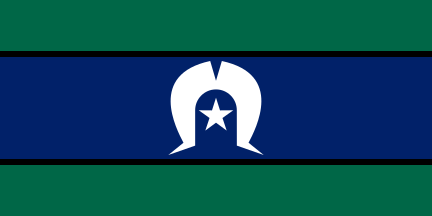
Torres Strait Islander peoples have an official flag representing their collective identity.
The flag was designed by the late Bernard Namok of Waiben.
It was selected through a design competition organised by the Island Coordinating Council and was officially presented in May 1992.
On 14 July 1995, it was legally recognised as a Flag of Australia under the Flags Act.
The green panels at the top and bottom represent the land.
The blue central panel represents the sea.
The black lines between the green and blue panels represent Torres Strait Islander peoples.
A white dhari appears in the centre. The dhari is a dancer’s headdress representing Torres Strait Islander identity and culture.
Below the dhari is a white five-pointed star. It represents peace, the five major island regions, and the importance of stars to navigation.
The colour white represents peace.
The Torres Strait Islander Flag is distinct from the Australian Aboriginal Flag. Both are officially recognised flags associated with Australia’s First Peoples, but they represent different peoples. TSRA information about the Torres Strait Islander Flag
The Dhari
The dhari is an important visual expression of Torres Strait Islander culture and identity.
It may also be written as dhoeri or in other regional forms.
Headdresses worn in actual dances are not all identical to the stylised white design shown on the flag.
They may be made from feathers, plant fibres, shells, cloth, and modern materials, with forms suited to particular islands, performances, and dancers.
A dhari should not be treated as a generic costume or as a headdress shared by every Indigenous people in Australia.
The Five-Pointed Star
The star on the flag represents the five main regions of the Torres Strait and the use of stars in navigation.
Torres Strait Islander navigation also draws on winds, tides, waves, water colour, clouds, and the movement of living creatures.
The star therefore represents not only geographic regions, but also knowledge of the sea and sky that connects the islands.
Canoes, Marine Animals, and Pearl Shell
Canoes, sea turtles, dugongs, sharks, crocodiles, and pearl shell may appear in Torres Strait Islander art and regional symbols.
However, none of these is the single official emblem of all Torres Strait Islander peoples.
The meaning of an animal or object may differ according to island, clan, family, and story.
When these elements are presented on Linglobe, they should be described as cultural motifs connected with the sea, navigation, particular island stories, or the history of regional industries, rather than as universal totems of all Torres Strait Islander peoples.
Languages
The Torres Strait is home to two traditional languages and the creole language known as Yumplatok.
English, languages associated with Papua New Guinea, and other languages are also spoken.
Language use varies by island and family. There is no single language that can accurately be called “the Torres Strait language.”
Kala Lagaw Ya
Kala Lagaw Ya is a traditional language associated primarily with the western, central, northern, and inner islands of the Torres Strait.
Its name may also be written as Kalaw Lagaw Ya or Kalau Lagau Ya.
Linguists generally classify it within the Pama–Nyungan language family, which includes many Indigenous languages of mainland Australia.
The TSRA identifies the following regional varieties under Kala Lagaw Ya:
- Kulkalgau Ya
- Kalaw Kawaw Ya
- Kawrareg
- Mabuyag
Names, pronunciations, spellings, and methods of classification may vary among sources.
No single variety should be treated as the only correct form for all western, central, northern, or inner islands.
Meriam Mir
Meriam Mir is the traditional language associated with the Eastern Islands of Mer, Erub, and Ugar.
The TSRA identifies Mer and Erub regional varieties.
Meriam Mir belongs to a different linguistic lineage from Kala Lagaw Ya.
Linguists generally classify it as a Papuan language related to languages spoken in southern Papua New Guinea.
The Torres Strait is therefore a linguistically significant region where an Australian language and a Papuan language have existed in close proximity and long-term contact.
Kala Lagaw Ya and Meriam Mir are distinct languages. However, long histories of trade, marriage, and navigation have contributed to shared or borrowed vocabulary.
Yumplatok
Yumplatok is also known as Torres Strait Creole or Brokan.
Its vocabulary is based primarily on English, with influences from Kala Lagaw Ya, Meriam Mir, and languages of the wider Pacific.
Yumplatok has its own grammar, pronunciation, word order, and expressions.
It should not be described as “incorrect English,” “broken English,” or the speech of people who cannot speak English properly.
Today, Yumplatok is widely used on the Torres Strait islands, the Cape York Peninsula, and within Torres Strait Islander communities on the Australian mainland.
It can also function as a shared language among Islanders whose families have different traditional languages. AIATSIS information about Torres Strait languages
Writing and Spelling
Kala Lagaw Ya, Meriam Mir, and Yumplatok are now written using the Latin alphabet.
However, the same word may be written differently depending on the island, speaker, educational system, or source.
Missionaries and outside researchers historically recorded languages using different spelling systems. Older spellings therefore do not always correspond with contemporary community orthographies.
A spelling difference should not automatically be treated as an error. It is important to consider the island, speaker, and orthographic system from which it comes.
Language Transmission and Revitalisation
Colonial government, school systems, English-dominant administration, and migration to the mainland have weakened the intergenerational transmission of Kala Lagaw Ya and Meriam Mir.
Some people understand their family language but do not speak it fluently. Others begin relearning an ancestral language as adults.
Language transmission is now supported through schools, Indigenous Knowledge Centres, churches, radio, songs, dictionaries, videos, digital learning materials, and family conversation.
In 2023, regional language leaders worked toward establishing the Torres Strait Traditional Languages Association.
Language revitalisation is not only about preserving vocabulary. It also transmits island history, family relationships, maritime knowledge, songs, and Ailan Kastom. TSRA information about traditional language revitalisation
Basic Expressions
The following expressions are used in Yumplatok.
Mayem means “welcome.”
Eso means “thank you.”
Gud Moning means “good morning.”
Yawo is a farewell similar to “goodbye.”
These are Yumplatok expressions. They are not the only expressions used across every variety of Kala Lagaw Ya or Meriam Mir.
Pronunciation and spelling may also differ by island, family, and speaker. Yumplatok language information
Traditional Games and Activities
Torres Strait Islander games may be connected with physical coordination, fishing skills, material knowledge, song, and cooperation.
Some traditional games now played in schools or at cultural events have been reconstructed from records made during the nineteenth and twentieth centuries. Their rules and equipment may be adapted for contemporary safety.
Modern educational versions should therefore not be described as having continued with completely unchanged rules since ancient times.
The Australian Sports Commission’s Yulunga resources present games adapted for use in modern schools following research and consultation with traditional owners and Indigenous organisations. Australian Sports Commission Yulunga resources
Kai and Kai Wed
Kai is recorded as a game in which players use their palms to keep a light, dried fruit or similar object from touching the ground.
Players stand in a circle and strike the object toward one another, attempting to keep it in the air for as long as possible.
A related form known as Kai Wed is presented with song and rhythm.
Contemporary activities may use a light ball or another safe object in place of the original plant material.
The game requires hand-eye coordination, controlled movement, and cooperation with other players.
Kolap
Kolap is presented as a target-throwing game associated with Mer.
Traditionally, beans or seeds known as kolap were thrown toward a target marked on the ground.
Modern school activities use safe equipment such as beanbags, with players competing to throw as accurately and as close to the target as possible.
Distance and scoring methods may be adjusted according to the purpose of the activity and the ages of the participants.
Mer Kolap
Mer Kolap is a spinning-top game using a top made from stone.
On Mer, volcanic stone was shaped and smoothed into a spinning top, with players competing to keep it turning for the longest time.
Making a successful top required an understanding of the stone’s properties, weight, balance, centre, and surface shape.
Mer Kolap was therefore not only a game. It was also connected with close observation of materials, toolmaking, and knowledge of rotational movement. Australian Curriculum information about Mer Kolap
Introduction video
Common Misconceptions
“Torres Strait Islander peoples are the same as Aboriginal peoples”
Torres Strait Islander peoples and Aboriginal peoples are two distinct groups of First Peoples in Australia.
They have their own languages, cultures, histories, and relationships with Country.
Some people have both Aboriginal and Torres Strait Islander ancestry and identify with both.
Recognising the distinction between the two groups is compatible with respecting people who hold both identities.
“Torres Strait Islander peoples are Papua New Guineans or simply Pacific Islanders”
Torres Strait Islander peoples are one of the First Peoples of Australia.
They have ancient relationships with communities along the southern coast of Papua New Guinea and across the wider Pacific through trade, marriage, language, and culture, but they are not the same peoples.
A broad regional label such as “Melanesian” cannot by itself explain Torres Strait Islander islands, clans, and histories.
“All Torres Strait Islander people live on islands”
Many Torres Strait Islander people now live on the Australian mainland.
Some were born on the mainland or have limited opportunities to visit their ancestral islands.
A person’s identity cannot be determined only by where they currently live.
Family, ancestral islands, culture, and participation in community life remain important foundations of identity.
“The Torres Strait has only one language”
The Torres Strait has two distinct traditional languages, Kala Lagaw Ya and Meriam Mir.
Yumplatok, English, and other languages connected with particular families and regions are also spoken.
The traditional languages themselves contain several regional varieties.
“Torres Strait Islander culture began with Coming of the Light”
Coming of the Light commemorates an important turning point in the spread of Christianity from 1871.
However, Torres Strait Islander history, navigation, family systems, languages, and knowledge of land and sea are much older.
Christianity brought significant cultural change, but it did not completely replace Ailan Kastom.
“The Mabo case was Eddie Mabo’s personal victory”
Eddie Koiki Mabo was an important plaintiff and leader, but the case involved five Meriam plaintiffs, families, Elders, witnesses, lawyers, and supporters.
The decision recognised rights maintained by Meriam people through their own law and custom.
“The Australian Aboriginal Flag also represents Torres Strait Islander peoples”
The Australian Aboriginal Flag and the Torres Strait Islander Flag are two distinct official flags representing different peoples.
They may be displayed together when both Aboriginal and Torres Strait Islander peoples are included, but using only one flag to represent both groups may be inappropriate.
“Because they have a maritime culture, all Torres Strait Islander people are fishers”
The sea remains central to Torres Strait Islander culture and identity, but contemporary lives and occupations are diverse.
Some people work in fishing, marine management, or maritime industries. Others are teachers, nurses, doctors, artists, lawyers, public servants, researchers, members of the Australian Defence Force, business owners, athletes, or digital creators.
Torres Strait Islander Peoples Today
Torres Strait Islander peoples now live across the Torres Strait islands, the Cape York Peninsula, and cities and regional communities throughout Australia.
Island residents and mainland residents may have different experiences of transport, employment, education, healthcare, language, and participation in cultural events.
On the islands, important fields of work include fishing, government, education, healthcare, construction, retail, maritime services, environmental management, and the arts.
On the mainland, Torres Strait Islander people work across education, medicine, law, universities, business, government, defence, sport, media, and the performing arts.
Torres Strait Islander artists express island histories and contemporary experiences through printmaking, music, dance, film, literature, fashion, and digital art.
Rangers and traditional owners manage coral reefs, seagrass meadows, turtles, dugongs, invasive species, marine debris, and cultural heritage.
Language leaders, teachers, and families continue to pass Kala Lagaw Ya, Meriam Mir, and Yumplatok to younger generations.
Coming of the Light on 1 July, Mabo Day on 3 June, regional festivals, church events, dance festivals, and family gatherings help connect island and mainland communities.
At the same time, some islands face challenges involving housing shortages, high living costs, transport, healthcare and education access, communications, freshwater, and employment.
People may need to travel long distances from their islands to Waiben, Cairns, or Townsville for specialist medical treatment.
On low-lying islands, king tides, coastal erosion, saltwater intrusion, and rising sea levels affect homes, cemeteries, roads, freshwater sources, and culturally important places.
The TSRA reports that sea levels around the Torres Strait are rising at approximately three times the global average. However, the level of impact differs according to each island’s elevation, geography, coastal protection, tides, and storms. TSRA information about climate change
Responses to climate change involve more than seawalls and stronger buildings. Increasing importance is being placed on incorporating Islander knowledge of tides, winds, coastlines, plants, and marine species into adaptation planning.
Torres Strait Islander culture does not exist only in flags, dances, pearl shell, or picturesque island landscapes.
Through family, island identity, Sea Country, languages, Christianity, Ailan Kastom, art, law, education, environmental management, and contemporary work, Torres Strait Islander peoples continue to carry their cultures into the present and the future.