Overview
The Guaraní peoples are several Indigenous peoples of south-central South America who share closely related languages and cultural connections.
Today, they live across a broad region that includes Paraguay, Brazil, Argentina, and Bolivia. Their traditional territories include parts of the Paraná, Paraguay, and Uruguay river basins, the Atlantic Forest, the Gran Chaco, and the plains and foothills of eastern Bolivia.
The Guaraní are not a single, culturally uniform people.
Names such as Mbya Guaraní, Kaiowá, Paĩ Tavyterã, Ava Guaraní, Ñandeva, Guaraní Occidental, and the Guaraní of Bolivia refer to peoples and communities with distinct regional identities, linguistic varieties, histories, political organizations, and ceremonial traditions.
The cross-border research project Guaraní Continental Map 2016 documented more than 280,000 Guaraní people in 1,416 communities, villages, urban neighborhoods, and family groups across four countries.
However, these figures were based on information collected around 2016 and do not represent an exact current population total. National censuses use different categories for ethnicity, language, and self-identification, so their figures cannot simply be added together.
Guaraní cultures are deeply connected to forests and rivers, agriculture, kinship, community life, languages, music, oral traditions, and ceremonies.
At the same time, the Guaraní peoples do not live only in forests or rural communities. Today, Guaraní people participate in urban life, schools, universities, government, the arts, filmmaking, agriculture, tourism, business, and many other areas of contemporary society.
Homelands and Regional Peoples
Traditional Guaraní territories existed long before the borders of today’s South American countries were established.
As a result, members of the same people or extended family may live on opposite sides of an international border.
Ethnic classifications, names, and spellings also differ among countries. Similar names do not always refer to exactly the same people.
Paraguay
Paraguay is a country in which Guaraní influence remains strongly visible in its name, languages, food culture, and place names.
However, “Paraguayan” and “Indigenous Guaraní” do not mean the same thing.
In Paraguay, Paraguayan Guaraní is widely spoken by people who are not Indigenous. Indigenous Guaraní communities, meanwhile, have their own territories, social organizations, histories, linguistic varieties, and cultural identities.
Official ethnic and linguistic classifications in Paraguay recognize several Guaraní peoples, including:
- Mbya Guaraní
- Ava Guaraní
- Paĩ Tavyterã
- Guaraní Ñandeva
- Guaraní Occidental
These peoples live mainly in eastern Paraguay and the Chaco region, but their histories and languages are not identical.
Official Paraguayan classifications also place the Aché language within the Guaraní linguistic family. However, the Aché are a distinct people with their own history, language, culture, and identity. They should not automatically be described as a subgroup of the Guaraní peoples.
Brazil
In Brazil, Guaraní peoples are commonly identified as Guarani Mbya, Guarani Ñandeva or Nhandewa, and Guarani Kaiowá.
The main homeland of the Guarani Kaiowá is in the state of Mato Grosso do Sul, near the border with Paraguay.
The Kaiowá have deep linguistic and kinship connections with the Paĩ Tavyterã who live across the border in Paraguay. However, because their current names and political identities differ regionally, the two names should not be treated as completely interchangeable.
Guarani Mbya and Guarani Ñandeva communities are also found in Paraná, Santa Catarina, Rio Grande do Sul, São Paulo, Rio de Janeiro, Espírito Santo, and other parts of southern and southeastern Brazil.
Mbya communities distributed across the Atlantic Forest continue to maintain networks of relatives, language, ceremonies, and travel that cross modern national borders.
Some Guaraní people also live in cities and urban surroundings. Urban residence does not mean that a person has lost their Indigenous identity.
Argentina
Many Mbya Guaraní communities live in Misiones Province in northeastern Argentina.
Misiones borders both Paraguay and Brazil, and cross-border connections continue through forests, rivers, family relationships, and community networks.
Ava Guaraní and other Guaraní communities are also found in the northwestern provinces of Salta and Jujuy.
Some Guaraní people have moved to Buenos Aires and other urban areas because of employment, education, healthcare, changes in land use, or family circumstances.
In Corrientes Province, Guaraní was recognized by provincial law in 2004 as an alternative official language alongside Spanish.
However, the Guaraní widely spoken in Corrientes is not identical to the Indigenous linguistic varieties spoken by the Mbya, Ava Guaraní, and other Guaraní peoples.
Bolivia
The Guaraní of Bolivia live mainly in the Chaco region, across parts of Santa Cruz, Chuquisaca, and Tarija.
Regional, linguistic, and historical identities include names such as Ava, Simba, and Isoseño.
These peoples share important cultural and political connections while also maintaining regional differences in language, clothing, music, ceremonies, and history.
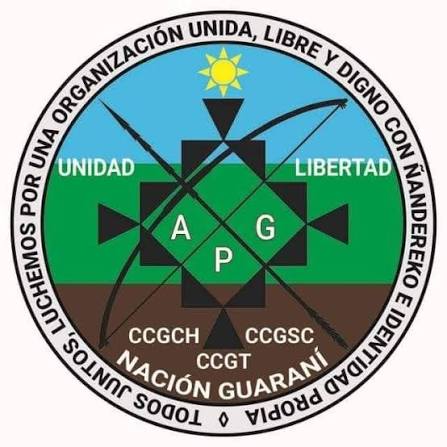
The Asamblea del Pueblo Guaraní, or APG, is a major representative organization in Bolivia that works on issues such as land, education, language, autonomy, and culture.
Bolivia and neighboring regions are also home to the Tapieté, Guarayo, and other Indigenous peoples whose languages are related to Guaraní. Linguistic relationships alone do not mean that all these peoples belong to a single Guaraní ethnic nation.
About the Name
Guaraní is a name used for several Indigenous peoples, languages, and a broad historical cultural region in South America.
In Spanish, it is commonly written Guaraní. In Portuguese and English, it is often written Guarani without the accent mark.
The singular expression “Guaraní People” is sometimes used. However, “Guaraní Peoples” is more appropriate when emphasizing the cultural, linguistic, and historical diversity of the different communities.
Linglobe uses the page title “Guaraní Peoples” to avoid presenting the Guaraní as one culturally uniform people.
Regional names include Mbya, Mbyá, Kaiowá, Paĩ Tavyterã, Ava, Ñandeva, and Nhandewa.
In several Guaraní linguistic varieties, Ava is a word connected to the meaning of “person” or “human being.”
Ñandeva is often explained as a term related to “we,” “us,” or “our own people.” However, the people identified by this name differ according to country and region.
The people called Ñandeva or Nhandewa in Brazil and those officially classified as Guaraní Ñandeva in the Paraguayan Chaco do not always belong to the same ethnic group.
Historical sources from Bolivia and Argentina also use the name Chiriguano for some Guaraní peoples.
Although this name still appears in academic and historical materials, many contemporary communities and organizations prefer self-designations such as Guaraní or Ava Guaraní.
History and Origins
Before European Contact
The ancestors of the Guaraní peoples lived in the Paraná, Paraguay, and Uruguay river basins, the Atlantic Forest, the Chaco, and surrounding regions long before Europeans arrived in South America.
They cultivated maize, cassava, beans, squash, sweet potatoes, peanuts, and other crops while combining agriculture with fishing, hunting, and the gathering of wild plants.
Rivers provided food, but they were also important routes for travel, trade, visits among relatives, and the exchange of information.
Settlements were generally organized around kinship. Communities were connected through language, marriage, trade, ceremonies, and regional alliances.
There was no single centralized kingdom or state that governed all Guaraní peoples. Communities and regional leaders maintained their own lands and social systems.
Contact with Europeans
During the 16th century, Spanish and Portuguese colonial expansion entered Guaraní territories.
Diseases introduced from Europe caused many deaths among Indigenous populations.
In Spanish-controlled regions, systems such as the encomienda were used to obtain Indigenous labor for farms, ranches, transportation, construction, and other colonial activities.
From the direction of present-day Brazil, armed expeditions known as bandeirantes entered the interior and captured Indigenous people to be sold into slavery.
Land seizure, forced labor, slave raids, disease, and missionary activity had severe effects on Guaraní populations, settlements, movement, and social relationships.
Jesuit Missions
During the 17th and 18th centuries, Jesuit missionaries established settlements known as reducciones or missions, bringing together Guaraní and other Indigenous communities.
These missions were created across areas that are now part of Paraguay, Argentina, and Brazil.
Christian teaching, agriculture, livestock raising, craftsmanship, music, and literacy were practiced within the missions.
Guaraní was used for religious teaching and education, and missionaries produced dictionaries, grammars, and religious texts in the language.
The missions were part of the colonial system and the Christianization of Indigenous peoples. At the same time, they also became places where Guaraní communities maintained elements of their language, agriculture, music, and local organization and organized resistance against slave raiders.
For this reason, it would be inaccurate to describe the missions either as entirely peaceful communities or as places where Guaraní culture completely disappeared.
Not all Guaraní people lived in the missions. Some communities remained outside missionary control and continued their own ways of life in forests and along rivers.
Several mission sites are now protected as World Heritage Sites or national heritage sites. However, these places are not solely the legacy of European missionaries. They are also connected to the Guaraní people who carried out much of the construction, agriculture, craftsmanship, music, and everyday life within them.
The Guaraní War
In 1750, Spain and Portugal signed the Treaty of Madrid, which changed colonial boundaries in South America.
Under the treaty, seven Guaraní mission settlements east of the Uruguay River were transferred to Portuguese control, and their residents were ordered to leave their lands.
Guaraní communities resisted the relocation order, leading to armed conflict with combined Spanish and Portuguese forces.
This conflict became known as the Guaraní War and continued into the mid-1750s.
Sepé Tiaraju is remembered as one of the leaders of this resistance.
Many Guaraní people were killed, and settlements and agricultural lands were destroyed.
The Jesuits were later expelled from Portuguese territories in 1759 and from Spanish territories in 1767. After their expulsion, the political and economic structures of the missions changed, and many residents moved to other areas.
Nineteenth-Century Borders and Land
During the 19th century, the formation of states such as Paraguay, Brazil, Argentina, and Bolivia divided Guaraní territories among several national borders.
The creation of borders did not immediately end relationships among relatives or the movement of languages, trade, visits, and ceremonies across regions.
However, the expansion of ranches, plantations, yerba mate extraction, mining, logging, and military settlements caused many communities to lose land.
State documents defining legal property often failed to match the wider territories that Guaraní communities had used over many generations.
Kuruyuki and the Guaraní of Bolivia
In the Chaco region of Bolivia, resistance to the expansion of ranches and farms, forced labor, and land occupation continued from the colonial period into the republican era.
In 1892, a major battle took place at Kuruyuki between Bolivian government forces and Guaraní resistance fighters.
The Guaraní were defeated, and many people were killed, captured, or forcibly displaced. Some survivors were subjected to harsh labor on farms and ranches.
Kuruyuki has become an important place of memory for the Guaraní of Bolivia, associated with land, resistance, sacrifice, and cultural renewal.
From the Twentieth Century to the Present
During the 20th century, roads, railways, cities, agricultural projects, dams, ranches, logging, and mining expanded further into Guaraní territories.
In Brazil, some Guarani Kaiowá and Ñandeva communities were relocated to small reserves while much of their traditional territory was converted into farmland and ranches.
In Paraguay and Argentina, deforestation, agricultural expansion, and concentrated land ownership affected many communities.
In parts of the Bolivian Chaco, forms of servitude on farms and ranches continued into the late 20th century.
Across the four countries, Guaraní organizations have worked for the return and legal recognition of their lands, language education, healthcare, political autonomy, and the protection of forests and water sources.
Culture
Families, Communities, and Leadership
Families and kinship relationships form an important foundation of Guaraní community life.
Family networks may include parents, children, grandparents, aunts, uncles, cousins, and relatives connected through marriage. These relationships can support farming, childcare, food sharing, housing, ceremonies, and other community responsibilities.
However, family systems and social organization differ among peoples, regions, religions, and rural and urban communities.
In some regions, a community representative or leader may be called a mburuvicha.
Other people hold responsibilities related to religious knowledge, songs, healing, oral traditions, and ceremonies. Names such as karaí, kuña karaí, ñanderu, ñandesy, and opygua may be used, but their meanings and responsibilities differ among communities.
These positions cannot all be translated uniformly as “chief” or “shaman.”
Teko and Tekoha
Teko and tekoha are important words for understanding aspects of Guaraní culture.
Teko is connected to a way of life, a state of being, custom, and social order.
Tekoha is often translated as “the place where a way of life can be lived” or as “community territory.”
However, it means more than a village or a legally defined parcel of land.
It may include forests, rivers, water sources, fields, homes, paths, burial places, ceremonial spaces, plants, animals, and the network of relationships that allows community life to continue.
The expressions ñande reko or nhandereko are connected to the idea of “our way of life.”
The spelling, pronunciation, and meanings of these words vary among Guaraní languages and communities. They should not be reduced to a single fixed philosophy or set of rules shared identically by every Guaraní people.
Agriculture and Forests
Maize and cassava have long held important roles in Guaraní life.
Beans, squash, sweet potatoes, peanuts, fruits, and other crops are also cultivated.
In some regions, several crops are grown together, allowing communities to benefit from different growing and harvesting seasons.
Fishing, hunting, honey gathering, fruits, nuts, and medicinal plants have also contributed to food systems and environmental knowledge.
Today, Guaraní people work in agriculture, forestry, livestock raising, crafts, tourism, construction, commerce, education, government, and many other fields.
Not all Guaraní communities depend entirely on traditional subsistence agriculture.
Food Culture
Maize is connected not only to everyday food but also to cultivation, harvests, ceremonies, and relationships among families.
Cassava may be boiled, roasted, processed into flour, or prepared in other ways.
Among the Mbya Guaraní, foods such as avachikui are made with maize, peanuts, and other locally cultivated ingredients.
Ka’a is the Guaraní word for the plant widely known as yerba mate.
Drinks made from its leaves are now central to the national cultures of Paraguay, Brazil, Argentina, Uruguay, and surrounding regions.
However, the national customs associated with mate and tereré are not identical to the ways Indigenous Guaraní communities have used the plant within their relationships to land, family, and ceremony.
Homes and Settlements
Guaraní homes differ according to region, climate, available materials, territory, and economic circumstances.
Some homes are built from timber, bamboo, earth, palm leaves, and other local materials. Other families live in houses made from brick, concrete, metal roofing, and modern construction materials.
The arrangement of settlements also varies according to access to fields, forests, water, schools, roads, and nearby cities.
Some Mbya communities have a prayer or community house known as an opy.
An opy is not a tourist facility. It is a place of religious and social importance, and some of the ceremonies, songs, objects, and knowledge associated with it are not intended for public access.
Photographing these places without permission or reproducing sacred buildings as general cultural decoration would therefore be inappropriate.
Baskets, Woodwork, and Adornment
Guaraní crafts include baskets, woodwork, pottery, textiles, and ornaments made from seeds and plant materials.
Baskets may be made from bamboo, vines, palms, and other locally available plants.
Some baskets are created for carrying or storing food, while smaller baskets and decorative objects may also be produced for sale.
Wood is used to make household objects, musical instruments, toys, and carvings representing animals and other subjects.
Seeds, nuts, and plant fibers may be made into necklaces, bracelets, and other ornaments.
These traditions were not suddenly created for tourists. They developed from long-standing knowledge of plants and materials and continue to change in response to contemporary art, markets, and community needs.
Music, Songs, and Oral Traditions
Songs, prayers, stories, names, and spoken words hold important places in Guaraní cultures.
Songs may be connected not only to entertainment but also to children’s education, community memory, agriculture, healing, and religious life.
In some Mbya ceremonies, instruments known as mbaraka are used alongside the takuapu, a bamboo rhythm instrument played by striking it against the ground.
However, the names, forms, and uses of musical instruments vary among regions and peoples.
Today, Guaraní musicians and artists use not only traditional songs and instruments but also guitars, violins, choral music, rock, rap, film, and digital media to express their languages and contemporary experiences.
Arete Guasu
Arete Guasu is a name that can be translated approximately as “Great Festival” or “Great Celebration.”
It is particularly important among Guaraní communities in the Chaco regions of Bolivia, Argentina, and Paraguay.
The festival is associated with the maize harvest, community reunions, music, dance, ancestral memory, and the renewal of life.
Depending on the region, it may include masks, drums, flutes, and circular dances.
Arete Guasu is not celebrated in the same form by every Guaraní people.
Its masks and clothing may also carry ceremonial meanings. They should not be removed from their context and treated as general decorations or mascots representing all Guaraní peoples.
Flags and Symbols
There is no single universally recognized official flag representing all Guaraní peoples.
Several designs are presented online as a “Guaraní flag.”
Some of these belong to regional organizations, political movements, cultural associations, or sports clubs. They should not be treated as a common flag approved by every Guaraní community.
The national flags of Paraguay, Brazil, Argentina, and Bolivia represent their respective states rather than the Guaraní peoples alone.
The APG Flag
The Asamblea del Pueblo Guaraní in Bolivia uses a flag with brown, green, and light blue sections.
Brown is described as representing the earth, green as representing nature, and light blue as representing the sky or cosmos.
This flag is an important symbol of the Guaraní organization and political movement in Bolivia.
However, it is not a common flag for every Guaraní people in Paraguay, Brazil, Argentina, and Bolivia.
Tekoha and the Land
Tekoha—including forests, rivers, fields, water sources, and settlements—is central to Guaraní life and cultural continuity.
Land is not simply a background or a collection of natural resources. It connects language, family, food, ancestors, stories, and ceremonies.
Maize and Cassava
Maize and cassava are connected to food, agriculture, seasonal cycles, collective work, and celebrations.
However, neither plant is an official emblem shared by all Guaraní peoples.
Baskets and Plant Materials
Baskets and ornaments made from plant materials represent environmental knowledge, practical skills, family-based learning, and contemporary craft traditions.
Patterns, materials, and weaving techniques differ by people, region, family, and individual artist.
No single design can be described as a sacred pattern shared by all Guaraní peoples.
Sacred Objects
The petyngua pipe used by some Mbya religious leaders and objects kept within the opy may have religious significance.
Masks used during Arete Guasu also carry meanings related to regional ceremonies and histories.
Using these objects as general logos or decorations for all Guaraní peoples requires cultural understanding and respect for their religious and ceremonial contexts.
Language
Guaraní languages belong to the Tupi-Guaraní branch of the Tupian language family.
Paraguayan Guaraní, Mbya, Kaiowá, Paĩ Tavyterã, Ava Guaraní, Ñandeva, and Bolivian Guaraní are among several closely related languages or linguistic varieties.
Some linguistic sources classify them as dialects of a single Guaraní language.
Other researchers treat them as separate but closely related languages because of differences in pronunciation, vocabulary, grammar, and mutual understanding.
It is therefore inaccurate to claim that there is only one correct way to speak Guaraní.
Paraguayan Guaraní
Paraguayan Guaraní is spoken not only by Indigenous people but by a large part of Paraguayan society.
Article 140 of the Constitution of Paraguay recognizes Spanish and Guaraní as the country’s official languages.
Guaraní is used in cities, rural communities, homes, music, television, radio, and politics.
Speech that combines Spanish and Guaraní is commonly known as Jopara or Yopará.
However, the national form of Paraguayan Guaraní is not identical to the linguistic varieties spoken by Indigenous peoples such as the Mbya, Paĩ Tavyterã, and Ava Guaraní.
Speaking Paraguayan Guaraní does not automatically mean that a person is Indigenous Guaraní.
Likewise, an Indigenous Guaraní person who mainly speaks Spanish or Portuguese may continue to maintain a Guaraní identity through family, community, ancestry, and self-identification.
Legal Status in Different Countries
In Bolivia, the Constitution recognizes Guaraní as one of the country’s official languages.
Educational materials and regional school programs have also been developed to include Guaraní language and culture.
In Argentina, Corrientes Province recognizes Guaraní as an alternative official language. Intercultural bilingual education and Indigenous language programs are also found in Misiones, Salta, Jujuy, and other areas.
In Brazil, Guaraní languages do not have nationwide official status, but they are used in Indigenous schools, community education, books, films, music, and other cultural projects.
Brazil’s 2022 census recorded 38,658 speakers of Guarani Kaiowá, making it one of the country’s most widely spoken Indigenous languages.
Writing Systems and Orthography
Guaraní languages are now primarily written with Latin-based alphabets.
Paraguayan Guaraní uses letters and marks such as ã, ẽ, ĩ, õ, ũ, and ỹ for nasal vowels, as well as ñ, g̃, and a symbol representing the glottal stop.
However, spelling systems differ by country, people, educational system, and linguistic variety.
The same name or word may appear in forms such as Mbya, Mbyá, Ñandeva, or Nhandewa.
The orthography used in one country cannot automatically be applied to every Guaraní language.
Language Transmission
Although Paraguayan Guaraní is an official language spoken by millions of people, this does not mean that every Indigenous Guaraní linguistic variety is being securely transmitted.
Varieties spoken by smaller communities may be affected by land loss, urban migration, formal education, discrimination, and the dominance of Spanish or Portuguese.
Indigenous schools, community radio, dictionaries, educational materials, songs, children’s books, films, and digital media are now being used to support language transmission.
Basic Expressions
In standardized Paraguayan Guaraní, the following expressions are widely introduced:
Mba’éichapa? is a common greeting that can mean “How are you?” or “Hello.”
Aguyje means “Thank you.”
However, greetings, pronunciations, and spellings vary among regions and linguistic varieties.
These should not be presented as the only expressions used across Mbya, Kaiowá, Paĩ Tavyterã, Ava Guaraní, and every other Guaraní language.
Traditional Games and Sports
Manga Ñembosarái
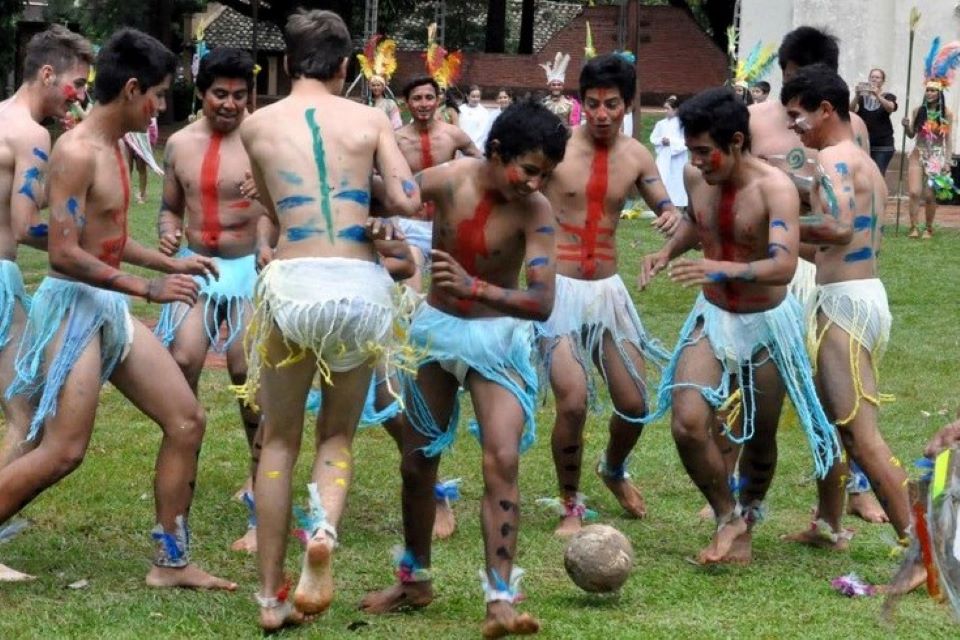
Manga ñembosarái is known as a historical Guaraní ball game.
Manga refers to a ball, while ñembosarái is a word connected to playing or games.
Seventeenth-century Guaraní language materials produced by Antonio Ruiz de Montoya recorded a game in which Guaraní people used their feet to play with a ball.
The ball is sometimes described as having been made from elastic resin obtained from regional plants.
Players are believed to have kicked the ball, attempted to keep it from touching the ground, or sent it back toward the opposing side.
However, descriptions of the rules differ according to period, region, and source.
Manga ñembosarái is important evidence that the Guaraní played their own foot-based ball games long before the development of modern association football.
The standardized rules of modern football, however, were developed in Britain during the 19th century.
It is therefore more accurate to explain that the Guaraní had an independent foot-based ball tradition than to claim that they invented the modern game of football exactly as it is played today.
Peteca
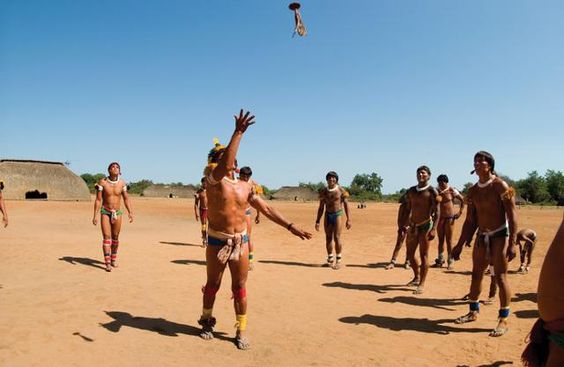
A game similar to peteca has been documented among Guarani Mbya children in Brazil.
A feathered object may be made from feathers, leaves, maize husks, and other locally available materials and struck with the hands.
It may be played by one person attempting to keep the object in the air or by several players passing it between them.
Similar games are found among several Indigenous peoples in Brazil, so peteca cannot be described as belonging exclusively to the Guaraní.
The Cassava-Pulling Game
A group game modeled on pulling cassava from the ground has been documented among Guarani Mbya children.
Players form a line by holding onto the person in front of them, while another participant attempts to pull players away from the line one by one.
Those in the line cooperate to remain connected.
The game imitates harvesting while also involving strength, cooperation, and physical coordination.
Its name and detailed rules vary among communities.
Modern Football
Football is now popular in many Guaraní communities.
It may be played as a children’s activity, in schools, during community festivals, and in competitions between communities.
Indigenous teams and athletes also participate in regional and national competitions.
However, playing modern football is not the same as directly continuing Manga ñembosarái without change.
Guaraní communities maintain their historical game traditions while also adapting global modern sports to their contemporary lives.
Introduction video
Common Misunderstandings
“The Guaraní Are One Uniform People”
The Guaraní peoples share closely related languages and important cultural connections.
However, the Mbya, Kaiowá, Paĩ Tavyterã, Ava Guaraní, Ñandeva, Guaraní Occidental, and other peoples have distinct territories, histories, linguistic varieties, ceremonies, and political organizations.
A custom documented in one community should not automatically be presented as universal to all Guaraní peoples.
“All Paraguayans Are Indigenous Guaraní”
Many non-Indigenous Paraguayans speak Guaraní.
Guaraní as a national language and cultural influence is connected to Indigenous Guaraní history, but it is not identical to Indigenous identity.
Indigenous identity also involves community, family, ancestry, territory, history, and self-identification.
“The Guaraní Began in the Jesuit Missions”
Guaraní history began long before Jesuit missionaries arrived in South America.
The missions form an important part of Guaraní history, but they were not its beginning.
Not all Guaraní people lived in missions.
“The Guaraní Invented Modern Football”
Historical records show that Guaraní people played a foot-based ball game before modern association football developed.
However, the two games differ in their rules, organization, and historical development.
Manga ñembosarái should be recognized as an independent cultural game rather than described as exactly the same sport as modern football.
“The Guaraní Live Only in Forests”
Forests and rivers remain important to the lives and cultures of many Guaraní communities.
However, Guaraní people now live in forests, rural areas, urban neighborhoods, agricultural regions, and small reserves.
Moving to a city or using mobile phones, vehicles, schools, and the internet does not mean that a person has ceased to be Guaraní.
“Guaraní Is an Official Language, So Every Guaraní Language Is Safe”
Paraguayan Guaraní is spoken by a large population.
However, Indigenous varieties such as Mbya, Paĩ Tavyterã, and Kaiowá have different numbers of speakers and different levels of intergenerational transmission.
Official status for a national language does not automatically protect every Indigenous variety, territory, educational right, or cultural practice.
“The Guaraní Have Always Wandered in Search of the Land Without Evil”
Yvy Marã E’ỹ is often translated as the “Land Without Evil” or the “Land That Cannot Be Destroyed.” It is connected to beliefs and narratives found among some Guaraní peoples.
Researchers have discussed its relationship to spirituality, migration, and social renewal.
However, its meanings and importance differ among peoples, places, and historical periods.
Guaraní movement cannot be explained through a single belief alone. War, land loss, kinship, agriculture, employment, education, and state policies have also shaped migration and settlement.
Guaraní Peoples Today
Today, Guaraní people live in forests, rural communities, border regions, agricultural areas, towns, and cities across Paraguay, Brazil, Argentina, and Bolivia.
Their work includes agriculture, fishing, crafts, tourism, construction, commerce, education, healthcare, public administration, research, art, filmmaking, music, and sport.
Some people use a Guaraní language as their first language. Others are bilingual in Guaraní and Spanish or Portuguese, primarily speak a national majority language, or begin learning their ancestral language again as adults.
Educational initiatives include training Guaraní-speaking teachers, developing intercultural bilingual education, producing regional learning materials, and creating books and films for children.
Guaraní filmmakers, photographers, writers, poets, musicians, and rappers use their own languages and perspectives to express experiences related to land, discrimination, family life, cities, and younger generations.
Cross-border mapping and cultural projects allow communities in different countries to work together and demonstrate that Guaraní territories cannot be understood through national borders alone.
At the same time, some communities face land shortages, deforestation, agricultural chemicals, water pollution, dams, road construction, limited access to healthcare and education, violence, and discrimination.
Some Guarani Kaiowá communities in Brazil have established land-recovery settlements known as retomadas as part of their efforts to return to and live on their traditional territories.
Communities and organizations in Paraguay, Argentina, and Bolivia also continue to seek legal recognition of their lands, protection of forests and water sources, political autonomy, and language education.
These challenges are not identical in every Guaraní community.
Communities in the Atlantic Forest, the Paraná River basin, the Chaco, rural agricultural areas, and cities have different histories, environments, populations, and needs.
Guaraní culture does not exist only in mission ruins, traditional clothing, or remote forests.
Through family, tekoha, language, agriculture, songs, stories, crafts, schools, film, music, political organization, and contemporary work, the Guaraní peoples continue to carry their cultures into the present.