Overview
The Wayuu are an Indigenous people whose homeland is the La Guajira Peninsula in northern South America.
The peninsula extends across what is now northeastern Colombia and northwestern Venezuela. Wayuu families, clans, grazing lands, cemeteries, and trade routes existed throughout this region long before the present international border was established.
The Wayuu call their language Wayuunaiki. It belongs to the Arawakan language family and has its own grammar, vocabulary, and sound system distinct from Spanish.
Wayuu society has a strong matrilineal foundation, with clan membership inherited through the mother’s family line. Relationships among family, land, cemeteries, and ancestors are connected through matrilineal clans known as e’irukuu.
Herding, fishing, trade, seasonal farming during rainy periods, weaving, music, dance, and oral traditions have also shaped Wayuu life.
The Wayuu are internationally known for their colorful bags commonly called mochilas. However, Wayuu culture cannot be understood through handicrafts alone.
The Wayuu are not a people who live only according to an unchanging desert lifestyle. Today, they live in rural communities, coastal settlements, border towns, and major cities while continuing to pass their language, clan relationships, cultural knowledge, and connections to the land on to new generations.
Where the Wayuu Live
The La Guajira Peninsula
The main homeland of the Wayuu is the La Guajira Peninsula, which extends into the Caribbean Sea.
Much of the peninsula is arid or semi-arid, with sand dunes, dry forests, shrubland, cactus-covered terrain, salt lagoons, and coastal environments.
However, the peninsula is not environmentally uniform. The Macuira mountain range in the north contains areas with higher humidity, and rainfall, vegetation, and elevation vary across the region.
The amount of rain can change considerably from one season or year to another. These environmental conditions have influenced the movement of livestock, access to water, farming, the location of settlements, and cooperation among families.
For the Wayuu, this land is not simply a desert or tourist destination.
It is a homeland where grazing lands, water sources, the sea, paths, settlements, cemeteries, and ancestral memories are deeply connected.
The Colombian Side
In Colombia, most Wayuu live in the Department of La Guajira.
Large communities are found particularly in and around Uribia, Manaure, Maicao, and Riohacha.
Some live in resguardos, legally recognized collective Indigenous territories. Others live in town centers, urban outskirts, or general residential neighborhoods.
Uribia has a strong connection to Wayuu political, cultural, and commercial activity. Salt production has long been important around Manaure, fishing is practiced in coastal communities, and Maicao has played a major role in cross-border trade.
The Venezuelan Side
In Venezuela, Wayuu communities are concentrated mainly in the state of Zulia.
Many live in the municipalities of Guajira and Mara near the Colombian border, while large Wayuu communities are also found in Maracaibo and its surrounding urban areas.
Wayuu people in Venezuela live not only in rural and coastal communities but also in cities, where they work in commerce, education, transportation, handicrafts, public administration, healthcare, the arts, communications, and many other fields.
The Wayuu therefore cannot be described as an Indigenous people belonging only to Colombia.
Life Across the Border
The border between Colombia and Venezuela passes through the ancestral territory of the Wayuu.
Members of the same clan or extended family may live on both sides of the border. People have long crossed it for marriage, funerals, herding, trade, employment, healthcare, and education.
Some Wayuu hold citizenship or identity documents from both countries, while others face difficulties obtaining birth registration or official documentation.
Border closures, travel restrictions, political tensions, and checkpoints are not simply matters of international travel. They can affect access to family members, food, water, employment, livestock, and cultural responsibilities.
Wayuu people continue to maintain family and clan networks extending across both sides of the border.
Urban Communities
Large Wayuu communities now live in cities such as Riohacha, Maicao, and Maracaibo.
People move to urban areas for many reasons, including education, employment, healthcare, family reunification, drought, and difficulties involving land or water.
Some have also moved to Colombian cities such as Barranquilla, Santa Marta, and Cartagena.
Living in a city does not mean that a person has lost their Wayuu identity.
Wayuunaiki, clan relationships, food, weaving, music, funerary responsibilities, and cooperation among relatives continue to connect urban families with Wayuu culture and their ancestral homeland.
Population Statistics
In Colombia’s 2018 national census, 380,460 people identified themselves as Wayuu. This represented approximately 20.2 percent of the Indigenous population recorded in the census, making the Wayuu the country’s largest Indigenous people by population. Wayuu population information from Colombia’s National Administrative Department of Statistics
Venezuela’s 2011 national census recorded 413,437 Wayuu, representing more than 57 percent of the country’s recorded Indigenous population. 2011 Indigenous population report from Venezuela’s National Institute of Statistics
However, these figures come from censuses conducted in different years and under different methods.
Because some people move across the border or maintain relationships with both countries, the two figures cannot simply be added together to produce a current total Wayuu population.
They are also figures based on ethnic self-identification and should not be treated as the number of Wayuunaiki speakers.
About the Name
Wayuu is the name that the people use for themselves.
In Wayuunaiki, it is generally explained as a word meaning “person” or “people.”
In Spanish, the name is sometimes written as Wayúu with an accent mark, although Wayuu is also widely used.
The name Wayuunaiki combines Wayuu with a term related to speech or language and means “the language of the Wayuu.”
The names Guajiro and Guajira have also appeared in Spanish-language historical documents and general publications.
However, guajiro or guajira may refer to people from the wider La Guajira region, and not every person who lives in La Guajira is ethnically Wayuu.
Because Wayuu is the people’s own name, it is now generally preferred as the ethnic name.
Linglobe uses “Wayuu People” as the title of this page in recognition of the people’s self-designation.
History and Roots
Before European Contact
The ancestors of the Wayuu lived on and around the La Guajira Peninsula long before Europeans arrived in South America.
They combined fishing, the collection of marine resources, hunting, gathering, farming, and regional trade to make use of both the dry interior and the coastal environment.
The classification of Wayuunaiki within the Arawakan language family shows an ancient linguistic relationship with Arawakan-speaking peoples found across northern South America and parts of the Caribbean.
However, linguistic relationships alone cannot determine exactly when or by which routes the ancestors of the Wayuu reached the La Guajira Peninsula.
When Spanish expeditions arrived, the Wayuu did not form a single centralized kingdom or state.
Matrilineal clans, families, and settlements maintained relationships with particular lands, water sources, and fishing areas while remaining connected through marriage and trade.
Contact with Spanish Forces
From the 16th century onward, Spanish forces expanded along the Caribbean coast and into the La Guajira Peninsula.
Conflicts developed over pearl fishing, enslavement, missionary activity, control of land, and access to trade routes.
However, the peninsula’s dry terrain, dispersed settlements, clan networks, horseback mobility, and overseas trade made it difficult for Spanish authorities to maintain stable control over the entire region.
At the same time, it would be misleading to explain Wayuu history only by saying that the people were “never conquered.”
Wayuu communities were deeply affected by warfare, forced labor, missionary activity, introduced diseases, changes in land use, and the colonial economy.
Herding and Caribbean Trade
After European contact, horses, cattle, goats, and sheep were introduced to the La Guajira Peninsula.
The Wayuu incorporated these animals into their society in ways suited to the local environment.
Goats and sheep were especially well adapted to the dry landscape and became important in food production, exchange, ceremonies, and social relationships.
Horses were used for traveling across the peninsula and managing livestock.
The Wayuu traded not only with Spanish colonial settlements but also with Dutch, English, and French merchants.
They exchanged livestock, hides, pearls, dyes, and other goods for cloth, tools, weapons, and imported products.
Using introduced animals and objects did not mean that Wayuu culture was replaced by an outside culture. The Wayuu selectively incorporated new resources while maintaining their own social systems and trading networks.
The Uprising of 1769
In 1769, a major uprising began after Spanish authorities captured 22 Wayuu men for forced labor, including work on fortifications in Cartagena.
Wayuu from several regions attacked Spanish settlements, missions, and military positions, and the uprising spread across a large part of the La Guajira Peninsula.
Spanish authorities responded with military operations and negotiations but were unable to establish complete control over the entire peninsula.
The uprising reflects a longer history of Wayuu resistance to outside control over their land, movement, families, and labor. Cultural Network of the Bank of the Republic of Colombia: The Wayuu Uprising of 1769
Division by an International Border
When Colombia and Venezuela developed as separate republics during the 19th century, the Wayuu homeland was divided between two states.
After a long series of negotiations, the legal demarcation of the border was advanced through a boundary treaty signed in 1941.
However, clan relationships, families, grazing lands, cemeteries, and trade routes did not suddenly disappear or divide neatly when the border was established.
Wayuu people continued to cross it for marriage, trade, funerals, and the movement of livestock.
The Wayuu are therefore often described as a cross-border Indigenous people whose homeland extends through both Colombia and Venezuela.
From the 20th Century to the Present
During the 20th century, missionary schools, national administration, roads, urbanization, salt production, mining, commerce, and border controls significantly affected Wayuu life.
On the Colombian side, large economic activities such as the Manaure saltworks and the Cerrejón coal mine have been connected to questions of land, labor, water, and migration.
Spanish became increasingly dominant in schools and government institutions. As a result, the intergenerational transmission of Wayuunaiki has weakened in some regions and families.
At the same time, Wayuu people have used Indigenous organizations, traditional representatives, women’s organizations, education, law, communications, and the arts to defend their rights concerning land, water, language, culture, and political participation.
Relationships with outside societies have changed throughout history, but matrilineal clans, family networks, connections to land, and systems of mediation continue to play important roles in many communities.
Culture
Matrilineal Clans and Family
An important foundation of Wayuu society is the matrilineal clan known as the e’irukuu.
Children generally belong to their mother’s clan and inherit clan identity, relationships with ancestors, responsibilities concerning cemeteries, and certain rights and obligations relating to land through the maternal line.
Members of the same e’irukuu recognize one another as relatives connected through a shared maternal ancestry.
Individual clans may be associated with particular animals, marks, or stories. However, no single animal or clan symbol represents all Wayuu people.
Fathers and paternal relatives also play important roles in children’s upbringing, daily lives, education, livestock management, and social relationships.
Matrilineality does not mean that fathers or men are absent from family life.
It also does not mean that women alone hold all political or social authority.
Women, maternal uncles, elders, traditional representatives, and other relatives have different roles and responsibilities within families and communities. Wayuu cultural glossary from Colombia’s National Administrative Department of Statistics
A’laüla
A’laüla generally refers to a maternal uncle, particularly the brother of a person’s mother.
A senior a’laüla may possess detailed knowledge of clan history, family relationships, ancestral territory, and social obligations.
An a’laüla may offer guidance or represent maternal relatives in matters involving marriage, land, funerals, compensation, or disputes.
However, this does not mean that one a’laüla makes every decision alone.
Senior women, other relatives, and community representatives may also participate in discussion and decision-making.
Wayuu society cannot be accurately reduced to either a system ruled entirely by men or one governed exclusively by women.
Pütchipü’üi and Mediation
A Pütchipü’üi is a mediator commonly known in Spanish as a palabrero, or “word messenger.”
When disputes arise between clans over death, injury, land, livestock, marriage, or personal reputation, the Pütchipü’üi travels between the parties and conducts negotiations through carefully chosen words.
A Pütchipü’üi is not a judge who unilaterally imposes a sentence in the manner of a state court.
The mediator considers lineage, responsibility, harm, and the relationship between the parties. Negotiations may lead to apologies, agreements, or compensation in livestock and other forms.
The aim is to prevent further violence and restore workable relations between families and clans.
This role requires more than speaking ability. It depends on extensive knowledge of history, clan relationships, customary norms, negotiation, and personal trust.
The Wayuu normative system applied by the Pütchipü’üi was inscribed on UNESCO’s Representative List of the Intangible Cultural Heritage of Humanity in 2010. UNESCO: Wayuu Normative System Applied by the Pütchipü’üi
Rancherías and Homes
A ranchería is a settlement where several families connected through maternal kinship or other close relationships may live.
It is not necessarily a densely built village. Homes, livestock enclosures, cooking areas, and working spaces may be located some distance from one another.
Traditional homes have been constructed with locally available materials, including cactus wood, branches, earth, and plant leaves.
A dwelling may be called a piichi or miichi. A roofed, open-sided structure known as a luma or enramada may also be part of the household area.
The luma may be used to welcome visitors, rest, weave, work, or hold family discussions.
Today, Wayuu homes also include buildings made with cement, bricks, and metal roofing.
Some Wayuu live in apartments or other forms of urban housing. No single building style can therefore be presented as the only authentic “Wayuu house.”
Water and Daily Life
Securing water is a central part of life in the dry environment of La Guajira.
During rainy periods, water may be collected in artificial reservoirs known as jagüeyes. Communities may also use wells, storage tanks, water-delivery trucks, or piped systems.
However, drought, insufficient infrastructure, water quality, and the distance to water sources can make reliable access to safe water difficult.
Water is not simply a natural resource. It is closely connected to settlement locations, livestock, travel, family health, and land rights.
Herding, Fishing, Farming, and Trade
Goat and sheep herding is one of the best-known Wayuu livelihoods.
Livestock may provide food and income and may also be used in exchanges, ceremonies, and compensation agreements. Some households also raise horses, cattle, or donkeys.
Coastal communities fish for fish, shrimp, shellfish, and other marine resources. Some communities have also been involved in the collection and sale of salt.
Where rainfall and soil conditions allow, people cultivate maize, beans, squash, watermelon, and other crops.
Not all Wayuu depend exclusively on herding or fishing. Wayuu people work in commerce, transportation, construction, tourism, handicraft production, education, healthcare, public administration, communications, and many other fields.
Food Culture
Wayuu food traditions vary between the dry interior, coastal communities, border towns, and cities.
Friche, a dish made with goat meat, is widely associated with Wayuu cuisine.
Maize, beans, and squash are used in various foods, while fish and shellfish are important in coastal communities.
Rice, wheat flour, cooking oil, sugar, and other products introduced through trade and markets have also become part of contemporary diets.
No single dish should be presented as the everyday food of every Wayuu person.
Weaving and Handicrafts
Weaving is an important part of Wayuu cultural knowledge.
In Wayuu oral tradition, a spider known as Wale’kerü is said to have taught people the knowledge of weaving and pattern-making.
Geometric designs known as Kanasü may stylize animals, plants, footprints, natural phenomena, and objects from everyday life.
Some patterns have specific names and stories. However, not every design forms part of a single sacred code shared identically by all Wayuu communities.
The use and interpretation of patterns vary among regions, families, individual makers, and particular works.
A chinchorro is a woven sleeping and resting structure.
Although it resembles a hammock, a chinchorro may have distinctive weaving structures, decorative edges, and cultural uses. It is connected not only with sleep but also with hospitality and family life.
Susu is a Wayuunaiki word for a carrying bag. Such bags are now widely known in Spanish and English as Wayuu mochilas.
Different types and sizes may be used for everyday belongings, travel, herding, ceremonies, or special occasions.
Contemporary mochilas reflect both inherited knowledge and historical change. They may use crochet techniques, acrylic yarn, new color combinations, and designs created for modern markets.
For this reason, not every mochila sold today can be described as a craft that has remained unchanged since before European contact.
In some communities, men make wide-brimmed hats, sandals, livestock equipment, and other objects. The division of craft work varies among families and regions, so it is also inaccurate to assume that every Wayuu woman weaves in the same way. Wayuu craft information from Artesanías de Colombia
The Transmission of Knowledge into Adulthood
Traditionally, after a girl’s first menstruation, she may spend a period with women from her maternal family learning weaving, food preparation, family relationships, personal care, and adult social responsibilities.
In Spanish, this period is sometimes called the encierro.
Its duration, meaning, and practices vary according to region, family, religion, schooling, and urban life.
Not every Wayuu girl today experiences a long period of seclusion. Some families observe a shorter period of teaching or a family event, while others do not continue the practice.
Clothing
A garment widely associated with Wayuu women is the manta, a long and loose-fitting dress.
Mantas may be made from brightly colored or patterned fabric, but their form and material vary between everyday clothing, ceremonial clothing, and garments worn in urban settings.
Traditional men’s clothing has included forms of loincloth, but many Wayuu men today wear shirts, trousers, hats, and other contemporary clothing.
Some people wear culturally distinctive clothing every day, some wear it during special events, and others rarely wear it.
Clothing alone cannot determine whether a person is Wayuu.
Music, Song, and Oral Traditions
Knowledge about history, genealogy, land, animals, events, and personal emotions has long been transmitted through Wayuu storytelling, songs, and conversation.
Jayeechi is a form of traditional vocal expression. Songs may address herding, travel, love, nature, or individual experiences.
Musical instruments include the kasha drum, flutes, mouth harps, and rattles.
The names, forms, and performance contexts of instruments vary among communities.
Contemporary Wayuu music includes not only inherited vocal and instrumental traditions but also vallenato, popular music, rap, and electronic music.
Songs, radio programs, poetry, and audiovisual works in Wayuunaiki have also become ways of passing the language on to younger generations.
Dreams and Spiritual Culture
In many Wayuu families, dreams may be treated as more than private imagination.
They can be interpreted as messages or guidance concerning health, danger, travel, ceremonies, or family responsibilities.
A person may discuss a dream with a mother, grandmother, elder, or another relative known for understanding such experiences.
However, not every Wayuu person interprets dreams in the same way.
Wayuu spiritual traditions now coexist with Catholicism, evangelical Christianity, and other religious beliefs. Relationships with religion and ceremony vary among individuals and families.
Ancestral cemeteries are important places connecting clans, territory, and family history.
In some families, a second funerary ceremony may be held years after an initial burial, when remains are gathered and reburied.
Funerary practices and their timing are not uniform across all Wayuu communities.
Yonna
Yonna is one of the best-known Wayuu dances.
It is generally performed to the rhythm of the kasha drum. A woman advances while a man moves backward and turns in response, attempting to maintain his balance.
Yonna is not simply a courtship dance between a man and a woman.
It may be performed during family gatherings, celebrations, welcomes, expressions of gratitude, events related to dreams, or recovery from illness.
Clothing, movement, and the meaning of the dance may vary by community and occasion.
Flags and Symbols
Flags
There is no confirmed single official ethnic flag that represents every Wayuu clan and community in both Colombia and Venezuela.
Several designs are presented online as a “Wayuu flag.” These may include flags used by particular organizations or communities, designs created for cultural events, and proposals for a shared ethnic flag.
The national flags of Colombia and Venezuela represent their respective states. They are not flags belonging exclusively to the Wayuu people.
Kanasü Patterns
Kanasü geometric patterns are widely recognized as visual expressions of Wayuu weaving traditions.
However, no single Kanasü pattern has been established as the official emblem of the Wayuu people as a whole.
Patterns may be connected to particular makers, families, or interpretations. It is therefore inappropriate to reproduce a specific artist’s design without permission or to describe every pattern as having the same sacred meaning.
Clan Marks
Individual e’irukuu may be represented by marks associated with animals, ancestry, or clan histories.
These symbols express the identities and genealogies of particular clans. They are not universal emblems representing all Wayuu people.
The Landscape of La Guajira
Cacti, goats, dry land, the sea, salt, and water sources are sometimes used as visual elements representing Wayuu life and homeland.
However, none of these is an official symbol of the entire people.
The landscape of La Guajira is not merely a background for tourism. It is a homeland connected to Wayuu ancestors, clans, cemeteries, herding, fishing, and daily life.
Language
Wayuunaiki belongs to the Arawakan language family.
It is spoken mainly in the Department of La Guajira in northern Colombia and the state of Zulia in northwestern Venezuela.
It is not a dialect of Spanish or a simple mixture of Spanish and an Indigenous language. Wayuunaiki has its own vocabulary, sound system, and grammatical structure.
Regional and Grammatical Variation
Wayuunaiki varies in pronunciation and vocabulary according to region, family, and generation.
Some words and spellings may differ between Colombia and Venezuela. However, the language is not divided neatly into two separate forms at the international border.
Wayuunaiki words may also change according to grammatical gender and other features of the speaker or the person being described.
For this reason, one expression may not be the only correct form for every speaker or situation.
Legal Status
Under Colombia’s Constitution, Indigenous languages are official within their respective territories. Indigenous education is also expected to follow bilingual and intercultural principles.
Venezuela’s Constitution similarly recognizes Indigenous languages as official languages for their respective peoples.
However, legal recognition does not always mean that Wayuunaiki can be used effectively in schools, hospitals, government offices, and courts.
Some regions lack interpreters, Wayuunaiki-speaking teachers, educational materials, or health information in the language.
Writing and Orthography
Wayuunaiki is now written with the Latin alphabet.
Double vowels and apostrophe-like marks may be used to represent vowel length, glottal sounds, and other features of pronunciation.
Spellings such as Wayuu, Wayúu, and Wayuunaiki may also reflect differences between Wayuunaiki orthography and Spanish writing conventions.
Wayuunaiki has a strong oral tradition. Today, it is also used in dictionaries, textbooks, literature, newspapers, radio, videos, and digital learning materials. Wayuunaiki language information from the Instituto Caro y Cuervo
Language Transmission
In some communities, many children continue to grow up speaking Wayuunaiki as their first language.
In urban areas and Spanish-dominant schools, however, some younger people use Spanish more frequently.
A person may identify as Wayuu without speaking Wayuunaiki fluently. Some adults are also learning or relearning the language later in life.
Bilingual education, community radio, literature, music, audiovisual production, and language classes are being used to support the transmission and continued use of Wayuunaiki.
Basic Expressions
Ajaa is commonly introduced as a general greeting similar to “hello.”
Jamaya piia? means something similar to “How are you?” or “How are things?”
Jamaya pü’lapüin? may be used as a morning greeting. Its more literal meaning is similar to “How was your dream?” and reflects the cultural importance that dreams may hold.
Anaayawatchi is commonly introduced as an expression meaning “thank you.”
Pronunciation, spelling, and grammatical forms vary among regions and speakers, so these should not be treated as the only expressions used throughout every Wayuunaiki-speaking community.
Traditional Games and Competitions
Some Wayuu games and competitions are connected to skills once used in herding, travel, hunting, and the making of practical objects.
Today, cultural festivals, schools, and regional competitions help pass these activities on to children and younger generations.
Names, participation, and rules may vary from one community to another.
Atshinjirawaa
Atshinjirawaa is commonly described as a form of traditional Wayuu wrestling.
Two participants grapple and attempt to unbalance or bring the other person to the ground.
The activity requires not only strength but also balance, posture, technique, and the ability to read an opponent’s movements.
The methods used to determine victory and the techniques permitted may vary by community or competition.
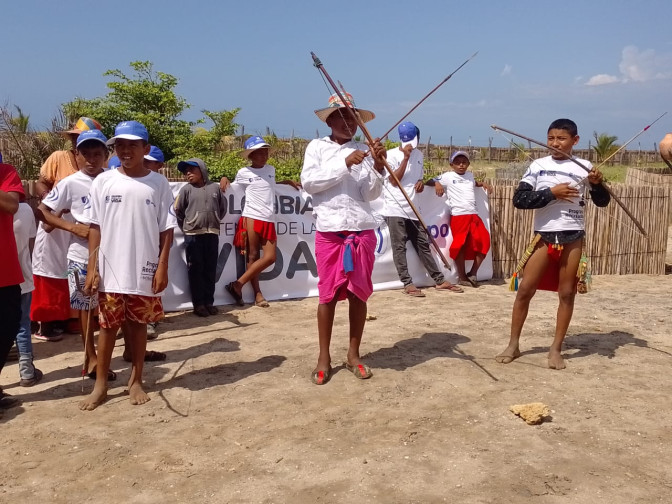
Archery, Slings, and Throwing Competitions
Some traditional activities involve bows and arrows, slings, stones, or pieces of the cardón cactus and test either accuracy or distance.
These practices developed from tools and skills associated with hunting, livestock protection, and everyday life.
Today, they may be performed as cultural competitions with safety rules and designated distances.
Because some of the equipment was historically used as weapons, these activities are better understood as competitions based on practical skills than as simple children’s toys.
Cardón Carts
Children may construct small carts or moving toys from cardón cactus wood and other materials available in the local environment.
They experiment with wheels, axles, and construction methods.
The activity encourages manual skill, observation, creativity, and knowledge of local materials.
Tops and Community Games
Wayuu games also include spinning tops made from wood or gourds, rope games, running competitions, and other activities.
Materials and rules vary by community and generation.
Although manufactured toys and modern sports are now widespread, schools and cultural events sometimes organize traditional games to keep this knowledge in use.
Horse Racing
Horse racing is connected to traditions of herding and travel.
In regions and families where horses are kept, races may be organized during festivals or community gatherings.
However, horse racing is not practiced by every Wayuu community.
Competition within Yonna
Yonna includes an element of physical challenge as the male dancer attempts to maintain his balance while responding to the woman’s movements.
However, Yonna is not simply a sport.
It is a cultural expression involving music, family, ceremony, celebration, and social interaction rather than an activity concerned only with winning or losing. Colombian Ministry of Sport information about traditional Wayuu games
Introduction video
Common Misconceptions
“The Wayuu Live Only in Colombia”
The Wayuu homeland extends across the present border between Colombia and Venezuela.
Wayuu communities exist in both countries, and clan, family, linguistic, commercial, and funerary relationships continue across the border.
Describing the Wayuu as belonging to only one country overlooks a history that began long before the international border existed.
“Matrilineal Society Means That Women Make Every Decision”
Wayuu clan identity and relationships with ancestors are inherited through the maternal line.
However, matrilineality does not mean that women alone hold every form of political or social authority.
Senior women, maternal uncles known as a’laüla, Pütchipü’üi, traditional representatives, and other relatives have different responsibilities.
“All Wayuu Live in Desert Rancherías”
Some Wayuu live in rural rancherías in arid regions, but others live on the coast, in mountain areas, in border towns, and in major cities.
Wayuu people attend universities and work in business, government, healthcare, education, law, research, and the arts.
A change in residence or occupation does not mean that a person has lost their Wayuu identity.
“Wayuu Culture Is Only About Mochilas”
Mochilas are important handicrafts, but they are only one part of Wayuu culture.
Clans, land, cemeteries, Wayuunaiki, mediation, herding, fishing, music, dreams, Yonna, and family responsibilities are also essential to understanding Wayuu life.
Focusing only on products can separate the craft from the people, knowledge, and history behind it.
“Every Pattern Has One Sacred Meaning”
Kanasü patterns may have names and stories connected to nature and daily life.
However, the meaning of a pattern is not necessarily identical among every region, family, and maker.
Contemporary artists also create original patterns and designs for modern markets.
“A Pütchipü’üi Is a Judge Who Punishes Clan Members”
A Pütchipü’üi does not function like a state judge who unilaterally imposes a criminal sentence.
The mediator uses speech and negotiation to help the parties reach an agreement concerning responsibility, compensation, and the restoration of relationships.
An important aim is to prevent disputes from developing into continuing violence between clans.
“Because the Spanish Never Fully Conquered Them, the Wayuu Were Unaffected by Outside History”
Spanish authorities were unable to maintain stable control over the entire La Guajira Peninsula.
However, Wayuu communities were still affected by warfare, introduced diseases, forced labor, missions, trade, livestock, and the later creation of national borders.
The Wayuu maintained their identity while selectively adapting outside objects and practices to their own society.
The Wayuu Today
Today, Wayuu people live in rural communities, coastal settlements, border regions, and cities in both Colombia and Venezuela.
Some speak Wayuunaiki as their first language, some use both Wayuunaiki and Spanish, and others primarily speak Spanish. Some adults are learning Wayuunaiki later in life.
Wayuu people work in herding, fishing, agriculture, salt production, handicrafts, commerce, transportation, tourism, education, healthcare, government, law, research, the arts, journalism, and digital media.
Young Wayuu writers, musicians, filmmakers, radio producers, photographers, and researchers use Wayuunaiki and Spanish to express contemporary experiences involving family, land, discrimination, urban life, the environment, and the international border.
At the same time, some communities face serious difficulties in obtaining safe drinking water, food, healthcare, schooling, roads, electricity, and communications.
In its 2017 T-302 ruling, Colombia’s Constitutional Court recognized widespread violations of the rights to water, food, health, and participation affecting Wayuu children in Riohacha, Manaure, Maicao, and Uribia. Colombian Constitutional Court ruling T-302
These conditions are connected to several factors, including drought and climate change, insufficient infrastructure, administrative failures, land use, pollution, poverty, and the distance to medical services.
Border closures and economic changes can also make it more difficult to visit relatives or obtain work, medical treatment, and food.
Mining, ports, roads, tourism, wind-energy projects, and other development activities have raised questions about land, water sources, environmental effects, the distribution of benefits, and the right of Indigenous communities to prior consultation.
These challenges are not identical in every Wayuu community. Conditions and priorities vary between the coast and the interior, between rural and urban areas, and between Colombia and Venezuela.
The Wayuu are not simply passive recipients of hardship or outside assistance.
A’laüla, Pütchipü’üi, women’s organizations, teachers, healthcare workers, community representatives, young people, artists, lawyers, and journalists all participate in decisions concerning their land, language, education, culture, and future.
Wayuu culture does not exist only in desert tourism images or in mochilas sold in markets.
Through maternal lineages, cross-border family relationships, Wayuunaiki, land, cemeteries, water, herding, fishing, mediation, weaving, songs, dreams, traditional games, education, contemporary art, and modern professions, the Wayuu continue to carry their culture into the present.